
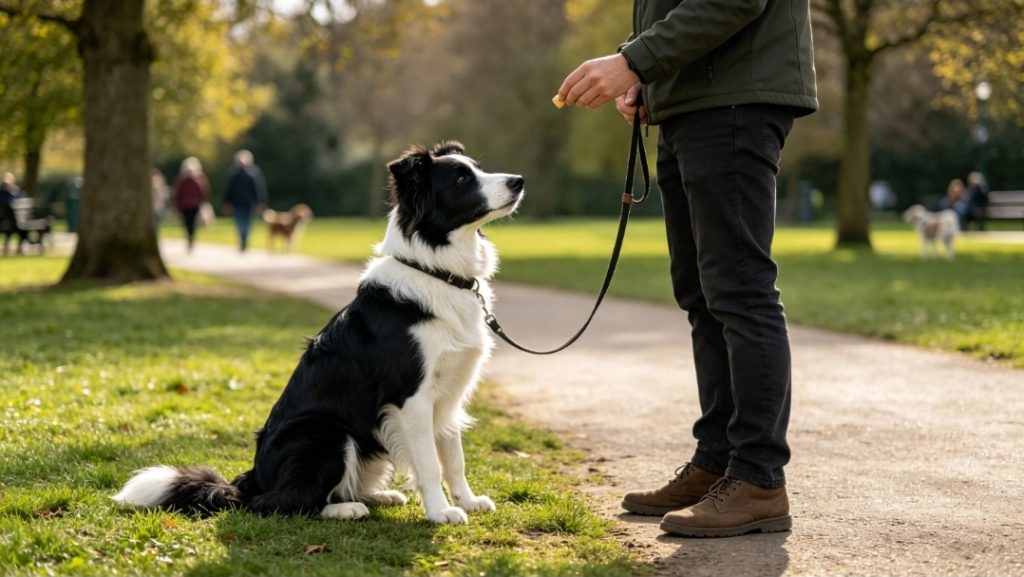
Basic obedience is one of the most important foundations you can give your dog.
It isn’t about making your dog perform tricks.
It’s about teaching your dog how to understand you, respond to you and behave appropriately in everyday situations.
A dog with reliable basic obedience is easier to manage at home, on walks and around distractions.
Commands such as sit, stay, come, down and heel can become valuable communication tools between you and your dog.
But obedience isn’t simply about teaching individual commands.
The real objective is to develop a dog that understands what you are asking and can respond reliably in different situations.
If you’re wondering how to teach your dog basic obedience, the key is to start with simple behaviours, build gradually and remain consistent.
What Is Basic Dog Obedience?
Basic obedience is a collection of behaviours that help you communicate with your dog.
These can include:
- Sit
- Down
- Stay
- Come when called
- Wait
- Leave it
- Focus
- Heel
- Loose-lead walking
- Place or bed
- Release
You don’t necessarily need to teach everything at once.
Start with the behaviours that are most useful for your everyday life.
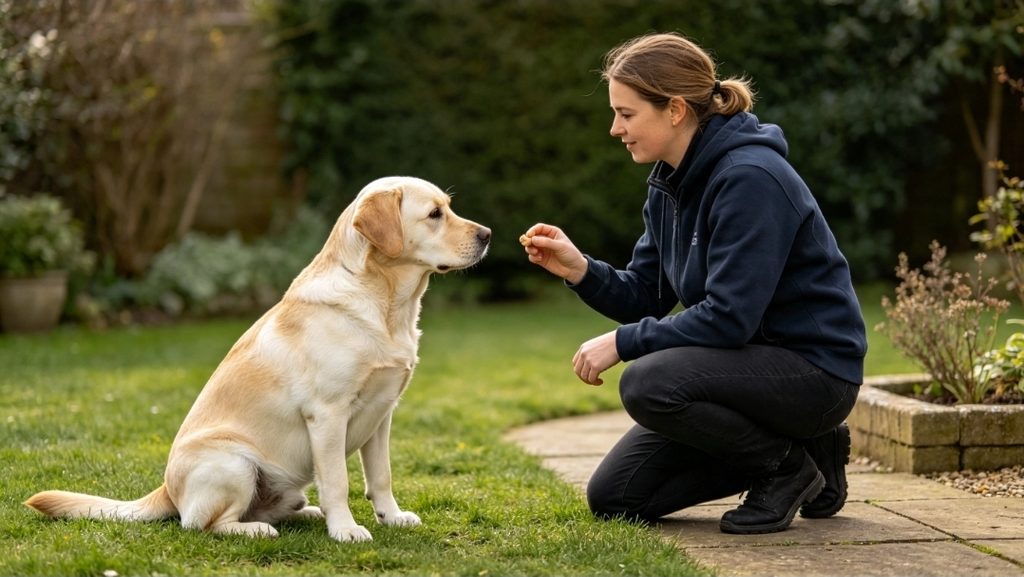
Why Is Basic Obedience Important?
A well-trained dog is easier to communicate with.
Imagine your dog is about to run towards something dangerous.
A reliable recall could help you call them back.
Your dog is about to jump on a visitor.
A trained sit can give them something else to do.
You’re walking past another dog.
A reliable heel or loose-lead behaviour can help you maintain control.
Obedience provides you with communication tools.
The more reliable those tools become, the more effectively you can manage everyday situations.
Start With Your Dog’s Name
Before teaching complicated commands, your dog needs to understand that responding to you is worthwhile.
Say your dog’s name.
When they look towards you, reward them.
Repeat.
You are teaching your dog:
“When I hear my name, I should pay attention.”
This simple exercise can become the foundation for future obedience training.
Teach Your Dog to Sit
Sit is often one of the first behaviours owners teach.
Hold a reward near your dog’s nose.
Move it slowly upwards and slightly backwards.
As your dog’s head follows the reward, their bottom may naturally move towards the floor.
As soon as they sit, reward them.
Repeat.
Once your dog understands the movement, introduce a verbal cue such as “Sit.”
Eventually, your dog should learn to respond to the cue rather than simply following the food.
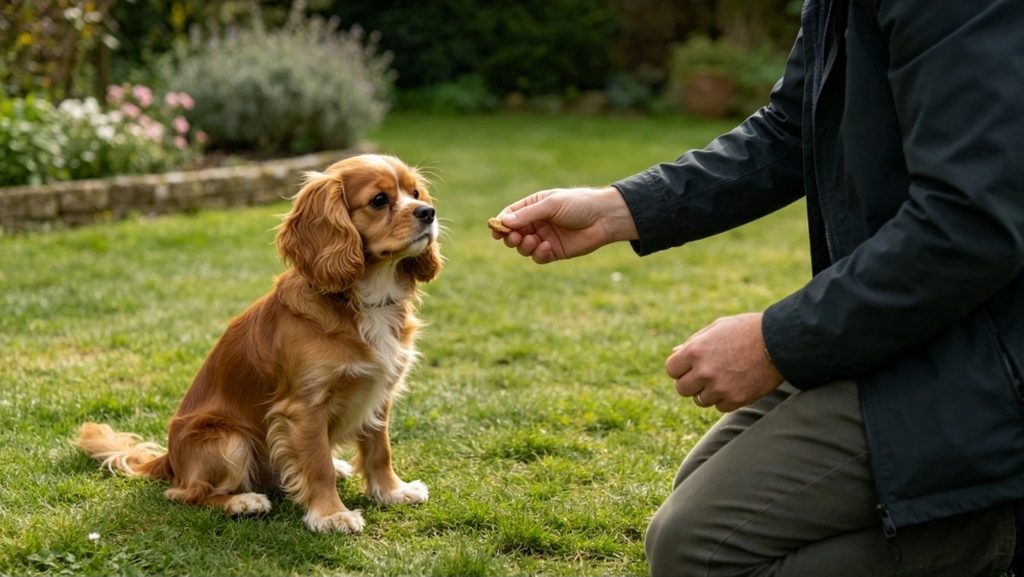
Teach Down
Once your dog understands sit, you can begin teaching down.
Start with your dog sitting.
Use a reward to guide their nose towards the ground and then forward.
When their body moves into the down position, reward them.
Practise repeatedly.
Once your dog understands the movement, introduce the verbal cue.
Don’t rush.
Your dog needs time to understand what the word means.
Teach Stay
Stay is different from sit.
Your dog needs to understand that the behaviour continues until you release them.
Start with a very short duration.
Ask your dog to sit.
Give the stay cue.
Wait for a second.
Reward.
Gradually increase the duration.
Then begin increasing distance.
Eventually, introduce distractions.
Build one variable at a time.
Don’t immediately expect your dog to stay for several minutes while you walk away.
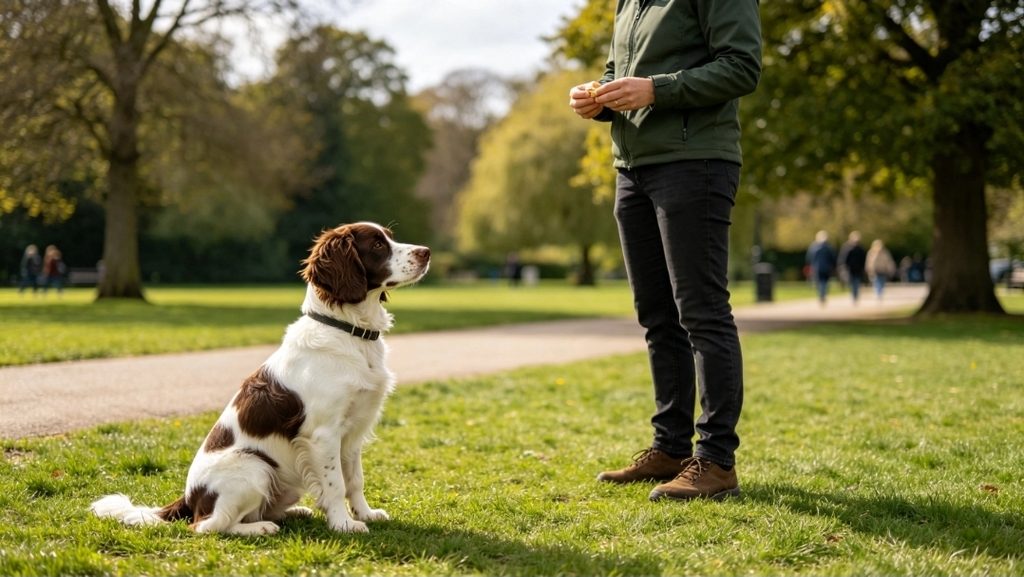
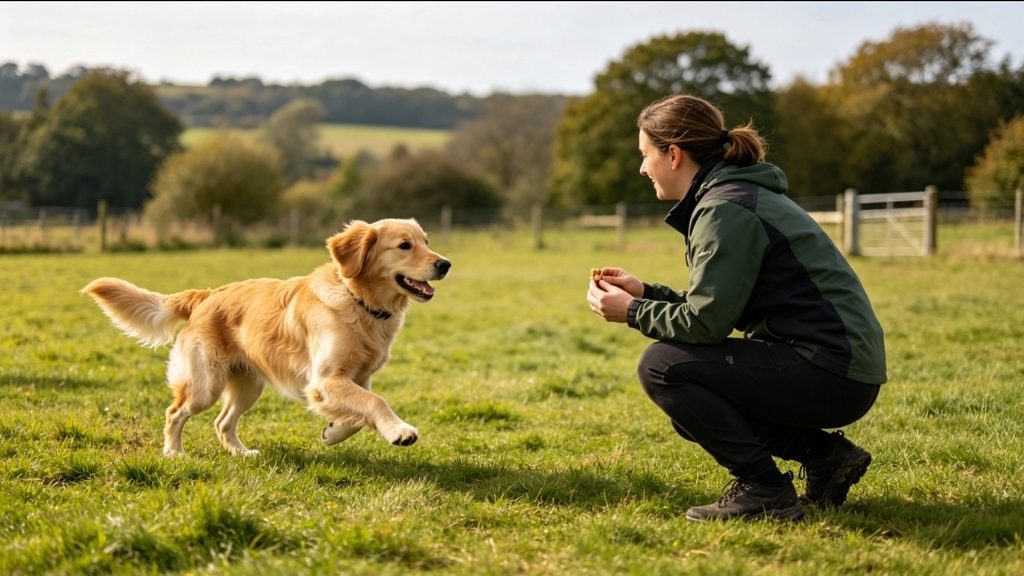
Teach Recall
A reliable recall is one of the most important obedience behaviours your dog can learn.
Start in a safe, low-distraction environment.
Move a short distance away.
Call your dog enthusiastically.
When they come towards you, reward them.
Make coming to you worthwhile.
Don’t repeatedly call your dog when you know they’re unlikely to respond.
Build success gradually.
As your dog improves, increase distance and distractions.
Recall training should be developed progressively.
Never Make Coming Back to You a Negative Experience
If your dog comes back to you and immediately receives something unpleasant every time, they may become reluctant to return.
Whenever possible, make recall rewarding.
Your dog should learn:
“When I hear my recall cue, coming to my handler is a good decision.”
Teach Your Dog to Wait
“Wait” can be useful in everyday situations.
For example:
- Before going through a doorway
- Before getting into a vehicle
- Before receiving food
- Before crossing a road
- Before being released from a position
Start with very short periods.
Reward your dog for waiting.
Gradually increase the duration and introduce distractions.
The objective is to teach your dog that they don’t always need to rush towards something they want.
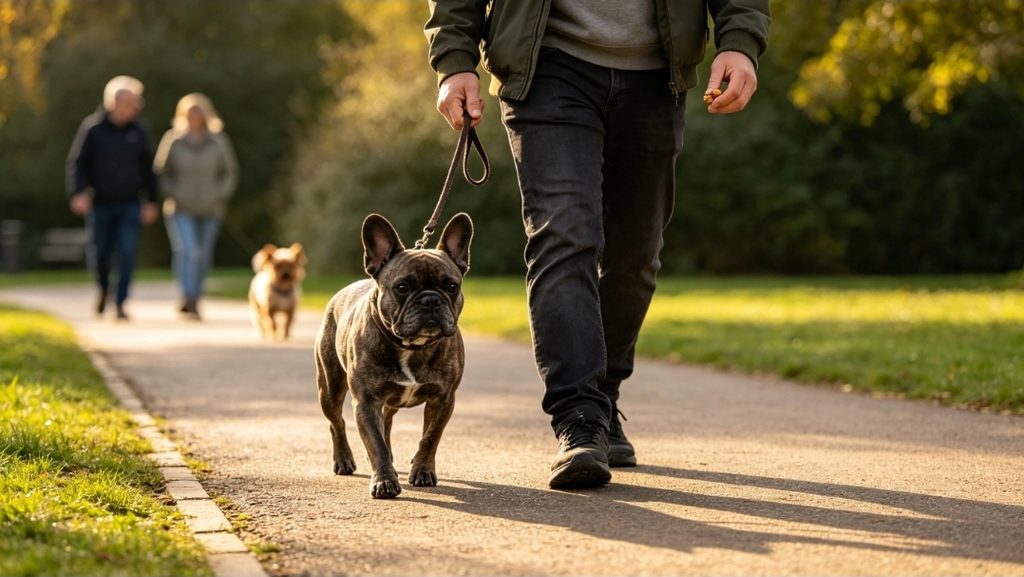
Teach Loose-Lead Walking
Basic obedience doesn’t only happen in your living room.
Your dog needs to learn how to behave during walks.
Loose-lead walking teaches your dog to move with you without continually pulling.
Reward your dog for maintaining a loose lead.
Change direction.
Encourage your dog to follow.
Reward engagement.
Gradually introduce distractions.
Teach Focus
One of the most valuable obedience skills is attention.
Your dog needs to understand that paying attention to you is worthwhile.
Start somewhere quiet.
Say your dog’s name.
When they look at you, reward.
Gradually increase distractions.
Eventually, you want your dog to be capable of disengaging from the environment and checking in with you.
This can make other obedience behaviours much easier.
Teach “Leave It”
“Leave it” can help your dog learn not to interact with something you’ve asked them to ignore.
Start with something your dog is interested in but can safely ignore.
Reward them for choosing not to take it.
Gradually increase the difficulty.
This is particularly useful around food, objects and environmental distractions.
Teach a Release Cue
Your dog should understand when an exercise has finished.
For example:
Sit.
Stay.
Release.
A release cue tells your dog that they can move again.
This can make obedience exercises clearer.
Instead of your dog deciding when the exercise ends, you communicate when they’re free to move.
Keep Training Sessions Short
You don’t need to train for an hour at a time.
Short sessions can be extremely effective.
Train for a few minutes.
Finish while your dog is still engaged.
Repeat later.
Several short sessions throughout the day can be easier to maintain than one long session.
Don’t Teach Too Many Commands at Once
Dogs need time to understand new behaviours.
If you introduce ten commands simultaneously, you can make training unnecessarily confusing.
Choose one behaviour.
Teach it.
Practise it.
Then gradually introduce another.
Once the behaviours are established individually, you can begin combining them.
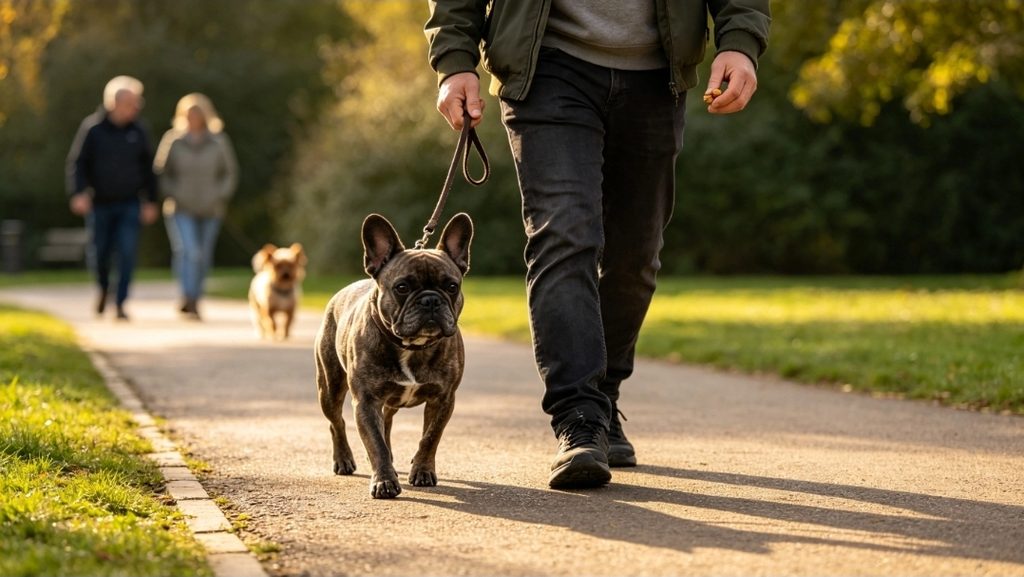
Practise Around Distractions
A dog that performs perfectly in your kitchen isn’t necessarily obedient everywhere.
The real test comes when distractions appear.
Start with mild distractions.
Then gradually increase the difficulty.
For example:
Quiet room → garden → quiet street → quiet park → busier environment.
Don’t jump straight from easy training to an extremely distracting environment.
Your dog needs to develop reliability gradually.
Use Consistent Commands
Everyone in the household should ideally use the same cues.
If one person says:
“Come.”
Another says:
“Here.”
And someone else uses the dog’s name repeatedly, the dog may receive inconsistent information.
Choose clear cues.
Use them consistently.
Reward Good Behaviour Throughout the Day
Training doesn’t have to happen only during formal sessions.
Your dog is learning all the time.
Reward calm behaviour.
Reward attention.
Reward waiting.
Reward coming when called.
Reward good lead behaviour.
The more opportunities you create for your dog to succeed, the more useful training becomes.
Don’t Rely on Food Forever
Food can be an excellent training tool.
But your ultimate objective should be reliable behaviour, not a dog that only responds when they see food.
As the behaviour becomes established, gradually vary your rewards.
You can use:
- Food
- Praise
- Play
- Toys
- Access to the environment
- Sniffing opportunities
- Freedom to explore
Different dogs find different things rewarding.
What If My Dog Doesn’t Listen?
If your dog doesn’t respond, don’t immediately assume they’re being stubborn.
Ask yourself:
Have they actually learned the behaviour?
Have I trained it around this level of distraction?
Is the environment too difficult?
Am I giving a clear cue?
Have I increased the difficulty too quickly?
Training is a process.
If your dog succeeds in your kitchen but fails in a busy park, the park may simply be too difficult at that stage.
Go back to an easier environment and build again.
How Long Does It Take to Teach Basic Obedience?
There isn’t a universal timeframe.
Some dogs learn individual commands quickly.
Reliable obedience takes considerably longer.
The important difference is between:
Knowing a command
and
reliably responding to that command.
A dog may learn “sit” in one session.
That doesn’t mean they’ll automatically sit when another dog runs past them.
Reliability comes from repetition, consistency and gradually increasing distractions.
GPK9 and Basic Obedience Training
If you’re learning how to teach your dog basic obedience, building a structured training routine can make a significant difference.
Basic obedience provides the foundation for many other areas of dog training.
Engagement, communication, focus, recall and impulse control all contribute to creating a dog that is easier to manage in everyday situations.
GPK9 90 Day Transformation
The GPK9 90 Day Transformation is the most relevant GPK9 course for this subject because basic obedience isn’t something that should be treated as a one-off lesson.
It requires repetition, consistency and progressive development.
A structured 90-day training period gives owners time to establish routines, practise obedience and build greater reliability across different environments and distractions.
The objective is to develop training into a consistent part of everyday life.
A Simple Basic Obedience Training Plan
Step 1 — Teach Your Dog’s Name
Reward your dog for looking at you.
Step 2 — Teach Sit
Build a reliable sit in a quiet environment.
Step 3 — Teach Down
Introduce the down position once your dog understands the basics.
Step 4 — Teach Stay
Build duration before adding distance and distractions.
Step 5 — Teach Recall
Make returning to you rewarding.
Step 6 — Teach Wait
Develop impulse control around everyday situations.
Step 7 — Teach Loose-Lead Walking
Reward your dog for walking with a loose lead.
Step 8 — Teach Focus
Build your dog’s ability to disengage from distractions and pay attention to you.
Step 9 — Introduce Distractions
Gradually increase the difficulty.
Step 10 — Practise Consistently
Repetition turns individual behaviours into reliable habits.
Final Thoughts: How to Teach Your Dog Basic Obedience
Learning how to teach your dog basic obedience isn’t about controlling every movement your dog makes.
It’s about developing communication.
Your dog needs to understand what you are asking.
You need to understand how your dog learns.
Start with simple behaviours.
Build gradually.
Reward correct responses.
Practise around increasing distractions.
Don’t rush the process.
And don’t confuse knowing a command with being reliable.
A dog that sits in the kitchen isn’t necessarily ready to sit calmly beside a busy road.
A dog that comes when called in the garden isn’t automatically ready for a recall around other dogs.
Reliability comes from progressive training.
Teach the behaviour.
Build the behaviour.
Add distractions.
Reinforce the behaviour.
Repeat.
That’s how basic obedience becomes something your dog can use in real life.


