
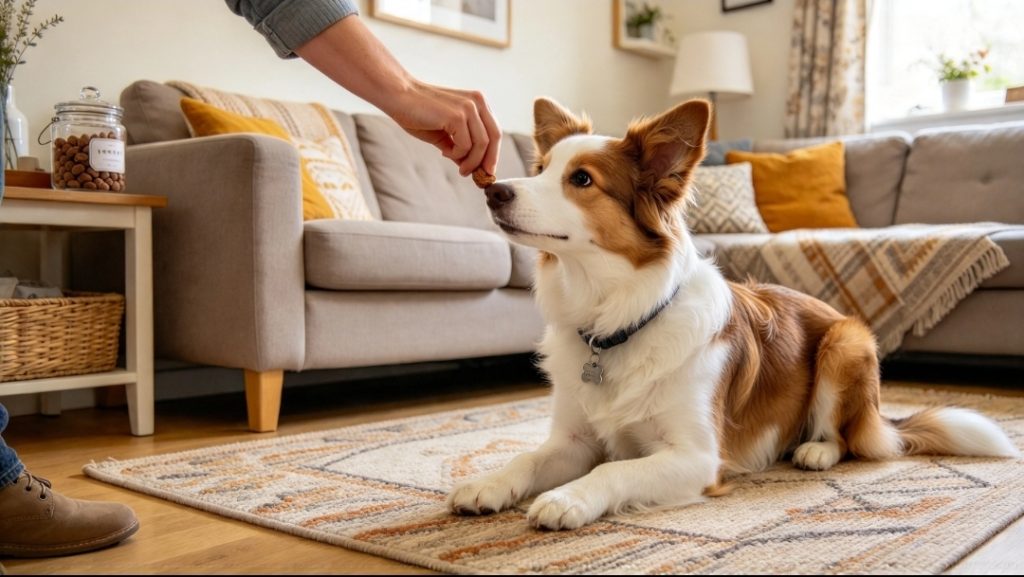
How Do I Use Luring to Improve My Dog’s Training?
Luring is a dog training technique that uses food or another suitable reward to guide a dog towards a desired position or movement. When used correctly, it can help you teach new behaviours, improve positioning, develop engagement and make your instructions easier for your dog to understand.
The aim is not simply to make your dog follow food. It is to use the lure to help your dog learn a behaviour, then gradually develop a clearer response to your cues so the skill becomes more reliable.
Successful luring depends on reward placement, timing, clear handling and appropriate progression. By observing your dog’s response and adjusting your approach, you can use luring to build better communication and support continued obedience training.
What Is Luring in Dog Training?
Luring involves using a reward, usually a small piece of food, to guide your dog’s movement into a position or through an exercise.
For example, you might move a food lure slowly upwards and backwards to encourage your dog to sit. You could also guide your dog around your body, towards a particular position or through a movement that you want to teach.
The lure provides a visual guide that helps your dog discover the behaviour you are looking for.
Luring can be useful when teaching:
- Basic positions such as sit and down.
- Changes in body position.
- Following a handler’s hand.
- Moving into a particular position beside the handler.
- Controlled movements during obedience exercises.
- New patterns that require more precise positioning.
The technique should be suitable for your dog and the behaviour being taught. Move the food in a way your dog can follow comfortably, and avoid physically forcing them into position.
How Do I Start Using Food Lures?
Begin in a quiet environment where your dog can concentrate. Choose small, suitable food rewards that your dog finds appealing and that can be delivered easily during training.
Before starting an exercise, allow your dog to notice the food and become interested in participating. Keep your hand movements controlled and make the intended movement easy to follow.
1. Introduce the Lure
Hold a small piece of food close enough for your dog to follow comfortably. Move your hand slowly in the direction you want your dog to move.
For example, to encourage a sit, guide the food upwards and slightly backwards from your dog’s nose. As your dog follows the movement, they may naturally lower their hindquarters.
The precise movement will depend on the dog. If your dog backs away, jumps up or becomes confused, adjust the direction and speed of your hand.
2. Recognise the Correct Behaviour
Observe what your dog does as they follow the lure. When they perform the behaviour you want, acknowledge the response and deliver the reward at the appropriate moment.
Clear timing helps your dog connect the reward with the action you are teaching.
Avoid moving the lure so quickly that your dog cannot follow it, or continuing to move it after the desired position has been achieved.
3. Repeat Without Making the Exercise Repetitive
Repeat the movement a few times, allowing your dog to become familiar with the exercise.
If your dog performs it successfully, you can gradually refine the movement or introduce a simple cue when appropriate. If the behaviour becomes inconsistent, return to an easier version.
Short, focused sessions help you observe your dog’s responses and adjust the technique before confusion develops.
How Does Luring Improve Positioning?
Positioning is an important part of obedience training. Where your dog stands, sits, turns or moves can influence how clearly they respond to you and how accurately they perform an exercise.
A lure can help you guide your dog’s body through a movement without relying entirely on physical handling.
Use the Direction of Movement Carefully
The direction in which you move the food can influence your dog’s response.
For example, moving the lure towards one side may encourage your dog to turn. Moving it closer to a particular position may help your dog understand where you want them to be.
Use small, controlled movements and observe the result. If your dog consistently moves away from the intended position, change the direction or reduce the complexity of the exercise.
Reward the Position You Want
Where appropriate, deliver the reward while your dog is in the desired position. This helps reinforce the behaviour you are teaching.
If you are teaching a sit, for example, reward the sit rather than allowing the food movement to encourage the dog to stand up again before receiving the reward.
As your dog improves, you can refine the exercise to encourage more consistent positioning.
Avoid Unnecessary Hand Movements
Large or exaggerated movements may make an exercise harder to reproduce consistently. Aim to guide the dog clearly without adding movements that do not contribute to the behaviour.
The objective is to make your handling easier for your dog to understand, not to create an elaborate routine that depends on constant movement.
How Can Luring Improve Engagement?
Engagement describes your dog’s willingness to participate and interact with you during training. Luring can help develop that engagement by giving your dog a clear reason to follow your guidance and take part in an exercise.
However, following food is not the same as maintaining engagement throughout a training session.
Pay attention to whether your dog is interested, comfortable and able to respond. A dog that repeatedly jumps at your hand, becomes frustrated or loses interest may need a different approach.
To support engagement:
- Use food your dog finds rewarding.
- Keep the exercise achievable.
- Make your hand movements clear and controlled.
- Reward successful responses promptly.
- Allow breaks when your dog needs them.
- Adapt the reward to your dog’s preferences and the environment.
Food is not the only possible source of motivation. Some dogs enjoy play, toys, praise or other suitable rewards. The most effective approach depends on the individual dog and the task.
The Food, Rewards and Food Motivation course — Understanding Food Motivation can help you explore how food rewards can support learning and how to consider your dog’s motivation during training.
How Do I Stop My Dog from Depending on the Lure?
One of the most important parts of luring is understanding when to reduce the dog’s reliance on the visible food.
If your dog only performs a behaviour when food is held directly in front of their nose, they may be following the lure rather than responding reliably to your cue.
This does not mean luring is ineffective. It means the training needs to develop beyond the initial guiding stage.
Gradually Reduce the Visible Lure
Once your dog understands the movement, begin making your guiding hand less dependent on visible food.
You can use the same or a similar hand movement while delivering the food from your other hand or another suitable reward location. Keep the exercise easy enough for your dog to succeed.
Make changes gradually. If your dog becomes confused, return briefly to a clearer version of the exercise and then try again with a smaller reduction in the lure.
Introduce a Clear Cue
When your dog begins to understand the behaviour, you can introduce a consistent verbal or visual cue at the appropriate point in the learning process.
Give the cue clearly, allow your dog an opportunity to respond and reinforce the correct behaviour.
Avoid repeatedly giving the cue while continuing to move the food in different directions. This can make it harder for your dog to understand which information matters.
Reinforce the Behaviour, Not Just the Food-Following
As the exercise develops, focus on whether your dog can perform the intended behaviour with less guidance.
The reward should reinforce the correct response rather than simply encourage your dog to chase your hand.
You can continue to reward successful performance while gradually refining the cue, movement and positioning. The aim is a behaviour your dog understands, not a behaviour that only works when a lure is visible.
How Can I Develop Luring into More Advanced Obedience?
Once your dog understands basic lure movements, you can begin refining precision, consistency and responsiveness.
Advanced luring is not simply about moving food in more complicated ways. It involves understanding how your handling influences your dog’s movement and how to make the exercise clear enough for the dog to perform successfully.
Areas to develop include:
- Precision: Guide your dog towards the intended position with controlled movements.
- Timing: Reinforce the correct response at the appropriate moment.
- Consistency: Repeat clear handling patterns so your dog can learn what they mean.
- Engagement: Maintain your dog’s interest without creating unnecessary excitement.
- Responsiveness: Develop the ability to follow familiar cues and guidance.
- Progression: Increase the difficulty only when the current exercise is sufficiently established.
The Advanced Luring course — Developing Advanced Luring Skills focuses on positioning, reward placement, timing, engagement and clearer communication through structured lure-based training.
As you progress, continue to observe the dog rather than concentrating solely on your own hand movements. The dog’s response tells you whether the exercise is clear and whether the current level of difficulty is appropriate.
Should I Use Food or Toys to Motivate My Dog?
Food and toys can both be useful rewards, but dogs do not respond to them in the same way.
Some dogs are highly motivated by food. Others become more engaged when a suitable game or toy is involved. A dog may also respond differently depending on the environment, the exercise and their current level of excitement.
Food can be particularly useful when you need to guide a precise movement or reward a small, controlled response. Play may be suitable when your dog enjoys interactive games and can participate without becoming overwhelmed.
You do not need to force your dog to prefer one reward over another.
Use the Reward That Supports the Exercise
Consider what you want your dog to learn and which reward is most appropriate.
For a precise positioning exercise, small food rewards may allow you to reinforce the correct movement accurately. For a dog that enjoys interactive play, a suitable toy may provide an effective reward after a successful response.
The important consideration is whether the reward supports learning and helps maintain clear communication.
The Play, Toys and Motivation course — Developing Engagement Through Play explores how play can be used to develop engagement and motivation while taking the dog’s individual preferences into account.
Keep Motivation Manageable
A reward should help your dog participate, not make the exercise unnecessarily difficult.
If food causes your dog to jump at your hands, slow down and make the reward delivery clearer. If play makes your dog too excited to respond, reduce the intensity or return to a simpler exercise.
Observe how your dog behaves before, during and after receiving the reward. Adjust the method to suit the dog rather than expecting every dog to respond in the same way.
How Do I Know When to Progress My Luring Training?
Progression should depend on what your dog can demonstrate, not simply on how many times you have practised.
Before making an exercise harder, consider whether your dog:
- Understands the movement you are teaching.
- Can follow the lure without becoming confused.
- Can perform the behaviour repeatedly under the current conditions.
- Remains comfortable and engaged during the exercise.
- Can begin responding with less reliance on visible food.
- Can perform the skill in another suitable environment when ready.
These are useful indicators, not a requirement for perfect performance.
If your dog struggles when you reduce the lure, return to a clearer guiding movement and make the change smaller. If performance deteriorates when you introduce distractions, reduce the distractions and rebuild the behaviour in easier conditions.
The Training Progression and Advancement course — Understanding Training Progression explores how to assess readiness and develop skills in manageable stages.
The objective is to build understanding and reliability rather than rushing through exercises.
Common Luring Mistakes to Avoid
Luring can be a useful training technique, but poor timing or unclear movements can make learning more difficult.
Moving the Food Too Quickly
If the food moves faster than your dog can follow, the intended behaviour may become unclear. Slow down and use smaller movements.
Keeping the Food Visible Indefinitely
If your dog only responds when the food is directly in front of them, gradually develop the exercise so the dog can respond to clearer cues without needing to follow a visible lure every time.
Rewarding the Wrong Position
If you deliver the reward after your dog has moved away from the intended position, you may reinforce a different behaviour from the one you wanted. Pay attention to timing and reward placement.
Repeating an Exercise When the Dog Is Confused
Repeatedly performing an exercise that your dog does not understand can create frustration. Simplify the movement, reduce distractions or take a break before trying again.
Progressing Too Quickly
A dog that performs an exercise successfully once may need more practice before it is reliable. Develop consistency before increasing the difficulty.
Ignoring the Dog’s Response
Watch for signs that your dog is uncomfortable, overwhelmed or losing interest. Change your approach when necessary, and do not force the dog to continue an exercise they are struggling to understand.
A Simple Luring Practice Routine
You can use a short session to develop your dog’s understanding while keeping the exercise manageable.
- Choose one behaviour. Decide what you want your dog to learn, such as following a hand movement into a position.
- Start in a quiet area. Reduce distractions so your dog can concentrate.
- Guide the movement. Use a controlled food lure that your dog can follow comfortably.
- Reward the correct response. Deliver the reward at the appropriate moment.
- Repeat a few successful attempts. Observe whether your dog is becoming more confident and consistent.
- Make a small adjustment. If your dog is ready, refine the movement or begin reducing reliance on the visible lure.
- Review the result. If the behaviour becomes less reliable, simplify the exercise before progressing again.
Keep the session short enough for your dog to remain engaged. The aim is to develop understanding through successful repetitions, not to complete as many repetitions as possible.
Frequently Asked Questions
Is luring a good way to train a dog?
Luring can be useful for teaching positions and movements because it gives the dog a clear visual guide. Its effectiveness depends on how it is applied, the dog’s response and whether the training develops towards a behaviour the dog can perform without continually following visible food.
Can I teach obedience using food alone?
Food can be an effective reward and a useful teaching aid, but training also involves clear cues, timing, repetition and appropriate progression. You can explore other suitable rewards, including play, depending on your dog’s preferences and the exercise.
What should I do if my dog ignores the food lure?
First consider whether your dog is comfortable, interested in the food and able to concentrate. Try a more suitable reward or a quieter environment. Avoid forcing the interaction, and allow your dog time to engage.
When should I stop using a food lure?
Begin reducing reliance on the visible lure when your dog understands the movement and can perform the behaviour successfully. Do this gradually, continuing to reward correct responses while developing clear cues and more independent performance.
How often should I practise luring?
Use regular, short sessions that suit your dog’s age, attention and experience. Focus on clear, successful practice rather than prolonged repetition. Adjust the session if your dog becomes tired, frustrated or disengaged.
Use Luring to Build Clearer Communication
Luring can help you guide your dog’s movement, improve positioning and create opportunities for successful learning. Its value comes from how clearly you use the technique and how you develop the behaviour beyond following visible food.
Start with a manageable exercise, observe your dog’s response and reward the behaviour you want to reinforce. As understanding improves, gradually refine your handling, reduce dependence on the lure and introduce further challenges when your dog is ready.
By combining clear communication, appropriate rewards and sensible progression, you can use luring to support more consistent obedience and a stronger working relationship with your dog.




