How Do I Train My Dog Around Distractions?
How do I train my dog around distractions? Start in a low-distraction environment, teach your dog to respond to you, introduce one distraction at a manageable level, and reward calm, correct responses before gradually increasing the difficulty. The aim is to teach your dog that it can notice distractions while still listening and making appropriate choices.
What does training a dog around distractions involve?
Training around distractions means teaching a behaviour in situations where something else is competing for your dog’s attention.
Your dog may respond perfectly to a command in the house but struggle when another dog, person, animal, noise or moving object appears.
This does not necessarily mean your dog has forgotten its training. The environment has simply become more difficult.
Distraction training bridges the gap between knowing a behaviour and being able to perform it reliably in real-life situations.
What distractions should I train my dog around?
Start with distractions that your dog can manage and gradually introduce more difficult ones.
Common distractions include:
- Other dogs
- People
- Children
- Wildlife
- Cars and bicycles
- Other animals
- Food
- Toys
- Movement
- Noises
- Strong smells
- Busy environments
- New places
The difficulty of a distraction depends on the individual dog. A person walking past may be easy for one dog and extremely difficult for another.
How do I start training my dog around distractions?
Begin somewhere your dog already understands the behaviour.
If you are teaching your dog to look at you, for example, establish that behaviour in a quiet environment before introducing distractions.
Your dog needs to understand what you are asking before you expect it to perform reliably in a difficult environment.
1. Choose one behaviour
Start with a useful behaviour your dog already knows.
This could be:
- Responding to its name
- Looking at you
- Walking calmly
- Sitting
- Waiting
- Coming when called
- Returning to your side
Do not introduce several new behaviours and major distractions at the same time.
2. Introduce a mild distraction
Choose something your dog notices but can still cope with.
For example, you could practise with a person standing at a distance rather than immediately training beside a busy group of people.
Allow your dog to notice the distraction.
Then ask for the behaviour.
3. Reward the correct response
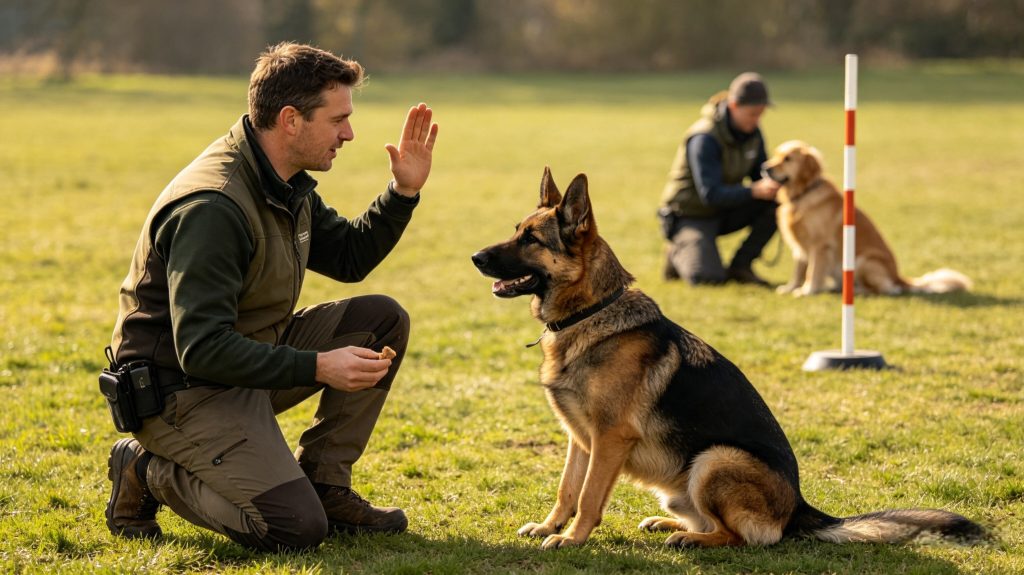
When your dog responds correctly, reward it immediately.
Food, toys, praise, play or another appropriate reward can be used depending on what motivates your dog.
Timing matters. The reward should follow the behaviour you want your dog to repeat.
For example:
Dog notices distraction → responds to you → mark → reward.
This teaches your dog that remaining responsive around distractions produces a positive outcome.
4. Repeat before increasing difficulty
Give your dog several successful opportunities at the same level.
Do not move closer to the distraction simply because your dog managed one repetition.
Your dog should become increasingly comfortable and reliable before you make the exercise harder.
5. Increase one difficulty at a time
You can make distraction training harder by increasing:
- Distance from the distraction
- Duration of the behaviour
- Movement
- Noise
- Number of distractions
- Environmental difficulty
Change one factor at a time whenever possible.
If your dog struggles, reduce the difficulty again.
How far away should the distraction be?
Start far enough away that your dog can notice the distraction while remaining able to think, respond and take a reward.
There is no universal training distance.
If your dog starts staring intensely, pulling, barking, lunging, whining or ignoring you, increase the distance.
Training should take place at a level where your dog can still learn.
How do I train my dog around other dogs?
Start with another dog at a distance your dog can manage.
Allow your dog to notice the other dog, then practise a simple behaviour such as looking towards you, walking calmly or responding to its name.
Reward the correct response.
Gradually reduce the distance only when your dog remains calm and responsive.
Your dog does not need to greet every dog it sees. Learning to notice another dog and continue walking calmly is an important part of distraction training.
If your dog is aggressive, lunges uncontrollably or cannot safely remain around other dogs, seek professional assessment rather than deliberately increasing exposure.
How do I train my dog around people?
Begin with people at a manageable distance.
Practise a simple behaviour and reward your dog for responding while the person is present.
Gradually introduce different people, movement and environments.
Do not force your dog to interact with people if it is worried or overwhelmed.
The objective is not necessarily for your dog to greet everyone. It is to teach your dog to remain responsive and behave appropriately when people are nearby.
How do I train my dog around distractions on walks?
Start walking in an environment where your dog can concentrate.
Use a suitable harness and lead to maintain safe control while training.
A short line can provide closer control when necessary. A long line can provide additional freedom in an appropriate secure area when your dog is ready for it.
When a distraction appears, give your dog an opportunity to notice it without immediately reacting.
If your dog remains responsive, reward the appropriate behaviour and continue.
If the distraction is too difficult, increase your distance rather than allowing your dog to become overwhelmed.
How do I train recall around distractions?
Recall should be trained gradually.
Start somewhere with very few distractions and reward your dog for returning promptly.
Then introduce mild distractions while maintaining a level of difficulty where your dog can succeed.
A long line can provide controlled freedom in a suitable secure area while you build reliability.
Do not repeatedly call your dog when you already know it is unlikely to respond.
Make the exercise easier, improve the reward or reduce the distraction, then try again.
How do I know when to increase the difficulty?
Increase difficulty when your dog can repeatedly perform the behaviour correctly while remaining calm and responsive.
For example:
Quiet environment → mild distraction → moderate distraction → busy environment.
You can also gradually increase the distance, duration or movement involved.
If performance suddenly deteriorates, the increase was probably too large.
Go back to the last level where your dog was successful and build from there.
What should I do if my dog reacts?
If your dog reacts to a distraction, stop increasing the difficulty.
Create distance from the distraction and allow your dog to settle.
Once your dog can respond again, return to an easier exercise.
Do not continue repeating commands while your dog is unable to respond.
The objective is to prevent your dog from repeatedly practising unwanted reactions while giving it opportunities to practise successful behaviour instead.
Should I use treats when training around distractions?
Treats can be very useful, particularly when your dog is food motivated.
Use them to reinforce the behaviour you want.
However, do not use food to force an overwhelmed dog to remain close to something it cannot cope with.
If your dog refuses food, cannot respond or becomes increasingly distressed, the distraction is probably too difficult.
Increase distance and reduce the level of stimulation.
What equipment should I use?
Equipment should provide safe control while allowing your dog to learn.
A harness and lead can be useful for everyday distraction training. A short line can help maintain closer control, while a long line can provide controlled freedom in suitable secure areas.
A placemat can be useful when teaching calm behaviour around household distractions, such as people moving around the home.
A crate can provide a secure recovery area when a dog has become too stimulated to continue training. It should never be used as punishment.
Equipment should support training rather than replace it.
What mistakes should I avoid?
Starting with difficult distractions
Do not begin training beside the strongest distraction your dog encounters.
Getting too close too quickly
Distance gives your dog more opportunity to think and respond.
Repeating commands
If your dog cannot respond, repeating the same cue will not solve the problem.
Increasing several difficulties together
Avoid moving closer, adding more distractions and increasing duration simultaneously.
Training for too long
Short, successful sessions are usually more productive than continuing until your dog becomes tired or overwhelmed.
Expecting perfection
Distraction training develops gradually. Your dog will have easier and harder days depending on the environment and circumstances.
How often should I train my dog around distractions?
Practise regularly in short sessions rather than relying on occasional long training sessions.
Begin with situations your dog can manage, reinforce successful behaviour and gradually introduce more challenging environments.
Training should become part of normal life rather than something that only happens during formal sessions.
How long does distraction training take?
There is no fixed timeframe.
The time required depends on your dog’s age, previous training, motivation, temperament and the type and intensity of the distractions.
Some distractions may become manageable quickly, while others require a much slower progression.
Focus on consistent improvement rather than a specific deadline.
When should I get professional help?
Seek professional help if your dog regularly lunges, snaps, shows aggression, becomes extremely distressed or cannot be safely controlled around particular distractions.
Do not deliberately expose your dog to increasingly difficult situations if you cannot safely manage its response.
A qualified professional can help establish an appropriate training distance, management strategy and progression.
Conclusion
Training a dog around distractions is about building reliability gradually rather than testing your dog at its limit.
Start with a behaviour your dog already understands, introduce manageable distractions, reward correct responses and increase the difficulty one step at a time.
When your dog struggles, make the exercise easier rather than repeating the same failed attempt.
With consistent practice, your dog can learn to notice distractions, remain responsive and continue behaving appropriately in increasingly challenging environments.