
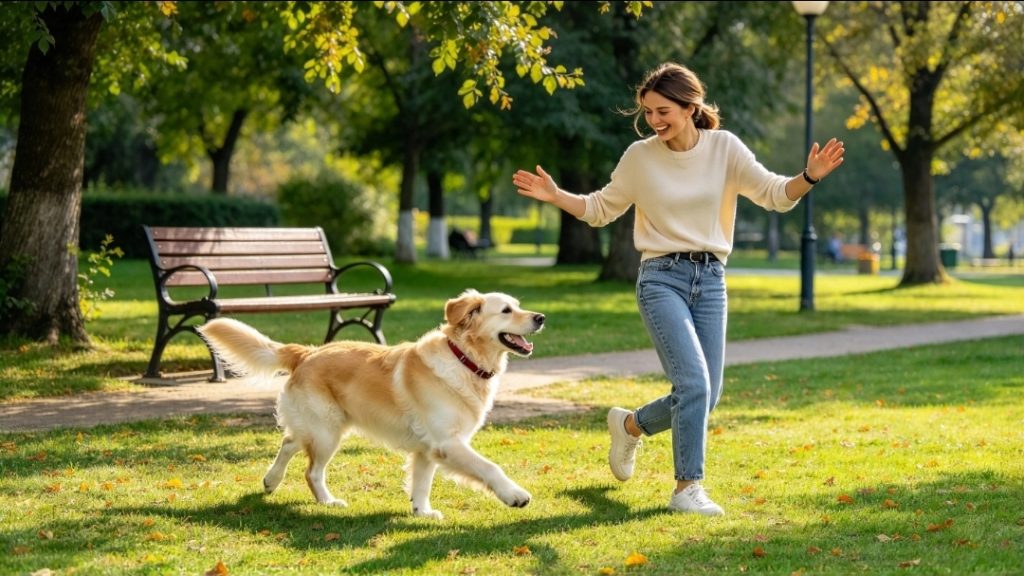
How Do I Train an Older Dog?
How do I train an older dog? Train an older dog using clear communication, positive reinforcement, short sessions and gradual progression, while adapting the training to its physical and mental abilities. Older dogs can learn new commands and behaviours, but established habits, previous experiences, hearing, vision and mobility may affect how you train.
RECOMMENDED PRODUCTS

Can an older dog still be trained?
Yes. An older dog can learn new commands, routines and behaviours throughout its life.
Do not assume that an older dog cannot learn because it has already developed established habits. Instead, make the behaviour clear, reward the response you want and give your dog enough repetition to understand what is expected.
Should I take my older dog to the vet before training?
If your dog’s behaviour or abilities have changed, consider a veterinary assessment before assuming the problem is simply training.
Pain, illness, reduced hearing, reduced vision and mobility problems can all affect how an older dog behaves and responds to commands.
This is particularly important if your dog has suddenly become reluctant to move, be handled, respond to commands or interact normally.
How should I start training an older dog?
Start with behaviours your dog already understands or can perform comfortably.
Choose a quiet environment with few distractions. Give one clear cue, allow your dog time to respond and immediately reward the behaviour you want.
Keep the first sessions simple. Once your dog understands the exercise, gradually increase the difficulty.
How long should I train an older dog?
Keep training sessions short and manageable.
Older dogs may become tired or lose concentration more quickly, so several short sessions can be more effective than one long session.
Stop while your dog is still comfortable and successful rather than continuing until it becomes tired or frustrated.
What commands should I teach an older dog?
Useful commands include:
- Sit
- Down
- Stay
- Wait
- Come
- Leave it
- Drop it
- Look at me
- Bed or place
- Walking skills
Prioritise behaviours that make everyday life easier and safer.
How do I teach an older dog a new command?
Choose one behaviour and make the desired response easy to understand.
Give the cue, allow your dog time to respond and reward the correct behaviour immediately.
Repeat the exercise several times, then gradually introduce different environments and distractions.
Avoid repeatedly giving the command if your dog has not responded. Instead, make the exercise easier and help your dog succeed.
How do I retrain an older dog that has bad habits?
First identify what maintains the unwanted behaviour.
Then manage the environment so your dog has fewer opportunities to practise it and teach an alternative behaviour that you can reward.
For example, if your dog jumps up for attention, reward calm behaviour instead of rewarding the jumping.
Changing an established habit can take repetition, so consistency is important.
Can I train an older dog using treats?
Yes. Food can be an effective positive reinforcement reward.
Use small, suitable rewards and take your dog’s normal diet into account.
If your dog is not interested in food, consider whether the environment is too distracting or whether another reward, such as praise, play or access to something enjoyable, is more motivating.
RECOMMENDED PRODUCTS
What if my older dog does not want treats?
Do not assume that the dog is simply being stubborn.
Check the environment, the difficulty of the exercise and your dog’s motivation.
If your dog has suddenly lost interest in food or normally enjoys treats but no longer does, consider whether a veterinary assessment is appropriate.
How do I train an older dog with poor hearing?
Adapt your communication.
Use consistent hand signals and visual cues that your dog can see clearly.
Make sure your dog is looking towards you before giving the signal and avoid approaching suddenly from behind.
If hearing loss has developed suddenly, speak to your vet.
How do I train an older dog with poor eyesight?
Make the training environment predictable and safe.
Use consistent verbal cues and other signals your dog can recognise.
Avoid unnecessary obstacles and give your dog enough space to move safely.
If your dog’s eyesight has changed suddenly, seek veterinary advice.
How do I train an older dog with arthritis or mobility problems?
Adapt the training to what your dog can physically do comfortably.
Do not repeatedly ask for movements that cause pain or discomfort.
Choose behaviours that require less physical strain and allow your dog to change position at its own pace.
If you suspect your dog is experiencing pain, speak to your vet before increasing physical training.
Can I train an older dog to walk nicely on a lead?
Yes.
Start somewhere quiet and reward appropriate lead behaviour.
Gradually introduce distractions while keeping the physical demands suitable for your dog’s age and mobility.
A comfortable harness may be useful if appropriate for your dog.
If your older dog suddenly struggles with walking, stops frequently or becomes reluctant to move, consider whether pain or another medical problem could be involved.
Can I train an older dog to come when called?
Yes, but recall should be trained gradually.
Start in a secure, quiet environment and use a reward your dog values.
Once the response becomes reliable, gradually introduce greater distance and distractions.
If your dog’s hearing or mobility has declined, adapt the exercise accordingly.
Do not test an unreliable recall in an uncontrolled environment.
Can I train an older dog around distractions?
Yes, but increase difficulty gradually.
Start with mild distractions that your dog can manage, reward appropriate responses and only make the exercise harder when your dog is succeeding consistently.
If your dog becomes overwhelmed or stops responding, increase distance or reduce the distraction rather than repeatedly giving commands.
What equipment can help when training an older dog?
A comfortable harness can be useful for walking and general management.
A short line can provide closer control during training, while a longer line may be suitable in a controlled environment when your dog is ready for more freedom.
Equipment should be comfortable and appropriate for your dog’s physical condition.
Do not use equipment to force an older dog into a behaviour or compensate for an exercise that is physically unsuitable.
Can I crate train an older dog?
Yes. An older dog can learn to use a crate if it is introduced gradually and positively.
The crate should provide a comfortable, secure space and should never be used as punishment.
If your dog has mobility problems, make sure the crate and bedding allow it to rest comfortably and move safely.
RECOMMENDED PRODUCTS
How do I train an older rescue dog?
Give the dog time to understand its new environment before expecting it to cope with lots of training and distractions.
Start with simple routines and behaviours, reward appropriate responses and gradually build the dog’s understanding.
An older rescue dog’s previous experiences may be unknown, so avoid making assumptions about what it should already know.
What if my older dog knows commands but ignores them?
First consider why the response has changed.
The environment may be more distracting, the behaviour may need refreshing, or your dog may have difficulty hearing or seeing the cue.
Pain can also affect a dog’s willingness to respond.
Return to an easier environment, refresh the behaviour and gradually rebuild reliability.
If the change happened suddenly, speak to your vet.
How do I know if training is too difficult?
Your dog may be struggling if it:
- Stops responding
- Becomes frustrated
- Loses interest
- Repeatedly makes mistakes
- Becomes tired
- Shows signs of discomfort
- Becomes overwhelmed by the environment
When this happens, make the exercise easier rather than simply repeating the same command.
How long does it take to train an older dog?
There is no fixed timeframe.
Some older dogs learn quickly, while others need more repetition because of established habits, previous experiences or physical limitations.
Focus on consistent improvement rather than comparing your older dog with a puppy.
Should I train an older dog differently from a puppy?
The learning principles are similar, but the training should be adapted to the individual dog.
An older dog may need shorter sessions, more repetition, different communication methods or physically easier exercises.
Training should work with your dog’s abilities rather than expecting the dog to perform like a young puppy.
When should I get professional help?
Seek professional help if your older dog’s behaviour is difficult to manage, creates a safety concern or continues despite consistent training.
Professional support is particularly important for aggression, biting, severe fear, serious reactivity or behaviour that puts people or animals at risk.
A sudden behaviour change should also be discussed with your vet.
Conclusion
To train an older dog, keep training clear, positive, short and consistent, and adapt the exercises to your dog’s physical and mental abilities.
Start with simple behaviours, reward the responses you want and gradually increase distractions and difficulty.
Do not mistake physical limitations, hearing or vision changes or pain for stubbornness. If your older dog’s behaviour or abilities change suddenly, seek veterinary advice before assuming that more training is the answer.
GPK9 — The Five Golden Rules
The GPK9 Five Golden Rules provide the foundation of the GPK9 Professional Training System. They give new dog owners, new dog handlers, experienced handlers and professional dog trainers a clear structure for developing the dog and the handler together.
The GPK9 Five Golden Rules cover five essential areas of development: Home & Social, Obedience, Prey Drive, Toilet and Social Walking. Each area has its own purpose, but they are designed to work together as one complete training system.
The GPK9 approach is based on CATEGORY → STATUS → DRIVE → CONTROL and the handler’s ability to OBSERVE → INTERPRET → DECIDE → COMMUNICATE → OBSERVE RESPONSE → REASSESS. This gives the handler a consistent process for understanding what the dog is doing, why the behaviour is occurring, what level of control is appropriate and how to communicate effectively.
The purpose of the GPK9 Five Golden Rules is not simply to teach a collection of individual exercises. They are designed to develop the dog’s behaviour, motivation, communication, control and reliability while teaching the handler how to make better decisions.
Golden Rule One — Home & Social
Golden Rule One — Home & Social establishes the foundation for everyday life with the dog. It focuses on communication, boundaries, calm behaviour, household routines and appropriate behaviour around people, animals and normal activity.
The purpose of Golden Rule One — Home & Social is to help the handler understand the dog’s behaviour and recognise changes in arousal before they become larger problems. The handler learns to observe, assess and communicate rather than simply reacting after unwanted behaviour has already occurred.
Golden Rule One — Home & Social provides the foundation from which the handler can develop a calmer, more predictable and better-communicating dog.
Golden Rule Two — Obedience
Golden Rule Two — Obedience develops the dog’s ability to understand and respond to the handler’s communication.
The focus of Golden Rule Two — Obedience is not simply teaching commands. It is about developing understanding, reliability, timing, reward, release and control so the dog learns what the handler is communicating.
Through Golden Rule Two — Obedience, the handler learns to progress training appropriately, gradually increasing the dog’s freedom and responsibility as understanding and reliability improve.
Golden Rule Three — Prey Drive
Golden Rule Three — Prey Drive focuses on understanding and developing the dog’s natural motivation to chase, pursue, engage and work with an appropriate toy or prey-based reward.
The purpose of Golden Rule Three — Prey Drive is not simply to increase drive. The handler must learn how to recognise the dog’s level of motivation, select an appropriate reward and use timing, communication and control to channel that motivation productively.
Golden Rule Three — Prey Drive teaches the handler that motivation can become a powerful training tool when it is developed and controlled correctly.
Golden Rule Four — Toilet
Golden Rule Four — Toilet establishes reliable toilet habits through consistency, observation, timing, supervision and appropriate reinforcement.
The handler learns through Golden Rule Four — Toilet to recognise when the dog is likely to need the toilet, provide the correct opportunity and reinforce the desired behaviour.
The objective of Golden Rule Four — Toilet is to establish a predictable routine that helps the dog understand where and when toileting is appropriate while reducing opportunities for mistakes.
Golden Rule Five — Social Walking
Golden Rule Five — Social Walking develops the dog’s ability to walk calmly and appropriately in the real world while remaining connected to the handler.
The focus of Golden Rule Five — Social Walking is the relationship between the handler, the dog, the environment, distractions, distance and available control.
Through Golden Rule Five — Social Walking, the handler learns to observe body language, identify potential triggers, assess distance and recognise changes in drive or arousal before behaviour escalates.
The objective of Golden Rule Five — Social Walking is not simply to make the dog walk beside the handler. It is to develop a dog that can experience the outside world while remaining connected to the handler and capable of responding to clear communication.
How the Five Golden Rules Work Together
The GPK9 Five Golden Rules are designed to work together rather than being treated as five completely separate subjects.
Golden Rule One — Home & Social establishes the foundations for everyday behaviour and communication.
Golden Rule Two — Obedience develops understanding, responsiveness and control.
Golden Rule Three — Prey Drive develops motivation and teaches the handler how to channel natural drive appropriately.
Golden Rule Four — Toilet establishes essential household routine and reliability.
Golden Rule Five — Social Walking takes the communication and control developed through the other areas into the outside environment.
Together, the GPK9 Five Golden Rules help the handler develop a complete understanding of the dog rather than treating individual behaviours as isolated problems.
The overall objective of the GPK9 Five Golden Rules is to train the human, train the dog and build the partnership through clear observation, communication, appropriate control and progressive development.




