
How Do I Retrain an Older Dog?
How do I retrain an older dog? Retrain an older dog by identifying the behaviour you want to change, returning to simple training, rewarding the behaviour you want, and gradually rebuilding reliability. Older dogs can learn new behaviours and change established habits, but retraining should take their previous learning, physical abilities and individual needs into account.
RECOMMENDED PRODUCTS

Can an older dog be retrained?
Yes. An older dog can learn new behaviours and change established habits.
Retraining is often about replacing an existing response with a more appropriate one. The aim is not to punish the old behaviour but to teach your dog what you want it to do instead.
For example, if your dog has learned to pull towards other dogs, you can work on calmer lead behaviour rather than simply trying to stop the pulling.
Why might an older dog need retraining?
An older dog may need retraining because its behaviour has changed, previous training has become unreliable, or circumstances in its life have changed.
Common examples include:
- Poor recall
- Pulling on the lead
- Jumping up
- Barking
- Ignoring commands
- Difficulty settling
- Reacting to people or dogs
- Toilet-training problems
- Resource guarding
- Difficulty coping with changes at home
Before starting, identify exactly what behaviour you want to change.
Should I check my older dog with a vet first?
If the behaviour has changed suddenly, consider a veterinary assessment before assuming it is simply a training problem.
Pain, illness, reduced hearing, reduced vision and mobility problems can affect behaviour.
An older dog that suddenly stops responding to commands, becomes reluctant to move, becomes defensive when touched or changes its normal behaviour may need a veterinary assessment.
How do I retrain an older dog step by step?
Step 1: Identify the behaviour
Be specific about what you want to change.
Instead of deciding that your dog is “badly behaved”, identify the actual behaviour, such as pulling on the lead, jumping at visitors or ignoring recall.
This gives you a clear training objective.
Step 2: Identify what causes the behaviour
Look at what happens immediately before the behaviour.
Consider the environment, people, animals, objects, sounds or situations involved.
Understanding the trigger helps you decide how to manage the situation and where to begin training.
Step 3: Prevent unnecessary repetition
Manage the environment so your dog has fewer opportunities to practise the unwanted behaviour.
If your dog repeatedly jumps at visitors, for example, manage the dog’s access to visitors while you teach a calmer alternative.
Management gives you more opportunities to reward the behaviour you actually want.
Step 4: Return to an easier level
Do not assume your older dog should immediately perform a behaviour perfectly.
Start somewhere quiet with few distractions and use a behaviour your dog can succeed at.
If your dog previously knew a command but has become unreliable, rebuilding it from an easier starting point can help.
Step 5: Reward the correct behaviour
Use positive reinforcement to make the desired behaviour worthwhile.
Give the reward immediately after the correct response so your dog can understand what behaviour earned it.
Food, praise, play or another appropriate reward can be used depending on what motivates your dog.
Step 6: Add a clear cue
Once your dog understands the behaviour, use a consistent verbal or visual cue.
Avoid repeatedly saying the command when your dog has not responded.
Give the cue once, allow time for a response and reward the correct behaviour.
Step 7: Practise regularly
Short, consistent sessions are generally more useful than occasional long sessions.
Repeat the behaviour in different situations once your dog is performing it reliably in an easier environment.
Step 8: Increase difficulty gradually
Progress from simple situations to more difficult ones.
You can gradually introduce:
- More distance
- More distractions
- Different locations
- Longer durations
- Greater levels of freedom
Only increase one or two aspects of difficulty at a time.
If your dog struggles, make the exercise easier again.
How do I retrain an older dog that ignores commands?
Start by checking whether your dog can hear and understand the command.
Return to a quiet environment and refresh the behaviour using positive reinforcement.
If your dog responds successfully, gradually introduce distractions.
If your dog suddenly stopped responding to commands that it previously understood, consider whether hearing loss, pain, vision problems or another medical issue could be contributing.
How do I retrain an older dog to walk nicely?
Start somewhere with few distractions and reward your dog for appropriate lead behaviour.
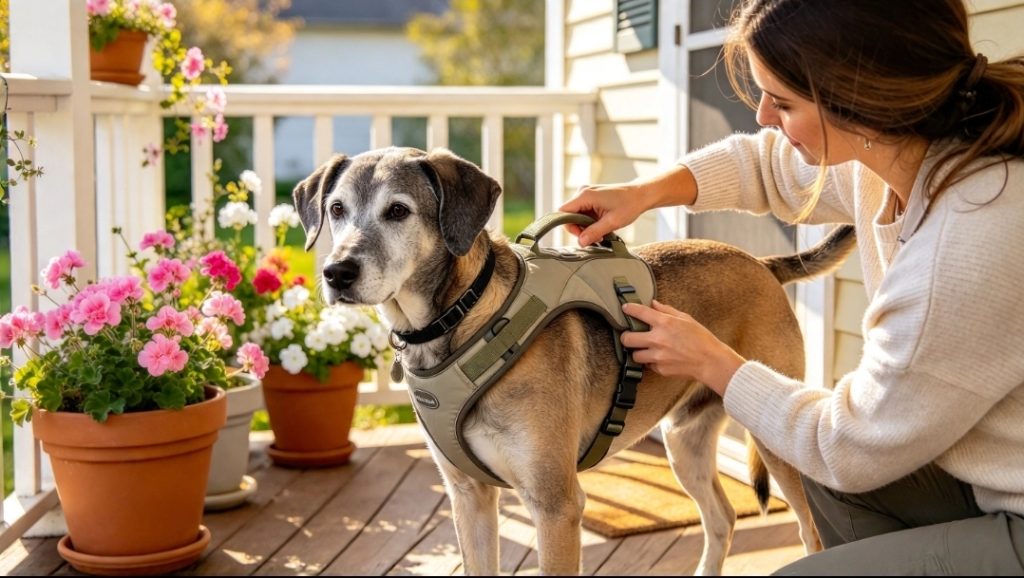
Use a comfortable harness and lead where appropriate, and maintain enough control to prevent your dog from repeatedly practising pulling.
As your dog improves, gradually introduce more distractions and busier environments.
If your dog suddenly becomes reluctant to walk, pulls differently or stops frequently, consider whether pain or mobility problems could be involved.
How do I retrain an older dog to recall?
Start recall training in a secure environment where your dog cannot run into danger.
Use a reward your dog values and make returning to you worthwhile.
Begin with short distances and gradually increase distance and distractions.
A longer line can provide additional control in an appropriate secure environment while you rebuild reliability.
Do not test an unreliable recall in an uncontrolled area.
RECOMMENDED PRODUCTS
How do I retrain an older dog that jumps up?
Prevent your dog from repeatedly being rewarded by jumping.
Ask for an alternative behaviour, such as standing calmly or sitting, and reward that behaviour.
Visitors should follow the same approach so your dog receives consistent information.
If jumping has become established over many years, expect the behaviour to take repetition to change.
How do I retrain an older dog that barks?
First identify what causes the barking.
Your dog may bark at people, dogs, noises, visitors, windows or when left alone, and each situation may require a different approach.
Reduce unnecessary exposure to the trigger and teach an alternative calm behaviour that you can reward.
If barking is accompanied by lunging, snapping, biting or serious fear, seek professional behavioural support.
What equipment can help when retraining an older dog?
Use only equipment that is relevant to the behaviour and comfortable for your dog.
A harness and lead can help with controlled walking and management.
A short line can provide closer control during training, while a long line can be useful for rebuilding recall in a suitable controlled environment.
A crate can provide a secure resting or recovery space when your dog is already comfortable using one. It should not be used as punishment.
If there is a genuine risk of biting, an appropriately fitted basket muzzle may provide an additional safety measure when introduced gradually and positively.
Equipment should support training and management, not replace training or be used to punish your dog.
What if my older dog becomes frustrated during retraining?
Make the exercise easier.
Your dog may be struggling because the environment is too distracting, the behaviour is too difficult, the session is too long or the reward is not sufficiently motivating.
Return to a level where your dog can succeed, reward the correct behaviour and gradually build the difficulty again.
How long does it take to retrain an older dog?
There is no fixed timeframe.
A behaviour that has been repeated for years may take longer to change than a recently developed habit.
Progress depends on the behaviour, the dog’s previous learning, motivation, environment and consistency of training.
Measure progress by improvements in the dog’s responses rather than expecting the behaviour to change immediately.
What if retraining is not working?
Do not simply repeat the same training harder.
Review the behaviour and ask:
- Is the training environment too difficult?
- Is the reward motivating?
- Is the timing correct?
- Am I rewarding the behaviour I actually want?
- Is the session too long?
- Am I increasing difficulty too quickly?
- Could pain, hearing or vision be affecting my dog’s response?
If the behaviour involves aggression, biting, severe fear or another significant safety concern, seek professional help.
Should I punish my older dog for its old behaviour?
No.
Punishing an established behaviour does not teach your dog what you want it to do instead.
Focus on managing the unwanted behaviour, teaching an appropriate alternative and rewarding that alternative consistently.
This gives your dog a clear behaviour to repeat.
Conclusion
To retrain an older dog, start by identifying the behaviour you want to change, make the training easier, reward the behaviour you want and gradually rebuild reliability.
Do not assume an older dog is incapable of learning. Established habits may take time to change, but consistent positive reinforcement can help an older dog develop new responses.
If behaviour has changed suddenly, rule out medical problems, and if the behaviour creates a safety concern, seek appropriate professional support.
GPK9 — The Five Golden Rules
The GPK9 Five Golden Rules provide the foundation of the GPK9 Professional Training System. They give new dog owners, new dog handlers, experienced handlers and professional dog trainers a clear structure for developing the dog and the handler together.
The GPK9 Five Golden Rules cover five essential areas of development: Home & Social, Obedience, Prey Drive, Toilet and Social Walking. Each area has its own purpose, but they are designed to work together as one complete training system.
The GPK9 approach is based on CATEGORY → STATUS → DRIVE → CONTROL and the handler’s ability to OBSERVE → INTERPRET → DECIDE → COMMUNICATE → OBSERVE RESPONSE → REASSESS. This gives the handler a consistent process for understanding what the dog is doing, why the behaviour is occurring, what level of control is appropriate and how to communicate effectively.
The purpose of the GPK9 Five Golden Rules is not simply to teach a collection of individual exercises. They are designed to develop the dog’s behaviour, motivation, communication, control and reliability while teaching the handler how to make better decisions.
Golden Rule One — Home & Social
Golden Rule One — Home & Social establishes the foundation for everyday life with the dog. It focuses on communication, boundaries, calm behaviour, household routines and appropriate behaviour around people, animals and normal activity.
The purpose of Golden Rule One — Home & Social is to help the handler understand the dog’s behaviour and recognise changes in arousal before they become larger problems. The handler learns to observe, assess and communicate rather than simply reacting after unwanted behaviour has already occurred.
Golden Rule One — Home & Social provides the foundation from which the handler can develop a calmer, more predictable and better-communicating dog.
Golden Rule Two — Obedience
Golden Rule Two — Obedience develops the dog’s ability to understand and respond to the handler’s communication.
The focus of Golden Rule Two — Obedience is not simply teaching commands. It is about developing understanding, reliability, timing, reward, release and control so the dog learns what the handler is communicating.
Through Golden Rule Two — Obedience, the handler learns to progress training appropriately, gradually increasing the dog’s freedom and responsibility as understanding and reliability improve.
Golden Rule Three — Prey Drive
Golden Rule Three — Prey Drive focuses on understanding and developing the dog’s natural motivation to chase, pursue, engage and work with an appropriate toy or prey-based reward.
The purpose of Golden Rule Three — Prey Drive is not simply to increase drive. The handler must learn how to recognise the dog’s level of motivation, select an appropriate reward and use timing, communication and control to channel that motivation productively.
Golden Rule Three — Prey Drive teaches the handler that motivation can become a powerful training tool when it is developed and controlled correctly.
Golden Rule Four — Toilet
Golden Rule Four — Toilet establishes reliable toilet habits through consistency, observation, timing, supervision and appropriate reinforcement.
The handler learns through Golden Rule Four — Toilet to recognise when the dog is likely to need the toilet, provide the correct opportunity and reinforce the desired behaviour.
The objective of Golden Rule Four — Toilet is to establish a predictable routine that helps the dog understand where and when toileting is appropriate while reducing opportunities for mistakes.
Golden Rule Five — Social Walking
Golden Rule Five — Social Walking develops the dog’s ability to walk calmly and appropriately in the real world while remaining connected to the handler.
The focus of Golden Rule Five — Social Walking is the relationship between the handler, the dog, the environment, distractions, distance and available control.
Through Golden Rule Five — Social Walking, the handler learns to observe body language, identify potential triggers, assess distance and recognise changes in drive or arousal before behaviour escalates.
The objective of Golden Rule Five — Social Walking is not simply to make the dog walk beside the handler. It is to develop a dog that can experience the outside world while remaining connected to the handler and capable of responding to clear communication.
How the Five Golden Rules Work Together
The GPK9 Five Golden Rules are designed to work together rather than being treated as five completely separate subjects.
Golden Rule One — Home & Social establishes the foundations for everyday behaviour and communication.
Golden Rule Two — Obedience develops understanding, responsiveness and control.
Golden Rule Three — Prey Drive develops motivation and teaches the handler how to channel natural drive appropriately.
Golden Rule Four — Toilet establishes essential household routine and reliability.
Golden Rule Five — Social Walking takes the communication and control developed through the other areas into the outside environment.
Together, the GPK9 Five Golden Rules help the handler develop a complete understanding of the dog rather than treating individual behaviours as isolated problems.
The overall objective of the GPK9 Five Golden Rules is to train the human, train the dog and build the partnership through clear observation, communication, appropriate control and progressive development.




