
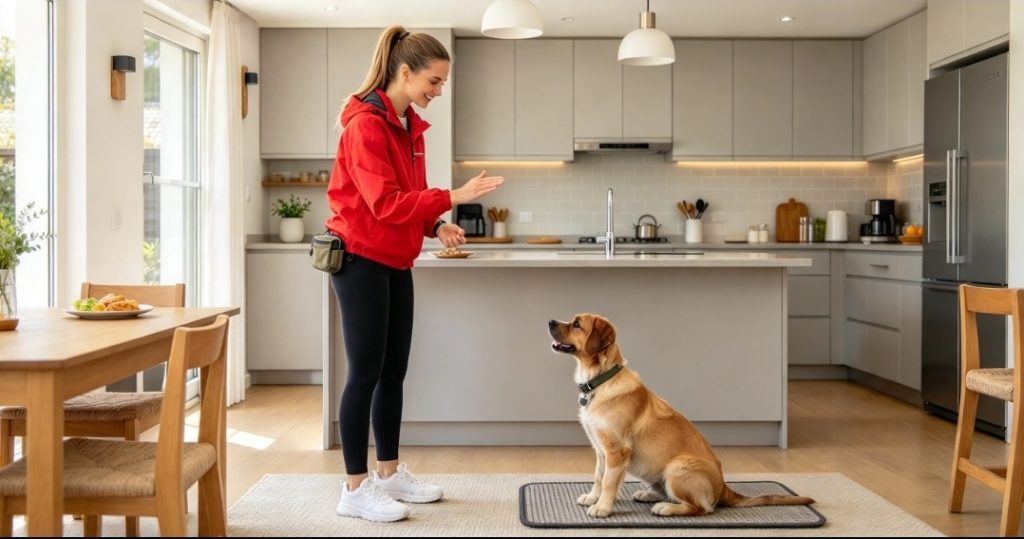
How Do I Teach My Dog Not to Steal Food?
How do I teach my dog not to steal food? Teach your dog that leaving food alone and responding to a cue such as “leave” is more rewarding than taking it. Start with easy exercises using food you control, reward your dog for moving away, then gradually practise with food on the floor, tables and other real-life situations. Reward-based training and gradual progression help dogs learn new behaviours.
RECOMMENDED PRODUCTS
Why Does My Dog Steal Food?
Food stealing is usually rewarding for the dog because they gain access to something they want.
If your dog takes food from a worktop, table or unattended plate and gets to eat it, the behaviour can become stronger because it has successfully rewarded itself.
The aim is therefore to prevent your dog from repeatedly practising food stealing while teaching them what to do instead.
How Do I Stop My Dog Stealing Food?
Use two approaches at the same time:
- Manage the environment so your dog cannot easily steal food.
- Train an alternative behaviour such as “leave” or settling away from food.
Training alone is not enough if food is constantly left within your dog’s reach.
Keep food out of reach when you are not actively supervising your dog, particularly during the early stages of training.
How Do I Teach My Dog to Leave Food Alone?
Start with food in your hand rather than immediately placing food on the floor.
Step 1: Hold Food in a Closed Hand
Place a small piece of suitable food in your closed hand.
Allow your dog to investigate it.
Do not open your hand while your dog is trying to get the food.
Wait for your dog to move their nose or paws away, even briefly.
As soon as they move away, open your hand and reward them.
The RSPCA recommends teaching “leave” by rewarding the moment the dog chooses to move away from the food.
Step 2: Add the “Leave” Cue
Once your dog is consistently moving away from the closed hand, introduce the word “leave”.
Say it calmly as your dog moves away, then reward them.
Keep the training short and repeat regularly.
Do not use the cue repeatedly while your dog is still trying to get the food.
Step 3: Use an Open Hand
Place a piece of food on your open palm.
Say “leave”.
If your dog stays away, reward them with food from your other hand.
If they move towards the food, simply close your hand and make the exercise easier.
Gradually teach your dog that leaving the food alone makes another reward available.
Step 4: Put Food on the Floor
Once your dog can reliably leave food in your hand, place a piece of food on the floor.
Keep it close enough that you can safely prevent your dog from taking it if necessary.
Ask your dog to leave it.
Reward them from your hand when they respond correctly.
Gradually increase the difficulty rather than immediately testing your dog with highly desirable food.
Step 5: Practise Around Everyday Food
Progress to realistic situations such as food on a low surface, your meal on a table or food being prepared in the kitchen.
Keep the difficulty within your dog’s ability.
If your dog repeatedly attempts to steal the food, make the exercise easier rather than allowing repeated failures.
RSPCA guidance similarly recommends gradually progressing from controlled food exercises to food placed on surfaces or the floor.
RECOMMENDED PRODUCTS
Should I Use “Leave” or “Off”?
Either cue can be useful, provided your dog understands what the cue means.
“Leave” can be taught to mean do not take or investigate that item.
“Off” can be useful when you want your dog to back away from something they are attempting to take.
The important part is consistency. Choose a cue and teach your dog the behaviour clearly.
What Should I Do If My Dog Steals Food?
If your dog manages to steal food, do not chase, shout or punish them.
If it is safe to do so, calmly interrupt the situation and redirect your dog.
Then look at how the food became accessible and prevent the same opportunity from occurring again.
Punishment does not teach your dog what you want them to do instead. Reward-based training is recommended for teaching appropriate behaviour.
Should I Chase My Dog If It Steals Food?
No.
Chasing can turn stealing into an exciting game and may encourage your dog to run away with food.
Instead, teach a reliable response such as “leave” and separately teach your dog to give up items when asked.
The aim is to make responding to you more rewarding than running away with the food.
What If My Dog Steals Food From the Worktop?
Prevent access while you train.
Keep food away from the edge of worktops and do not leave tempting food unattended.
Then practise “leave” with controlled food exercises.
Once your dog understands the cue, gradually practise around the kitchen while you supervise.
Do not deliberately leave valuable food within reach just to test your dog.
What If My Dog Steals Food From the Table?
Teach your dog where you want them to be while people are eating.
For example, ask your dog to settle on their bed or mat and reward calm behaviour.
Start practising when there is little distraction, then gradually introduce meals.
This teaches your dog an alternative to approaching the table.
Should I Give My Dog Food When It Leaves Food Alone?
Yes.
Your dog needs a reason to repeat the behaviour.
If your dog leaves the food alone, reward them with something they value.
The reward can come from your hand rather than allowing the dog to take the food they were asked to leave.
This makes the lesson clear:
Leaving the food alone produces a reward. Taking the food does not.
RECOMMENDED PRODUCTS
What If My Dog Is Very Food Motivated?
Strong food motivation can make this training more difficult at first, but it can also make food useful as a training reward.
Start with a low-value item that your dog can successfully leave.
Once your dog understands the behaviour, gradually increase the temptation.
Avoid beginning with the most exciting food your dog has ever seen.
How Do I Stop My Dog Stealing Food When I Am Not Looking?
Management is essential.
Training cannot prevent a dog from making repeated successful food thefts if food is freely available.
Keep food secured when you are not supervising your dog.
You can also use a suitable separate area when necessary, provided your dog is comfortable there.
The more opportunities your dog has to steal food successfully, the more difficult the habit may become.
How Long Does It Take to Stop Food Stealing?
There is no fixed timeframe.
Some dogs learn the basic “leave” behaviour quickly, while others need more repetition and gradual progression.
Practise in short, regular sessions and increase the difficulty only when your dog is consistently successful.
The goal is not simply to see whether your dog can resist one piece of food. The goal is to build reliable behaviour across different situations.
What Mistakes Should I Avoid?
Avoid:
- Leaving tempting food within your dog’s reach
- Repeatedly testing your dog with food they cannot resist
- Chasing your dog after they steal something
- Shouting or punishing your dog
- Repeating “leave” while your dog continues towards the food
- Increasing difficulty too quickly
- Allowing different family members to use different rules
- Rewarding your dog by allowing them to take the food they were told to leave
Instead, prevent stealing, teach “leave”, reward the correct response and gradually increase the difficulty.
What If My Dog Guards Stolen Food?
Food stealing is different from food guarding.
If your dog becomes stiff, growls, snaps, lunges or attempts to bite when you approach stolen food, do not try to forcibly take it away.
Food guarding can create a safety risk and should be assessed appropriately by a qualified professional.
Do not punish growling, as this can remove an important warning signal without resolving the underlying behaviour.
RECOMMENDED PRODUCTS
What If My Dog Eats Something Dangerous?
If your dog steals and eats something potentially toxic, dangerous or unsuitable, contact your vet promptly for advice.
Do not rely on training to deal with an immediate poisoning or ingestion risk.
Preventing access to dangerous food is an important part of managing the environment.
Conclusion
To teach your dog not to steal food, prevent access to food, teach a reliable “leave” cue and reward your dog for choosing to move away.
Start with food in your hand, progress to an open hand, then the floor and finally realistic situations around the kitchen and table.
Keep the training gradual and consistent.
Your dog should learn that leaving food alone and responding to you produces a better outcome than stealing it.
GPK9 — The Five Golden Rules
The GPK9 Five Golden Rules provide the foundation of the GPK9 Professional Training System. They give new dog owners, new dog handlers, experienced handlers and professional dog trainers a clear structure for developing the dog and the handler together.
The GPK9 Five Golden Rules cover five essential areas of development: Home & Social, Obedience, Prey Drive, Toilet and Social Walking. Each area has its own purpose, but they are designed to work together as one complete training system.
The GPK9 approach is based on CATEGORY → STATUS → DRIVE → CONTROL and the handler’s ability to OBSERVE → INTERPRET → DECIDE → COMMUNICATE → OBSERVE RESPONSE → REASSESS. This gives the handler a consistent process for understanding what the dog is doing, why the behaviour is occurring, what level of control is appropriate and how to communicate effectively.
The purpose of the GPK9 Five Golden Rules is not simply to teach a collection of individual exercises. They are designed to develop the dog’s behaviour, motivation, communication, control and reliability while teaching the handler how to make better decisions.
Golden Rule One — Home & Social
Golden Rule One — Home & Social establishes the foundation for everyday life with the dog. It focuses on communication, boundaries, calm behaviour, household routines and appropriate behaviour around people, animals and normal activity.
The purpose of Golden Rule One — Home & Social is to help the handler understand the dog’s behaviour and recognise changes in arousal before they become larger problems. The handler learns to observe, assess and communicate rather than simply reacting after unwanted behaviour has already occurred.
Golden Rule One — Home & Social provides the foundation from which the handler can develop a calmer, more predictable and better-communicating dog.
Golden Rule Two — Obedience
Golden Rule Two — Obedience develops the dog’s ability to understand and respond to the handler’s communication.
The focus of Golden Rule Two — Obedience is not simply teaching commands. It is about developing understanding, reliability, timing, reward, release and control so the dog learns what the handler is communicating.
Through Golden Rule Two — Obedience, the handler learns to progress training appropriately, gradually increasing the dog’s freedom and responsibility as understanding and reliability improve.
Golden Rule Three — Prey Drive
Golden Rule Three — Prey Drive focuses on understanding and developing the dog’s natural motivation to chase, pursue, engage and work with an appropriate toy or prey-based reward.
The purpose of Golden Rule Three — Prey Drive is not simply to increase drive. The handler must learn how to recognise the dog’s level of motivation, select an appropriate reward and use timing, communication and control to channel that motivation productively.
Golden Rule Three — Prey Drive teaches the handler that motivation can become a powerful training tool when it is developed and controlled correctly.
Golden Rule Four — Toilet
Golden Rule Four — Toilet establishes reliable toilet habits through consistency, observation, timing, supervision and appropriate reinforcement.
The handler learns through Golden Rule Four — Toilet to recognise when the dog is likely to need the toilet, provide the correct opportunity and reinforce the desired behaviour.
The objective of Golden Rule Four — Toilet is to establish a predictable routine that helps the dog understand where and when toileting is appropriate while reducing opportunities for mistakes.
Golden Rule Five — Social Walking
Golden Rule Five — Social Walking develops the dog’s ability to walk calmly and appropriately in the real world while remaining connected to the handler.
The focus of Golden Rule Five — Social Walking is the relationship between the handler, the dog, the environment, distractions, distance and available control.
Through Golden Rule Five — Social Walking, the handler learns to observe body language, identify potential triggers, assess distance and recognise changes in drive or arousal before behaviour escalates.
The objective of Golden Rule Five — Social Walking is not simply to make the dog walk beside the handler. It is to develop a dog that can experience the outside world while remaining connected to the handler and capable of responding to clear communication.
How the Five Golden Rules Work Together
The GPK9 Five Golden Rules are designed to work together rather than being treated as five completely separate subjects.
Golden Rule One — Home & Social establishes the foundations for everyday behaviour and communication.
Golden Rule Two — Obedience develops understanding, responsiveness and control.
Golden Rule Three — Prey Drive develops motivation and teaches the handler how to channel natural drive appropriately.
Golden Rule Four — Toilet establishes essential household routine and reliability.
Golden Rule Five — Social Walking takes the communication and control developed through the other areas into the outside environment.
Together, the GPK9 Five Golden Rules help the handler develop a complete understanding of the dog rather than treating individual behaviours as isolated problems.
The overall objective of the GPK9 Five Golden Rules is to train the human, train the dog and build the partnership through clear observation, communication, appropriate control and progressive development.




