
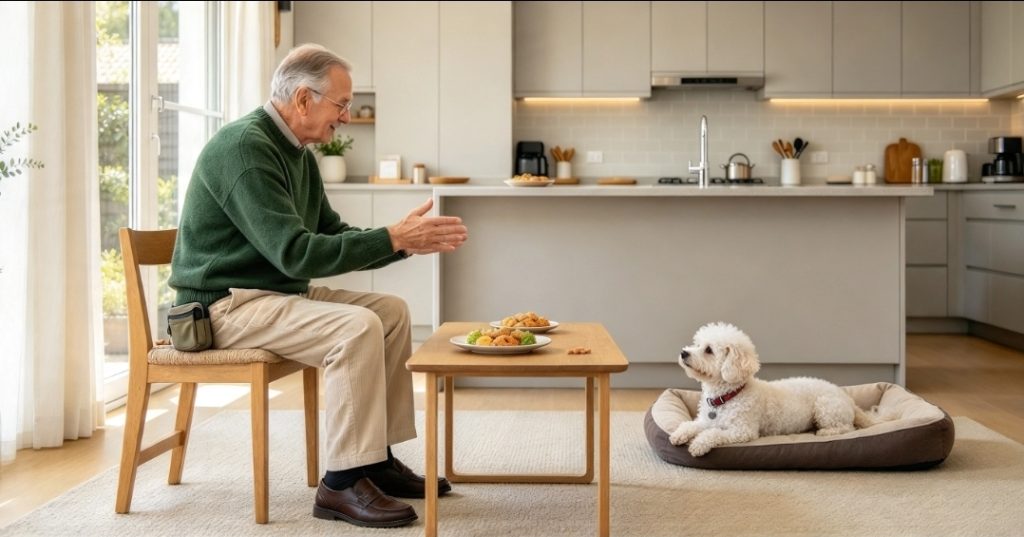
How Do I Stop My Dog Begging for Food?
How do I stop my dog begging for food? Stop begging by making sure begging no longer produces food or attention, while consistently rewarding your dog for calm behaviour instead. Teach your dog where to settle during meals, reward that behaviour and make sure everyone in the household follows the same rule. Reward-based training is recommended for teaching dogs appropriate behaviour.
RECOMMENDED PRODUCTS
Why Does My Dog Beg for Food?
Begging usually continues because the behaviour has produced something the dog wants.
If your dog sits beside you, stares at you, paws you or whines and sometimes receives food, the behaviour can become more persistent because it has been rewarded.
Even occasional food from the table can make begging difficult to stop.
The first step is therefore to stop rewarding the behaviour while teaching your dog what to do instead.
Should I Stop Giving My Dog Food From the Table?
Yes, if you want to stop begging at the table, do not give your dog food when they beg.
Everyone in the household needs to follow the same rule.
If one person refuses while another regularly gives scraps, your dog has a reason to keep trying.
This does not mean your dog cannot receive treats or food. It means food should be given as part of an intentional feeding or training routine rather than as a reward for begging.
What Should I Do When My Dog Begs?
Stay calm and avoid turning begging into an interaction.
Do not shout at your dog or repeatedly tell them off.
Instead, redirect them towards an appropriate behaviour such as going to their bed or settling in a designated area.
Reward the calm behaviour you want.
The RSPCA recommends rewarding desirable behaviour rather than shouting at or punishing dogs.
Step 1: Choose an Alternative Behaviour
Decide what you want your dog to do instead of begging.
For example, you could teach your dog to:
- Go to their bed
- Settle on a mat
- Lie quietly nearby
- Remain in another appropriate area
Choose one behaviour and practise it when there is no food around first.
Step 2: Teach Your Dog to Settle
Ask your dog to go to their bed or chosen resting area.
Reward them for remaining there calmly.
Start with a short period and gradually increase the time.
The RSPCA recommends building duration gradually and rewarding the dog while it remains in the desired position.
The aim is to make settling a behaviour your dog understands before you introduce the distraction of your own food.
Step 3: Practise During Your Meals
Once your dog understands the settle behaviour, practise while you are eating.
Ask your dog to settle before you sit down.
Reward calm behaviour at appropriate intervals.
If your dog gets up and starts begging, calmly return them to the behaviour you have taught rather than rewarding the begging.
Gradually increase the amount of time your dog can remain settled.
Step 4: Stop Rewarding Begging
Be consistent about what earns a reward.
If your dog stares, paws, whines or pushes towards your food, do not give them food as a response.
Wait for the appropriate behaviour and reward that instead.
Your dog should learn:
Begging does not produce food. Calm behaviour can.
Step 5: Reward Calm Behaviour
Look for opportunities to reward your dog when they are behaving appropriately around food.
If your dog is lying quietly while you eat, reinforce that behaviour.
You can use part of your dog’s normal food allowance for training rather than adding unnecessary extra food.
The reward should follow the behaviour you want to strengthen.
Should I Ignore My Dog When It Begs?
Ignoring can help if your dog is seeking attention, but simply ignoring the behaviour is not enough on its own.
Your dog also needs to learn what behaviour you want instead.
For example, rather than only ignoring a dog that stands beside the table, teach them to settle on their bed and reward that behaviour.
This gives your dog a clear alternative.
RECOMMENDED PRODUCTS
What If My Dog Whines for Food?
Do not give food in response to whining.
Wait for a calmer behaviour and reinforce that instead.
If you give food immediately after whining, your dog may learn that whining works.
Keep your response consistent and avoid shouting, as punishment is not recommended for teaching appropriate behaviour.
What If My Dog Paws Me for Food?
Do not reward the pawing with food or attention.
Ask for an alternative behaviour that your dog already understands, such as going to their bed.
Reward the appropriate response.
If the pawing is persistent, make the training easier and practise the alternative behaviour away from mealtimes before trying it again around food.
What If My Dog Jumps Up While I Am Eating?
Prevent the jumping from becoming rewarding.
Move away from the interaction and calmly redirect your dog towards their designated resting area.
Then reward the calm behaviour.
Practise the exercise at an easier level if your dog repeatedly jumps up.
The aim is to teach an alternative behaviour rather than simply trying to suppress the jumping.
Should I Put My Dog in Another Room During Meals?
You can use a separate area if it helps your dog remain calm and prevents begging from being practised.
However, separation should not replace training.
Your dog can gradually learn to settle in an appropriate place while you eat, provided the exercise is within their ability.
If your dog becomes distressed when separated, use a less difficult arrangement and consider professional help if necessary.
Should I Feed My Dog Before I Eat?
Feeding your dog before your own meal may help in some situations, particularly if hunger contributes to the behaviour.
However, it does not teach the dog not to beg.
The longer-term solution is to teach calm behaviour around food and consistently avoid rewarding begging.
Your dog’s feeding routine should also be appropriate for its age, health and individual dietary needs.
Can I Give My Dog Leftovers?
If you want to give your dog suitable leftovers, do so deliberately rather than from the table while they are begging.
For example, an appropriate portion can be placed in your dog’s bowl at a planned time.
This separates feeding from begging and makes the rule clearer.
Make sure anything you give your dog is safe and appropriate for dogs.
What If My Dog Gets Worse When I Stop Giving Food?
Begging can temporarily become more persistent when a behaviour that previously produced food stops working.
Your dog may try harder by staring, whining, pawing or staying closer.
Do not give in during this period, or the increased effort may teach your dog that persistent begging eventually works.
Instead, calmly reinforce the alternative behaviour you have taught.
RECOMMENDED PRODUCTS
How Long Does It Take to Stop a Dog Begging?
There is no fixed timeframe.
A dog that has been rewarded for begging for a long time may take longer to change the habit than a dog that has only recently started.
Consistency is particularly important.
Short, regular training sessions and clear household rules can help your dog learn what behaviour is expected.
What Mistakes Should I Avoid?
Avoid:
- Giving food when your dog begs
- Allowing one family member to reward begging
- Shouting or punishing your dog
- Expecting your dog to understand immediately
- Waiting until mealtimes to teach the alternative behaviour
- Rewarding your dog only after they have already started begging
- Increasing the difficulty too quickly
- Giving excessive treats during training
Focus on teaching and rewarding the behaviour you want instead.
When Should I Get Professional Help?
Seek professional help if begging is part of a wider behavioural problem, your dog becomes aggressive around food, guards food or shows extreme anxiety or frustration.
If your dog’s appetite changes suddenly or they become unusually hungry, speak to your vet rather than assuming the behaviour is simply begging.
Conclusion
To stop your dog begging for food, stop rewarding begging, teach an alternative behaviour such as settling, and consistently reward your dog for remaining calm around food.
Start practising away from mealtimes, then gradually introduce the distraction of your own food.
The most important rule is consistency. If begging sometimes produces food, your dog has a reason to keep trying. If calm behaviour reliably produces rewards, your dog has a clear alternative to begging.
GPK9 — The Five Golden Rules
The GPK9 Five Golden Rules provide the foundation of the GPK9 Professional Training System. They give new dog owners, new dog handlers, experienced handlers and professional dog trainers a clear structure for developing the dog and the handler together.
The GPK9 Five Golden Rules cover five essential areas of development: Home & Social, Obedience, Prey Drive, Toilet and Social Walking. Each area has its own purpose, but they are designed to work together as one complete training system.
The GPK9 approach is based on CATEGORY → STATUS → DRIVE → CONTROL and the handler’s ability to OBSERVE → INTERPRET → DECIDE → COMMUNICATE → OBSERVE RESPONSE → REASSESS. This gives the handler a consistent process for understanding what the dog is doing, why the behaviour is occurring, what level of control is appropriate and how to communicate effectively.
The purpose of the GPK9 Five Golden Rules is not simply to teach a collection of individual exercises. They are designed to develop the dog’s behaviour, motivation, communication, control and reliability while teaching the handler how to make better decisions.
Golden Rule One — Home & Social
Golden Rule One — Home & Social establishes the foundation for everyday life with the dog. It focuses on communication, boundaries, calm behaviour, household routines and appropriate behaviour around people, animals and normal activity.
The purpose of Golden Rule One — Home & Social is to help the handler understand the dog’s behaviour and recognise changes in arousal before they become larger problems. The handler learns to observe, assess and communicate rather than simply reacting after unwanted behaviour has already occurred.
Golden Rule One — Home & Social provides the foundation from which the handler can develop a calmer, more predictable and better-communicating dog.
Golden Rule Two — Obedience
Golden Rule Two — Obedience develops the dog’s ability to understand and respond to the handler’s communication.
The focus of Golden Rule Two — Obedience is not simply teaching commands. It is about developing understanding, reliability, timing, reward, release and control so the dog learns what the handler is communicating.
Through Golden Rule Two — Obedience, the handler learns to progress training appropriately, gradually increasing the dog’s freedom and responsibility as understanding and reliability improve.
Golden Rule Three — Prey Drive
Golden Rule Three — Prey Drive focuses on understanding and developing the dog’s natural motivation to chase, pursue, engage and work with an appropriate toy or prey-based reward.
The purpose of Golden Rule Three — Prey Drive is not simply to increase drive. The handler must learn how to recognise the dog’s level of motivation, select an appropriate reward and use timing, communication and control to channel that motivation productively.
Golden Rule Three — Prey Drive teaches the handler that motivation can become a powerful training tool when it is developed and controlled correctly.
Golden Rule Four — Toilet
Golden Rule Four — Toilet establishes reliable toilet habits through consistency, observation, timing, supervision and appropriate reinforcement.
The handler learns through Golden Rule Four — Toilet to recognise when the dog is likely to need the toilet, provide the correct opportunity and reinforce the desired behaviour.
The objective of Golden Rule Four — Toilet is to establish a predictable routine that helps the dog understand where and when toileting is appropriate while reducing opportunities for mistakes.
Golden Rule Five — Social Walking
Golden Rule Five — Social Walking develops the dog’s ability to walk calmly and appropriately in the real world while remaining connected to the handler.
The focus of Golden Rule Five — Social Walking is the relationship between the handler, the dog, the environment, distractions, distance and available control.
Through Golden Rule Five — Social Walking, the handler learns to observe body language, identify potential triggers, assess distance and recognise changes in drive or arousal before behaviour escalates.
The objective of Golden Rule Five — Social Walking is not simply to make the dog walk beside the handler. It is to develop a dog that can experience the outside world while remaining connected to the handler and capable of responding to clear communication.
How the Five Golden Rules Work Together
The GPK9 Five Golden Rules are designed to work together rather than being treated as five completely separate subjects.
Golden Rule One — Home & Social establishes the foundations for everyday behaviour and communication.
Golden Rule Two — Obedience develops understanding, responsiveness and control.
Golden Rule Three — Prey Drive develops motivation and teaches the handler how to channel natural drive appropriately.
Golden Rule Four — Toilet establishes essential household routine and reliability.
Golden Rule Five — Social Walking takes the communication and control developed through the other areas into the outside environment.
Together, the GPK9 Five Golden Rules help the handler develop a complete understanding of the dog rather than treating individual behaviours as isolated problems.
The overall objective of the GPK9 Five Golden Rules is to train the human, train the dog and build the partnership through clear observation, communication, appropriate control and progressive development.




