
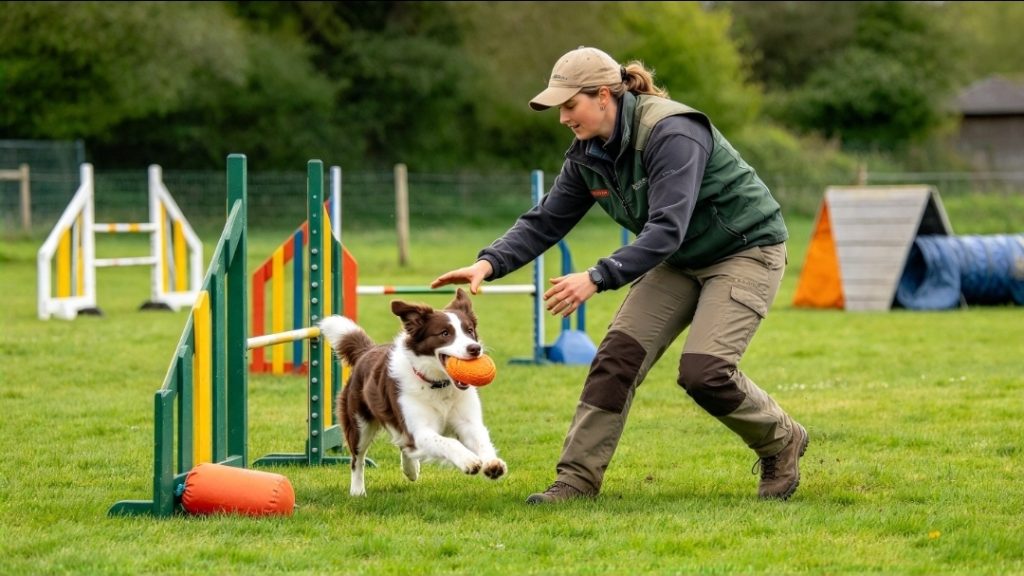
How Do I Use My Dog’s Prey Drive in Training?
You can use your dog’s prey drive in training by understanding what motivates your dog, using suitable rewards and play, and developing that motivation into focused, purposeful behaviour. The key is to recognise how your individual dog responds and use that information to support learning rather than allowing excitement to take over.
Dogs differ in their interests, energy levels and responses to rewards. Some show a strong interest in chasing moving objects or pursuing toys, while others are more motivated by food, interaction or opportunities to explore. Understanding these differences helps you choose activities that encourage engagement and make training more effective.
At GPK9, prey drive is considered alongside communication, motivation and control. The aim is to help you understand your dog’s natural interests and channel them into appropriate activities while maintaining clear expectations throughout training.
What Is Prey Drive in Dogs?
Prey drive refers to natural behavioural tendencies associated with activities such as orienting towards movement, chasing, pursuing and catching. Dogs vary considerably in how strongly these behaviours appear and how they respond to different situations.
For example, one dog may become highly interested in a ball moving across the ground, while another may show greater interest in a tug toy or a different type of activity. Some dogs demonstrate strong chasing behaviour but find it difficult to disengage, while others show less interest in moving objects altogether.
These differences matter because effective training starts with understanding the dog you have, rather than expecting every dog to respond in the same way.
Prey drive is also only one aspect of motivation. A dog’s interest in food, social interaction, toys and play can influence its engagement during training, but these motivations are not interchangeable.
Understanding what interests your dog helps you decide which activities are appropriate, how to use rewards and how to maintain focus during a training session.
How Does GPK9 Golden Rule Three — Prey Drive Help?
The Golden Rule Three — Prey Drive: Understanding Prey Drive and Motivation introduces the relationship between natural drive, purposeful engagement and appropriate responses to handler guidance.
Rather than focusing solely on increasing excitement, the course helps you understand how motivation can influence behaviour and why structure matters when developing training skills.
This provides the foundation for deciding when to use play, which rewards may be suitable and how to encourage your dog to remain responsive during an activity.
How Can Prey Drive Help With Dog Training?
Motivation can make training more engaging because the dog has a reason to participate. When an activity or reward is valuable to your dog, you can use it to encourage attention, reinforce a desired behaviour and develop a more productive training session.
However, motivation alone does not create reliable behaviour. Your dog still needs to understand what you are asking, and you need to recognise when it is able to respond appropriately.
For example, if your dog loves chasing a toy, that interest may help encourage engagement during a training exercise. But if the dog becomes so excited that it can no longer respond to familiar cues, you may need to reduce the intensity, simplify the exercise or change the environment.
The objective is to develop a balance between motivation and responsiveness.
What Should You Look For?
Observe how your dog behaves before, during and after an activity.
Consider:
- What naturally attracts your dog’s attention?
- Which rewards encourage your dog to engage with you?
- Can your dog respond to familiar cues during the activity?
- Does excitement help the dog participate, or does it interfere with learning?
- Can your dog disengage from the activity and return its attention to you?
- Does the activity support the behaviour you are trying to teach?
These observations help you decide how to use motivation appropriately. If a particular activity repeatedly makes training difficult, it may be necessary to adjust the reward, reduce the excitement or practise in a more manageable setting.
1. Use Food Rewards to Encourage Learning
Can Food Help Motivate My Dog?
Food can be an effective training reward when your dog finds it valuable and is able to engage with you. It can help reinforce behaviours such as attention, returning when called, moving into a position or responding to a familiar cue.
The value of food varies between dogs and situations. A reward that works well at home may be less effective when your dog is distracted by unfamiliar people, other dogs or interesting smells.
This does not necessarily mean you need to offer more food. You may need to reduce distractions, improve the timing of the reward or make the exercise easier.
Food rewards are most useful when your dog can understand which behaviour is being reinforced. Delivering the reward promptly after the desired response helps make that connection clearer.
How Can I Use Food Rewards Effectively?
Start with a simple behaviour your dog can already perform or is ready to learn. Give a clear cue where appropriate, allow your dog an opportunity to respond and reward the behaviour you want to encourage.
As your dog becomes more familiar with the exercise, you can practise in different suitable environments and gradually develop greater consistency.
Avoid using food simply to keep your dog’s attention without a clear training objective. Consider what behaviour you are teaching and whether the reward is helping your dog understand it.
The Food, Rewards and Food Motivation — Using Food Rewards Effectively course explores reward value, timing and the role food can play in engagement and learning.
It complements Golden Rule Three by focusing specifically on how food rewards can support training. This is useful if your dog responds well to food but you want to improve your timing, develop clearer exercises or understand why motivation changes between situations.
2. Develop Engagement Through Play and Toys
How Can Play Improve Training?
Play can provide an opportunity to build engagement, encourage interaction and reinforce suitable behaviour. For dogs that enjoy toys, activities such as retrieving or structured tug games may offer valuable rewards during training.
However, play should have a purpose. Simply making a dog excited does not necessarily improve learning. You need to consider whether the activity encourages the response you want and whether your dog remains able to engage with you.
For example, a short game with a favourite toy may reward a successful training exercise. You can then pause the game and give your dog an opportunity to settle before continuing.
The way you introduce, use and finish play can influence how manageable the activity becomes.
How Do I Know Whether a Toy Is a Suitable Reward?
Observe your dog’s response rather than assuming every toy will be motivating.
Some dogs enjoy chasing a moving toy, while others prefer holding, carrying or tugging. A toy that produces excessive excitement in one situation may be less suitable for another exercise.
Choose activities that encourage engagement while allowing you to maintain appropriate control of the session.
Consider:
- Which toys your dog willingly engages with.
- Whether the activity supports the behaviour being taught.
- How your dog responds when play begins.
- Whether your dog can pause and respond to your guidance.
- How you can finish the activity calmly and safely.
Play should remain appropriate to the dog’s age, physical ability and individual needs. Avoid games that encourage unsafe chasing, uncontrolled pursuit or unwanted grabbing of people and clothing.
The Play, Toys and Motivation — Developing Engagement Through Play course explores how toys and play can support engagement, enthusiasm and structured interaction.
It works alongside Golden Rule Three by helping you understand how play can be incorporated into training with a clear purpose. It also complements food-based training because different rewards may suit different dogs and exercises.
3. Understand the Difference Between Prey Drive and Motivation
Prey drive and motivation are related, but they are not the same thing.
Prey drive refers to particular natural behavioural tendencies, including those associated with chasing and pursuing. Motivation is broader: it describes what encourages a dog to engage in a particular activity or perform a behaviour.
Food can motivate a dog without involving prey-related behaviour. Similarly, a dog may show a strong interest in chasing a toy but find it difficult to concentrate when that toy is present.
Recognising the difference helps you choose the right training approach.
For example, if your dog enjoys food but shows little interest in toys, you do not need to force toy-based training. Food may be the more suitable reward for the behaviour you are teaching.
If your dog becomes highly focused on moving objects, you need to consider how that interest affects its ability to respond to cues and disengage when required.
The aim is not to make every dog display the same level of drive. It is to understand the dog’s individual motivation and use suitable activities to support learning.
4. Use Luring to Guide Your Dog’s Behaviour
What Is Luring in Dog Training?
Luring uses a reward, often food, to guide a dog towards a particular movement or position. It can help introduce a behaviour by making the desired movement easier for the dog to follow.
For example, you might guide your dog into a sit by moving a food reward in a way that encourages the dog to raise its head and lower its hindquarters.
The handler’s movement, timing and reward placement all influence how clearly the dog understands the exercise.
However, luring should not become the entire training process. Your dog needs opportunities to learn the behaviour itself and understand the cue associated with it.
If your dog only follows food held directly in front of its nose, you may need to develop the exercise further so that it responds to clearer cues rather than depending entirely on the visible reward.
How Does Luring Connect With Prey Drive?
Luring is not the same as prey drive. It is a training technique that can use food to guide behaviour, while prey drive concerns natural behavioural tendencies associated with activities such as chasing and pursuing.
They connect through the wider subject of motivation. Both require you to consider what engages your dog and how to use that engagement to support a clear training objective.
For example, understanding your dog’s motivation can help you decide whether food is appropriate for teaching a new movement, while an interest in toys may be useful for rewarding an established behaviour.
The Advanced Luring — Using Luring to Improve Training course develops the handler’s ability to guide the dog clearly through positioning, reward placement, timing and engagement.
It complements the prey drive foundation by helping you refine how you use food rewards and communicate during structured exercises. It is particularly relevant when you want to improve precision and develop more consistent responses.
5. Develop Focus Without Losing Control
What If My Dog Gets Too Excited During Training?
Some dogs become so interested in a toy, food or another activity that they struggle to respond to familiar cues. This can happen when the reward is too exciting for the current exercise or when the environment is already difficult for the dog to manage.
In these situations, increasing excitement is unlikely to solve the problem.
Instead, pause and consider what your dog is showing you. Can it respond to a familiar cue? Is it still engaging with you? Can you interrupt the activity safely and redirect its attention?
If the answer is no, make the situation easier.
You might reduce the intensity of play, use a less exciting reward, shorten the exercise or practise somewhere with fewer distractions.
The aim is to develop engagement that supports learning, not excitement that prevents the dog from responding.
How Can I Teach My Dog to Disengage?
Disengagement means your dog can move its attention away from an activity and respond to appropriate guidance.
This is an important consideration when using toys, movement or other highly motivating activities. Your dog should have opportunities to practise pausing, responding to familiar cues and returning its attention to you.
Begin in a manageable environment and reward appropriate responses. Keep the exercise simple enough that your dog can succeed, then increase the difficulty gradually as its skills develop.
Do not deliberately push a dog into a level of excitement where it can no longer respond appropriately. If that happens, reduce the difficulty and rebuild the exercise at a more suitable level.
6. Learn to Read Your Dog’s Responses
Why Is Observation Important When Using Motivation?
Your dog’s behaviour tells you something about how the training is progressing. If the dog remains engaged, responds to cues and can return to the exercise after a reward, the activity may be suitable for that stage of training.
If the dog repeatedly disengages, becomes overwhelmed or struggles to respond, you need to reconsider the approach.
It is important not to assume that every dog reacts to rewards or play in the same way. A dog that enjoys vigorous play may find another type of activity less motivating. A dog that appears excited may also be distracted or uncertain, so consider the full context rather than relying on one signal.
Ask yourself:
- Is my dog enjoying and engaging with this activity?
- Can it still respond to my communication?
- Is the reward appropriate for the exercise?
- Does the activity help reinforce the behaviour I want?
- Should I reduce the difficulty or change my approach?
These questions help you make better training decisions and avoid relying on excitement alone as a measure of progress.
How Does FUSS With Purpose Complement Prey Drive?
The FUSS With Purpose — Understanding Your Dog’s Response to Play course encourages you to consider how your dog experiences play, attention, affection, food, praise and other everyday interactions.
This is relevant to prey drive because the activity you intend as rewarding may not always be experienced in the same way by your dog.
For example, you may assume your dog wants to continue playing because the game has been enjoyable. However, the dog’s behaviour may indicate that it needs a pause or that the activity has become too intense.
FUSS encourages you to observe your dog, interpret its response, decide how to proceed, communicate clearly and reassess the outcome.
It complements Golden Rule Three by helping you consider the dog’s individual experience of motivation and play. Together, these subjects encourage a more thoughtful approach to choosing activities and using rewards appropriately.
7. Build Motivation Through Structured Practice
How Should I Progress My Dog’s Training?
Once you understand which activities motivate your dog, use them within structured exercises that have a clear objective.
Start with a behaviour your dog can manage, use an appropriate reward and practise in a suitable environment. As the dog becomes more consistent, introduce changes gradually.
For example, you might begin by rewarding attention in a quiet space. Once your dog can respond consistently, you can practise in a different suitable environment or introduce a mild distraction.
The same principle applies to toy-based activities. Begin with manageable play, reinforce the responses you want and develop the exercise as your dog’s ability improves.
Avoid changing too many things at once. If you increase the excitement, add distractions and introduce a new behaviour simultaneously, it can become difficult to understand why your dog is struggling.
Progress should be based on what your dog can demonstrate consistently, not simply on how enthusiastic it appears.
What If My Dog Is Not Interested in Food or Toys?
Not every dog will respond strongly to the same rewards. If food or toys do not appear motivating, observe what your dog naturally enjoys and consider whether the training environment is appropriate.
Your dog may be distracted, uncertain, tired or unfamiliar with the activity. The reward may also be less valuable in that situation than you expected.
Try simplifying the exercise and reducing competing distractions. Give your dog time to engage and avoid forcing it to participate in play it does not enjoy.
If motivation remains difficult to establish, consider seeking appropriate training guidance to identify a suitable approach for your individual dog.
How the GPK9 Courses Work Together
Understanding prey drive is one part of developing effective training. You also need to understand rewards, play, handler communication and how your dog responds during an exercise.
The GPK9 courses cover these connected areas:
- Golden Rule Three — Prey Drive provides the foundation for understanding natural drive, motivation and purposeful engagement.
- Food, Rewards and Food Motivation explores how food rewards can support learning through suitable reward value and timing.
- Play, Toys and Motivation focuses on developing engagement through play and toys within structured training.
- Advanced Luring develops the handler’s use of reward placement, positioning, timing and clear guidance.
- FUSS With Purpose helps you understand how your dog experiences play, food, attention and other interactions.
Each course has a distinct purpose. Golden Rule Three introduces the wider foundation, while the specialist subjects allow you to explore particular aspects of motivation and training in greater depth.
You do not need to use every type of reward or activity. Choose the approach that suits your dog’s needs and the behaviour you want to develop.
Conclusion: Use Motivation With Purpose
Your dog’s prey drive and individual motivations can provide useful opportunities for training when they are understood and managed appropriately.
The key is to identify what engages your dog, select suitable rewards and use them within clear, structured exercises. Food, toys, play and luring can all support learning, but their effectiveness depends on the dog, the activity and the way the training is delivered.
Observe your dog’s responses, maintain clear communication and adjust the exercise when excitement or distractions interfere with learning. Build skills gradually and focus on developing engagement, responsiveness and appropriate behaviour rather than simply increasing drive.
Start with Golden Rule Three — Prey Drive, then explore Food, Rewards and Food Motivation, Play, Toys and Motivation, Advanced Luring and FUSS With Purpose to develop your understanding of how motivation and interaction can support purposeful training.
By learning what motivates your dog and using that knowledge thoughtfully, you can make training more engaging while developing clearer communication and more reliable responses.




