
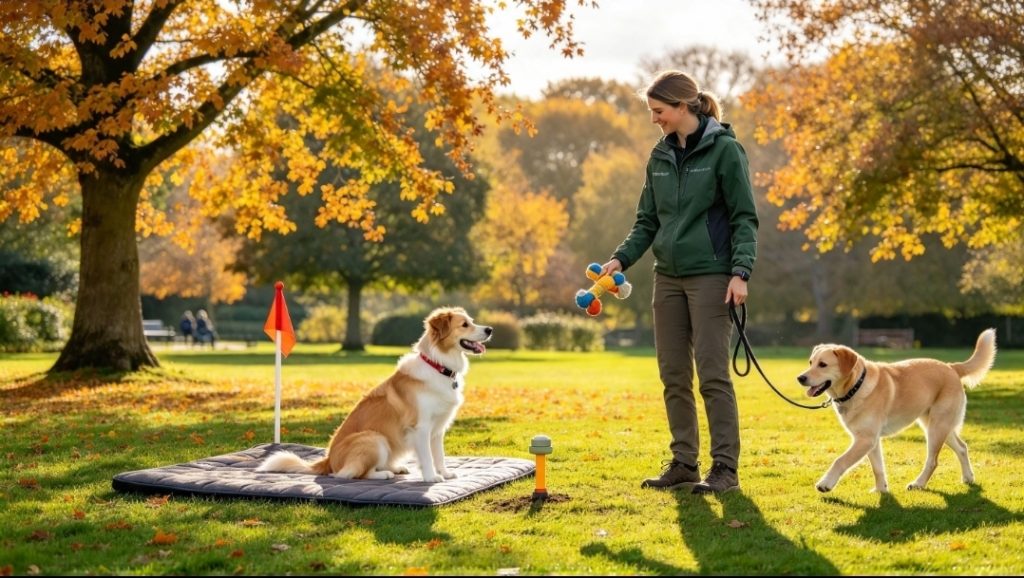
What Are the Five Golden Rules of Dog Training?
The Five Golden Rules of Dog Training provide a foundation for understanding your dog’s behaviour, developing clear communication and building consistent training habits. They cover five essential areas of everyday dog ownership: Home & Social, Obedience, Prey Drive, Toilet and Social Walking.
Each rule focuses on a different aspect of your dog’s life, from learning household boundaries to responding to commands, managing motivation, developing toilet habits and behaving appropriately during walks.
Together, these five areas help owners understand how everyday experiences influence behaviour and how consistent, appropriate training can support a better relationship between dog and handler.
You can explore the complete framework on the GPK9 Five Golden Rules overview page.
What Are the Five Golden Rules?
The five rules cover the following areas:
- Golden Rule One — Home & Social: Developing suitable household routines, boundaries and social behaviour.
- Golden Rule Two — Obedience: Building communication, responsiveness and reliable learned behaviours.
- Golden Rule Three — Prey Drive: Understanding motivation, natural instincts, play and engagement.
- Golden Rule Four — Toilet: Establishing appropriate toilet habits through routine, supervision and consistency.
- Golden Rule Five — Social Walking: Developing better walking behaviour, communication and responses to the outdoor environment.
Although each rule addresses a specific subject, the areas are connected. A dog’s home environment can influence its behaviour outside, motivation can affect training engagement, and consistent communication can support learning in many different situations.
Golden Rule One — Home & Social
How Does the Home Environment Affect Dog Behaviour?
Your dog’s learning begins in everyday life. Household routines, boundaries, interactions with family members and experiences with visitors all contribute to how your dog learns to behave.
Dogs benefit from clear and consistent expectations. When routines are predictable and the environment is managed appropriately, it becomes easier for them to understand what is expected.
Home and social training includes teaching your dog how to settle, interact appropriately with people, cope with normal household activity and become comfortable with suitable everyday experiences.
It is also important to recognise that dogs have individual needs. A puppy, a newly adopted rescue dog and a confident adult dog may require different approaches to learning and social experiences.
What Should You Focus On?
- Establish consistent household routines.
- Provide appropriate opportunities for rest and settling.
- Teach suitable behaviour around family members and visitors.
- Manage the environment to reduce confusion and prevent unwanted behaviour.
- Introduce social experiences at a pace your dog can manage.
- Observe how your dog responds to different people, situations and activities.
The objective is to create an environment in which your dog can learn, settle and participate appropriately in everyday family life.
To develop your understanding further, explore Golden Rule One — Home & Social.
Golden Rule Two — Obedience
Why Is Obedience Important?
Obedience training develops communication between you and your dog. It teaches your dog to recognise cues, understand expectations and practise appropriate responses.
However, obedience is about more than teaching a collection of commands. Your dog also needs opportunities to develop focus, learn consistently and apply those skills in different environments.
For example, your dog might respond reliably to a command at home but struggle when other dogs, unfamiliar people or exciting distractions are present. This can mean the behaviour needs more practice in gradually more challenging situations.
Clear cues, appropriate rewards and consistent training help your dog understand what you are asking. Progress should reflect the dog’s current ability rather than simply increasing the difficulty.
How Can You Improve Obedience?
- Use clear, consistent commands and cues.
- Reward the responses you want to encourage.
- Begin in manageable environments.
- Practise regularly in short, productive sessions.
- Gradually introduce distractions as your dog becomes more reliable.
- Pay attention to how your dog responds and adjust your approach when necessary.
Effective obedience training depends on understanding what your dog has learned, what it can manage and where further practice is needed.
The Golden Rule Two — Obedience course explores communication, commands, consistency and the development of appropriate responses.
Golden Rule Three — Prey Drive
How Does Prey Drive Influence Training?
Dogs have natural behavioural tendencies and individual motivations that can influence how they engage with training. Some are particularly interested in chasing moving objects, while others show a stronger preference for food, toys or interactive play.
Understanding these differences helps you identify suitable ways to motivate your dog and encourage engagement.
Prey drive relates to natural behaviours associated with orienting towards, chasing and pursuing. Its expression varies between dogs and situations, so it is important to observe your individual dog’s behaviour rather than make assumptions.
The aim is not simply to increase excitement. It is to understand your dog’s motivation and use appropriate activities to support purposeful learning.
How Can You Use Motivation Effectively?
Consider the following:
- Which rewards your dog finds valuable.
- How your dog responds to food, toys and play.
- Whether your dog can remain engaged with you during training.
- How excitement affects concentration and responsiveness.
- Which activities encourage useful, appropriate behaviour.
For instance, a toy may be highly motivating for one dog but relatively uninteresting to another. Food might work well in a quiet environment but become less effective when distractions increase.
By observing your dog’s response, you can make better decisions about the rewards and activities you use.
Explore Golden Rule Three — Prey Drive to learn more about motivation, play, engagement and the purposeful use of natural interests during training.
Golden Rule Four — Toilet
How Do You Establish Reliable Toilet Habits?
Toilet training teaches your dog where and when it is appropriate to toilet. Developing reliable habits requires suitable opportunities, supervision, consistent routines and timely rewards.
Puppies often need frequent toilet breaks, particularly after waking, eating, drinking and playing. Adult dogs may also need help establishing new habits when moving home or adapting to a different routine.
Learning to recognise your dog’s individual signals can help you provide a toilet opportunity before an accident occurs.
If accidents continue, consider whether your dog is being taken outside frequently enough, whether supervision is adequate and whether the routine suits its age and needs.
What Helps Toilet Training?
- Establish a consistent daily routine.
- Provide regular opportunities to toilet.
- Supervise your dog while it is still learning.
- Learn to recognise signs that your dog needs to go outside.
- Reward appropriate toileting promptly.
- Clean accidents thoroughly and avoid punishment.
Punishing a dog after an accident does not teach it where to toilet and may create confusion. If a previously reliable dog begins having unexplained accidents, consider whether stress, changes in routine or a medical issue could be contributing. Veterinary advice is appropriate when a change is sudden or persistent.
The aim is to make the expected behaviour clear while giving your dog regular opportunities to succeed.
For more guidance, visit Golden Rule Four — Toilet.
Golden Rule Five — Social Walking
How Can You Develop Better Walking Behaviour?
Walking introduces your dog to a constantly changing environment. People, other dogs, traffic, unfamiliar sounds, scents and movement can all influence attention and behaviour.
A dog that walks comfortably in a quiet location may find a busy street or an encounter with another dog more difficult. Developing better walking behaviour means understanding these differences and helping your dog learn to respond appropriately.
Good social walking combines suitable handling, communication, environmental awareness and an understanding of what your dog can manage.
The goal is not simply to complete a walk without pulling. It is to develop a more manageable walking experience while helping your dog respond appropriately to its surroundings.
What Should You Consider During Walks?
- Use suitable walking equipment and handle it correctly.
- Practise in environments appropriate to your dog’s current ability.
- Develop attention and responsiveness gradually.
- Allow suitable opportunities to explore and investigate.
- Observe changes in body language, movement and behaviour.
- Adjust the distance from distractions when necessary.
- Avoid forcing your dog into interactions it finds uncomfortable.
Dogs respond differently to outdoor situations. Some become excited, while others may feel uncertain or fearful. Recognising these responses helps you make better decisions about distance, difficulty and the support your dog needs.
Where serious reactivity or aggression is present, prioritise safety and seek appropriate professional guidance.
The Golden Rule Five — Social Walking course focuses on walking, handling, communication and appropriate behaviour in outdoor environments.
How Do the Five Golden Rules Work Together?
The Five Golden Rules are connected because your dog’s behaviour does not exist in isolation. What happens at home can influence behaviour outdoors, while motivation, communication and everyday experiences can affect learning across several areas.
For example, consistent household routines can support general learning. Understanding your dog’s motivation can help you choose appropriate rewards during obedience training. Recognising when your dog feels uncomfortable can help you make better decisions during social interactions and walks.
The five areas complement one another in several ways:
- Home & Social and Obedience: Clear household expectations support the development of everyday behaviours.
- Obedience and Prey Drive: Understanding motivation helps you select suitable rewards and encourage engagement.
- Toilet and Home & Social: Consistent routines and appropriate supervision help establish reliable toilet habits.
- Obedience and Social Walking: Practising communication and learned responses can make outdoor situations more manageable.
- Prey Drive and Social Walking: Understanding what attracts your dog’s attention can help you plan suitable activities and manage distractions.
These connections do not mean that every dog needs the same training programme. The right starting point depends on the individual dog, its existing skills and the challenges you want to address.
How Does FUSS With Purpose Complement the Five Golden Rules?
The Five Golden Rules introduce the main areas of everyday training. Understanding how your dog experiences everyday interactions adds another important dimension.
FUSS With Purpose — Understanding Your Dog Through Affection, Emotion and Everyday Interaction focuses on how dogs respond to affection, touch, petting, cuddling, play, food, praise and other common interactions.
An action intended to be friendly or rewarding is not necessarily experienced that way by every dog. A dog may enjoy being stroked at one moment but move away when tired or uncomfortable. Observing that response helps you decide whether to continue, change the interaction or give the dog space.
This understanding can support all five areas of training:
- Home & Social: Recognise how your dog responds to handling, attention and interactions with people.
- Obedience: Observe how your dog responds to cues, guidance and rewards.
- Prey Drive: Identify which toys, games and activities your dog genuinely enjoys.
- Toilet: Pay attention to your dog’s behaviour and recognise its needs.
- Social Walking: Consider how your dog responds to handling, movement and encounters with the environment.
FUSS With Purpose complements the Five Golden Rules by encouraging you to consider your dog’s experience, rather than relying solely on what you intended to communicate.
Where Should You Start?
If you are new to dog training, begin by considering your dog’s everyday routine and identifying the areas where you need the most support.
You can explore the GPK9 Five Golden Rules overview to understand the complete framework before moving on to the individual courses.
Choose the area most relevant to your current needs. You might begin with Home & Social if you need clearer household routines, Obedience if you want to improve communication, or Toilet if you are establishing reliable habits.
If your main aim is to understand how your dog responds to affection, touch, play and everyday interactions, explore FUSS With Purpose.
You can also visit GPK9 Dog Training Guidance & Online Support to explore the available training guidance and identify a suitable next step.
Conclusion
The Five Golden Rules of Dog Training cover five essential areas of everyday life with your dog: Home & Social, Obedience, Prey Drive, Toilet and Social Walking.
Each area helps you develop a clearer understanding of behaviour, motivation, communication and learning. Together, they provide a practical foundation for making informed training decisions and establishing more consistent habits.
Every dog is an individual. By recognising your dog’s needs, observing its responses and applying appropriate training consistently, you can build a stronger foundation for everyday life.
Start with the GPK9 Five Golden Rules and explore the individual courses to develop your understanding of each area. To learn more about your dog’s responses to everyday interactions, discover FUSS With Purpose.




