How to Prepare Your Dog When Arriving at a Walking Area
Preparing your dog when arriving at a walking area helps create a calmer transition from travelling to walking. Rather than immediately opening the vehicle and heading towards the path, take a moment to assess your dog, check the surroundings and decide whether the environment is suitable for the walk you have planned.
Some dogs become excited as soon as the vehicle stops. They may recognise the location, anticipate seeing other dogs or want to investigate the smells around them. Others may become worried by unfamiliar people, traffic, noise or activity.
The aim is to help your dog leave the vehicle safely, remain manageable and begin the walk at a level of excitement they can cope with.
RECOMMENDED PRODUCTS

Why Can Arriving at a Walking Area Be Difficult?
The arrival is a transition between two different environments. Inside the vehicle, your dog has limited space and fewer opportunities to investigate the surroundings. Outside, there may be numerous sights, smells, sounds and distractions competing for attention.
Common challenges include:
- Rushing towards the vehicle door when it opens.
- Pulling immediately towards the walking route.
- Becoming excited when other dogs arrive.
- Fixating on people, cyclists or wildlife.
- Sniffing and exploring before the handler is ready.
- Barking, whining or lunging when something catches the dog’s attention.
- Struggling to respond to familiar cues in a stimulating environment.
These behaviours do not all have the same cause. A dog may be excited, curious, frustrated, uncertain or uncomfortable. Understanding the individual dog’s response helps you decide how to manage the arrival.
1. Assess the Environment Before Opening the Vehicle
Before allowing your dog out, look around the parking area and the route you intend to take.
Check for approaching dogs, pedestrians, children, cyclists, moving vehicles and other potential distractions. Consider whether there is enough space to open the door and attach or manage the lead without placing your dog or anyone else at risk.
If another dog is passing close to your vehicle, wait until there is sufficient space or choose a safer exit where possible.
You should also consider the environment itself. A quiet countryside path may be suitable for one dog but difficult for another if livestock, wildlife or unfamiliar sounds are present.
Do not assume the walking area is suitable simply because you have arrived. The conditions and your dog’s behaviour should guide your decision.
2. Prepare Your Dog Before Leaving the Vehicle
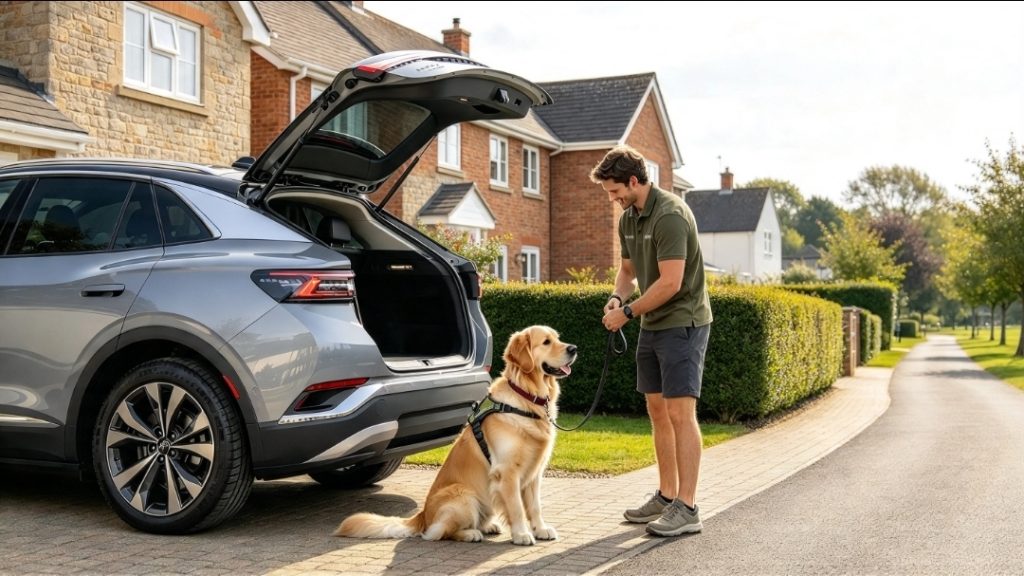
Make sure your dog is wearing appropriate, correctly fitted walking equipment and that you can safely manage them before opening the door.
If your dog travels in a crate or secured travel area, follow the appropriate procedure for releasing them safely. Keep the vehicle stationary and ensure the dog cannot move into traffic or an unsafe space.
Avoid allowing your dog to jump out and rush towards the nearest path. If the dog is already pushing towards the exit, take a moment to manage the situation before proceeding.
You do not need to demand a long formal obedience routine. The immediate priority is a safe exit and a manageable transition.
If your dog is too excited to leave safely, or you cannot maintain control, reconsider the exit, create more space or wait until the situation is easier to manage.
3. Manage the First Few Moments Outside
The first few moments can influence how the walk develops.
Once your dog is safely outside, observe their posture, movement, attention and response to the surroundings. Can they move with you? Can they notice a distraction and then look away? Are they pulling continuously, or are they able to explore without dragging you?
Reward-based training can help reinforce behaviour you want to see. For example, reward your dog for remaining near you with a loose lead, responding to a familiar cue or calmly moving away from a distraction.
Keep your communication clear and avoid repeating commands unnecessarily.
If your dog is struggling, do not rush towards the walking route in the hope that they will settle once you get moving. Pause where it is safe, increase distance from distractions or move to a quieter area.
The purpose is not to make your dog perfectly still. It is to establish a safe and manageable starting point.
4. Prevent Pulling From Becoming the Start of Every Walk
Some dogs learn to associate the arrival of the vehicle at a familiar location with immediate access to the environment.
They see the destination, become excited and pull as soon as they leave the vehicle. If pulling repeatedly gets them closer to the path, another dog or an interesting smell, the behaviour may become established.
Teach your dog that moving forward happens on a manageable lead rather than through continuous pulling.
When the lead becomes tight, avoid dragging or repeatedly pulling your dog backwards. Where it is safe and practical, pause or change direction. Resume movement when you can manage the lead safely and your dog is able to move with you.
Reward the behaviour you want to encourage. You can also use appropriate opportunities to sniff as a reward for calm movement.
For more guidance, read Why Does My Dog Pull on the Lead?.
Consistency matters, but so does the environment. If your dog is already overwhelmed, a quieter location or greater distance from distractions may be more useful than repeatedly practising in a difficult setting.
5. Manage Excitement Around Other Dogs
Other dogs can make arrivals particularly challenging. Your dog may want to greet them, play with them or investigate them. Alternatively, your dog may feel worried or frustrated by their presence.
Do not assume that pulling towards another dog means your dog is being friendly.
Look at the whole response. Consider whether your dog appears relaxed or tense, whether they can disengage and whether their behaviour changes as the other dog gets closer.
If your dog becomes increasingly excited or uncomfortable, create distance where possible. Avoid forcing a greeting or allowing your dog to rush towards another dog on a tight lead.
Reward calm observation and movement with you when your dog can manage these behaviours. Gradually work around distractions at distances your dog can cope with.
If your dog barks, lunges or becomes difficult to control, prioritise safety and move away rather than trying to force the interaction. Repeated or severe reactivity may require help from a suitably qualified professional.
6. Decide Whether Your Dog Needs a Toilet Break
Some dogs need to toilet after travelling, while others may need time to settle before they can do so.
Consider your dog’s normal routine and the immediate circumstances. If a toilet break is needed, choose an appropriate place away from traffic, entrances and other dogs where possible.
Allow your dog to toilet without turning the moment into a rushed start to the walk. Reward appropriate toileting in a way that suits your dog’s training.
Once the immediate need has been met, reassess the dog and the environment before continuing.
Keeping the purpose of each activity clear can help prevent the arrival from becoming a confusing mix of toileting, greeting other dogs, pulling towards the path and starting the walk.
7. Adapt Your Approach to the Walking Area
Different environments create different challenges. The arrival routine should reflect what is actually happening rather than follow the same sequence regardless of circumstances.
Parks
Parks may have dogs, children, ball games, runners and busy entrances. If the main entrance is crowded, consider a quieter route where access is permitted.
Woodland
Woodland paths can contain wildlife, strong smells, narrow routes and limited space to pass other walkers. Keep your dog at a manageable distance from distractions and consider visibility before moving into a narrow section.
Open Countryside
Open countryside can contain livestock, horses, cyclists, wildlife and other dogs. Follow local access rules and keep your dog under appropriate control, particularly around livestock.
Beaches
Beaches may introduce unfamiliar surfaces, water, wildlife, crowds and large open spaces. Check local restrictions and consider whether your dog can safely manage the conditions before moving away from the vehicle.
A quieter time or location may provide a more suitable starting point for a dog that struggles with busy environments.
8. Avoid Common Arrival Mistakes
Starting the Walk Too Quickly
Opening the vehicle and immediately heading into a busy area can increase pressure on an already excited dog. Take time to assess the situation first.
Repeating Commands Without Changing the Situation
If your dog cannot respond, repeating the same instruction may not help. Reduce the difficulty, create space or choose a quieter route.
Allowing Immediate Access Through Pulling
If pulling repeatedly takes your dog towards whatever they want, the behaviour may become more persistent. Reinforce manageable lead behaviour instead.
Assuming Excitement Means Happiness
A dog that is rushing, whining or pulling may be excited, frustrated or uncomfortable. Consider the whole body and the surrounding circumstances rather than judging by movement alone.
Continuing When the Situation Is Unsafe
You do not have to complete the planned walk if your dog cannot be managed safely. Move away from the difficulty where possible and choose a more appropriate option.
9. A Simple Arrival Routine
Use the following sequence as a practical guide. Adapt it to your dog’s needs and the conditions at the location.
Step 1 — Check the surroundings. Look for approaching dogs, people, vehicles and other potential hazards.
Step 2 — Prepare the equipment. Make sure your dog is safely secured and wearing suitable, correctly fitted walking equipment.
Step 3 — Leave the vehicle safely. Prevent rushing into traffic, crowded spaces or close contact with other dogs.
Step 4 — Observe your dog. Assess their movement, posture, attention and ability to respond.
Step 5 — Manage the immediate need. Allow a toilet break if required and appropriate.
Step 6 — Begin at a manageable pace. Move towards the walking route only when you can manage your dog safely.
Step 7 — Respond to changes. If your dog becomes increasingly excited or uncomfortable, create space or adjust your route.
Step 8 — Reassess as you go. Continue monitoring your dog and the environment instead of assuming the initial conditions will remain the same.
The routine should support a calm transition, not become a rigid test that your dog must pass before every walk.
RECOMMENDED PRODUCTS
When Should You Seek Professional Help?
If your dog repeatedly rushes dangerously from the vehicle, reacts intensely to people or dogs, attempts to escape or becomes impossible to manage safely, avoid repeatedly exposing them to the same difficult situation without a plan.
Choose safer, quieter locations where possible and seek guidance from a suitably qualified dog training or behaviour professional. If there is a risk of biting or a history of aggression, professional assessment is particularly important.
The goal is to understand why the behaviour occurs and develop a suitable approach, rather than simply trying to suppress the visible response.
Final Thoughts
Preparing your dog when arriving at a walking area is about more than opening the vehicle door and attaching a lead. It is an opportunity to assess the environment, understand your dog’s response and establish a safe transition into the walk.
Check the surroundings, prepare the equipment, manage the exit and observe how your dog responds once outside. Reinforce calm, manageable behaviour and adjust the situation when distractions become too difficult.
A successful arrival does not require your dog to ignore everything or remain perfectly still. It means you can manage the transition safely and make sensible decisions based on your dog’s behaviour and the environment.
With consistent, reward-based training and appropriate choices about where and when you walk, you can help your dog develop a more reliable routine from the moment you arrive.