
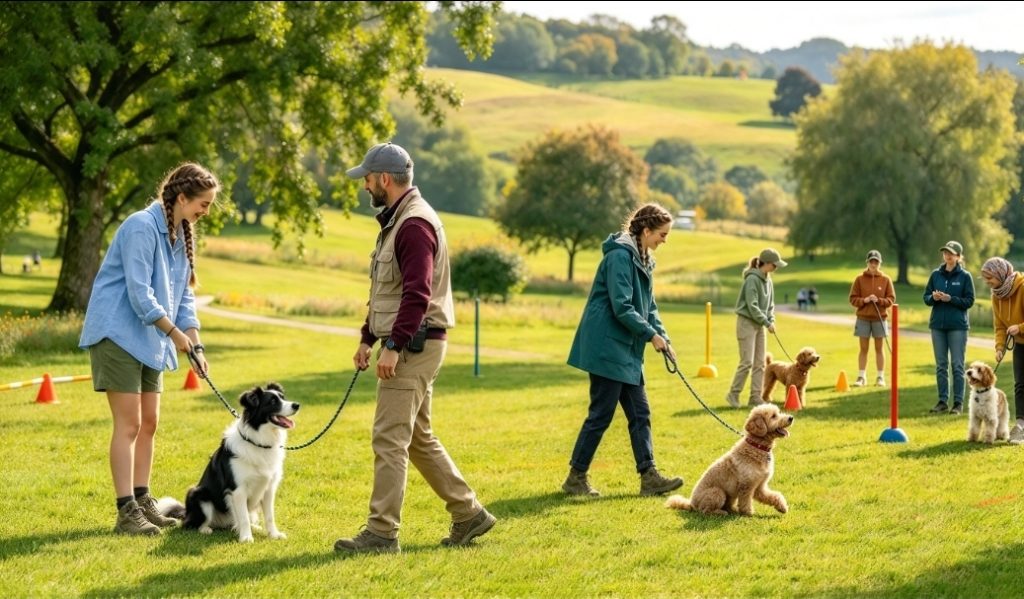
How Long Does Professional Dog Training Take?
How long does professional dog training take? There is no fixed amount of time because professional dog training depends on what you are teaching, your dog’s age and experience, the difficulty of the behaviour and how consistently you practise between sessions. Basic obedience may improve within a few weeks, while more complex behaviour can require months of structured training and ongoing reinforcement.
RECOMMENDED PRODUCTS

How Long Does Basic Professional Dog Training Take?
Basic professional dog training can often be started and progressed through a 4–8 week course, provided the owner continues practising between professional sessions.
Basic training may include:
- Responding to a name
- Sit and down
- Wait and stay
- Recall
- Lead walking
- Leave it
- Settling
- Basic household manners
Professional sessions provide guidance, but your dog does not learn everything during the time spent with the trainer.
The practice you carry out between sessions is a major part of the training process.
How Long Does It Take to Train a Puppy Professionally?
Puppy training starts as soon as the puppy comes home and continues throughout development.
A puppy may learn individual behaviours quite quickly, but developing reliable behaviour in different situations takes longer.
Puppies also need training that goes beyond commands. They need to learn how to respond to people, handle everyday experiences, settle, walk appropriately and cope with increasing distractions.
The RSPCA recommends short, regular training sessions and notes that dogs learn at different rates.
Puppy training is therefore not something that is completed after a single course. It is an ongoing process that changes as the puppy develops.
How Long Does One Professional Dog Training Session Last?
A professional dog training session may last around 30–60 minutes, depending on the trainer and the type of training being provided.
A session does not need to consist of continuous training for the entire period.
The trainer may spend time assessing your dog, explaining what you need to do, demonstrating an exercise and helping you practise it correctly.
Short practice periods are often more useful than repeatedly drilling the same behaviour.
The RSPCA recommends breaking training into short, regular sessions so dogs do not become overwhelmed.
How Long Does It Take to Train an Adult Dog?
An adult dog can learn new behaviours at any age.
The time required depends more on the behaviour being taught and the dog’s previous learning than simply its age.
A dog with little previous training may need to build basic skills first.
A dog that already understands the basics may progress more quickly but still needs practice to make those behaviours reliable around distractions.
How Long Does It Take to Retrain a Dog?
Retraining can take longer when you are changing an established behaviour.
Your dog may already have learned that a particular behaviour produces a useful result, so simply teaching another command may not be enough.
The training may need to:
- Identify what is causing the behaviour.
- Prevent the unwanted behaviour from being repeatedly rehearsed.
- Teach an appropriate alternative.
- Reward the new behaviour.
- Gradually introduce more difficult situations.
- Continue reinforcing the behaviour until it becomes reliable.
The amount of time required depends on how established the behaviour is and how consistently the new training is applied.
RECOMMENDED PRODUCTS
How Long Does Professional Recall Training Take?
A dog can learn the basic idea of recall relatively quickly, but reliable recall takes much longer to develop.
Training should progress from easy environments to increasingly difficult situations.
For example, you might begin indoors before progressing to the garden, quiet outdoor areas and eventually environments containing more distractions.
The RSPCA recommends gradually increasing recall distance and using rewards such as food or toys, with long training leads potentially useful when progressing outside.
Do not assume that a dog has reliable recall simply because it responds correctly several times in an easy environment.
How Long Does Professional Lead Training Take?
Lead training can improve within several sessions, but reliable loose-lead walking requires continued practice.
Start in an environment where your dog can concentrate.
Reward the behaviour you want, such as staying close, maintaining a loose lead and responding to you.
Gradually introduce distractions as your dog becomes more reliable.
If your dog struggles, make the exercise easier rather than repeatedly allowing it to practise the behaviour you are trying to change.
How Long Does Professional Behaviour Training Take?
Behaviour problems generally take longer to address than basic obedience.
A dog displaying fear, reactivity, aggression, severe barking or separation-related behaviour may require a detailed assessment and an individual training or behaviour plan.
The timescale can depend on:
- How long the behaviour has existed
- How frequently it occurs
- What triggers it
- How intense the response is
- How quickly the dog can recover
- Whether the behaviour occurs in multiple environments
- How consistently the owner can follow the plan
There should not be a promise that a serious behaviour problem will be fixed within a specific number of sessions.
The RSPCA advises seeking appropriately qualified behaviour professionals for serious behavioural issues and recommends reward-based training methods.
How Long Does It Take to Train a Reactive Dog?
Reactive dog training can take months rather than just a few sessions, particularly when the dog reacts strongly to triggers.
The objective is not simply to make the dog stop barking or lunging during a training session.
The dog needs to learn to cope with the trigger, remain within a manageable level of arousal, respond appropriately and recover when the situation becomes difficult.
Progress should therefore be measured by changes in the dog’s behaviour rather than the number of professional sessions completed.
If there is a significant safety concern or history of aggression, appropriate professional assessment should be obtained.
How Long Does It Take to Train an Aggressive Dog?
Aggression requires careful assessment because the underlying cause can vary.
Professional training or behaviour support may involve management, changing the dog’s response to specific situations and teaching alternative behaviours.
There is no safe universal timeframe for resolving aggression.
A qualified professional should assess the individual dog and determine what level of support is appropriate. The RSPCA recommends consulting an appropriate behaviour expert when serious behavioural problems are present.
How Long Does It Take to Train a Rescue Dog?
A rescue dog may need several weeks or months to develop reliable behaviour in its new home.
The dog may already have learned behaviours from previous experiences, and you may not initially know its full history.
Start with manageable expectations and establish predictable routines.
Teach basic behaviours, reward appropriate responses and gradually introduce more difficult situations.
Do not judge progress solely by how quickly the dog learns commands.
A rescue dog’s ability to feel comfortable, settle and respond appropriately in its new environment is also an important part of progress.
Does Professional Dog Training Work Immediately?
Professional training can give you useful results from the first session, but that does not mean the training is complete.
A trainer may identify the problem, demonstrate the correct technique and help you understand what to practise.
Your dog then needs repetition to develop the behaviour.
The RSPCA advises that dogs learn at different rates and recommends patience, consistency and short, regular training sessions.
How Often Should I Practise Between Professional Sessions?
Follow the training plan provided by your trainer and keep practice short enough that your dog remains engaged.
You can also incorporate training into everyday activities rather than treating every exercise as a formal lesson.
For example, you can practise waiting before opening a door, responding to their name during a walk or settling while you carry out normal household activities.
Consistency matters more than simply completing a large number of professional sessions.
How Do I Know If Professional Dog Training Is Working?
Look for gradual improvements such as:
- Your dog responds more reliably.
- Your dog can concentrate for longer.
- Your dog copes better with distractions.
- Your dog recovers more quickly after becoming excited or worried.
- Your dog performs behaviours in more locations.
- You need fewer prompts.
- You can gradually increase distance, duration or distractions.
A behaviour does not need to be perfect before you can consider the training successful.
Reliable progress means your dog is becoming more capable in increasingly difficult situations.
What If My Dog Is Not Improving With Professional Training?
If your dog is not progressing, do not simply continue repeating the same exercises.
Discuss the problem with your trainer.
The difficulty may be too high, the training may be progressing too quickly, the reward may not be sufficiently motivating or the behaviour may require a different approach.
For significant behavioural problems, an appropriate behaviour professional may need to assess the dog.
If your dog’s behaviour changes suddenly or you are concerned that pain or illness could be contributing, speak to your vet.
RECOMMENDED PRODUCTS
Can Professional Dog Training Ever Be Finished?
Basic professional training can eventually reduce or stop when you have learned how to train your dog effectively.
However, training itself is ongoing.
Dogs continue learning throughout their lives, and previously learned behaviours benefit from occasional reinforcement and practice. The Welsh Government’s dog welfare guidance also recognises that dogs continue to learn throughout their lives.
The goal is not to keep paying for professional sessions indefinitely.
The goal is to give you the knowledge and practical skills to continue training your dog successfully.
Conclusion
Professional dog training can take a few weeks for basic skills and considerably longer for complex behaviour.
A puppy learning basic commands may make noticeable progress during a short course, while recall, lead walking and reliable behaviour around distractions require continued practice. Reactivity, aggression, fear and other serious behavioural problems can require longer-term professional support.
The number of professional sessions is less important than the quality of the training, the consistency of your practice and your dog’s ability to perform the behaviour reliably in real-life situations.
GPK9 — The Five Golden Rules
The GPK9 Five Golden Rules provide the foundation of the GPK9 Professional Training System. They give new dog owners, new dog handlers, experienced handlers and professional dog trainers a clear structure for developing the dog and the handler together.
The GPK9 Five Golden Rules cover five essential areas of development: Home & Social, Obedience, Prey Drive, Toilet and Social Walking. Each area has its own purpose, but they are designed to work together as one complete training system.
The GPK9 approach is based on CATEGORY → STATUS → DRIVE → CONTROL and the handler’s ability to OBSERVE → INTERPRET → DECIDE → COMMUNICATE → OBSERVE RESPONSE → REASSESS. This gives the handler a consistent process for understanding what the dog is doing, why the behaviour is occurring, what level of control is appropriate and how to communicate effectively.
The purpose of the GPK9 Five Golden Rules is not simply to teach a collection of individual exercises. They are designed to develop the dog’s behaviour, motivation, communication, control and reliability while teaching the handler how to make better decisions.
Golden Rule One — Home & Social
Golden Rule One — Home & Social establishes the foundation for everyday life with the dog. It focuses on communication, boundaries, calm behaviour, household routines and appropriate behaviour around people, animals and normal activity.
The purpose of Golden Rule One — Home & Social is to help the handler understand the dog’s behaviour and recognise changes in arousal before they become larger problems. The handler learns to observe, assess and communicate rather than simply reacting after unwanted behaviour has already occurred.
Golden Rule One — Home & Social provides the foundation from which the handler can develop a calmer, more predictable and better-communicating dog.
Golden Rule Two — Obedience
Golden Rule Two — Obedience develops the dog’s ability to understand and respond to the handler’s communication.
The focus of Golden Rule Two — Obedience is not simply teaching commands. It is about developing understanding, reliability, timing, reward, release and control so the dog learns what the handler is communicating.
Through Golden Rule Two — Obedience, the handler learns to progress training appropriately, gradually increasing the dog’s freedom and responsibility as understanding and reliability improve.
Golden Rule Three — Prey Drive
Golden Rule Three — Prey Drive focuses on understanding and developing the dog’s natural motivation to chase, pursue, engage and work with an appropriate toy or prey-based reward.
The purpose of Golden Rule Three — Prey Drive is not simply to increase drive. The handler must learn how to recognise the dog’s level of motivation, select an appropriate reward and use timing, communication and control to channel that motivation productively.
Golden Rule Three — Prey Drive teaches the handler that motivation can become a powerful training tool when it is developed and controlled correctly.
Golden Rule Four — Toilet
Golden Rule Four — Toilet establishes reliable toilet habits through consistency, observation, timing, supervision and appropriate reinforcement.
The handler learns through Golden Rule Four — Toilet to recognise when the dog is likely to need the toilet, provide the correct opportunity and reinforce the desired behaviour.
The objective of Golden Rule Four — Toilet is to establish a predictable routine that helps the dog understand where and when toileting is appropriate while reducing opportunities for mistakes.
Golden Rule Five — Social Walking
Golden Rule Five — Social Walking develops the dog’s ability to walk calmly and appropriately in the real world while remaining connected to the handler.
The focus of Golden Rule Five — Social Walking is the relationship between the handler, the dog, the environment, distractions, distance and available control.
Through Golden Rule Five — Social Walking, the handler learns to observe body language, identify potential triggers, assess distance and recognise changes in drive or arousal before behaviour escalates.
The objective of Golden Rule Five — Social Walking is not simply to make the dog walk beside the handler. It is to develop a dog that can experience the outside world while remaining connected to the handler and capable of responding to clear communication.
How the Five Golden Rules Work Together
The GPK9 Five Golden Rules are designed to work together rather than being treated as five completely separate subjects.
Golden Rule One — Home & Social establishes the foundations for everyday behaviour and communication.
Golden Rule Two — Obedience develops understanding, responsiveness and control.
Golden Rule Three — Prey Drive develops motivation and teaches the handler how to channel natural drive appropriately.
Golden Rule Four — Toilet establishes essential household routine and reliability.
Golden Rule Five — Social Walking takes the communication and control developed through the other areas into the outside environment.
Together, the GPK9 Five Golden Rules help the handler develop a complete understanding of the dog rather than treating individual behaviours as isolated problems.
The overall objective of the GPK9 Five Golden Rules is to train the human, train the dog and build the partnership through clear observation, communication, appropriate control and progressive development.




