
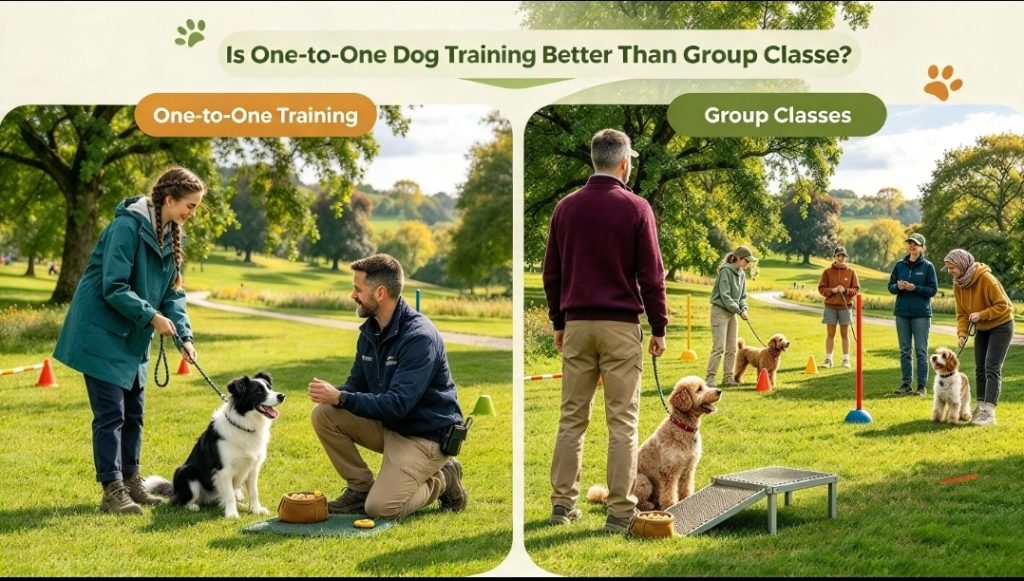
Is One-to-One Dog Training Better Than Group Classes?
Is one-to-one dog training better than group classes? Neither is automatically better for every dog. One-to-one training provides individual attention and can be better suited to specific training goals or behavioural difficulties, while group classes provide useful practice around other dogs, people and distractions. The right choice depends on your dog’s needs, temperament, current training and what you want to achieve.
RECOMMENDED PRODUCTS
What Is One-to-One Dog Training?
One-to-one dog training means you and your dog work directly with a professional trainer without other dogs and owners participating in the same session.
The trainer can focus specifically on your dog’s behaviour and adjust the training to suit its current ability.
Private training may take place at home, at a training venue or in an appropriate outdoor environment.
This can be particularly useful when you need help with a specific problem or want training adapted to your dog’s individual circumstances.
What Are the Benefits of One-to-One Dog Training?
The main advantage is individual attention.
The trainer can observe your dog closely, identify where you are struggling and adjust the exercise accordingly.
One-to-one training can also make it easier to work on:
- Specific training goals
- Household behaviour
- Lead walking
- Recall
- Settling
- Fearful behaviour
- Reactivity
- Other individual difficulties
Private sessions can also be useful when a dog is not currently comfortable working around other dogs.
Dogs Trust, for example, provides one-to-one training for dogs that are not ready for a group environment.
What Are the Benefits of Group Dog Training Classes?
Group classes provide something that private training cannot completely reproduce: training around other dogs and people.
Your dog has to learn to concentrate on you while other activity is happening nearby.
This can help develop skills such as:
- Attention
- Basic obedience
- Waiting
- Recall
- Lead walking
- Settling
- Responding to cues around distractions
The RSPCA recommends suitable dog training classes and notes that dogs can benefit from learning basic obedience and training around appropriate distractions.
Is One-to-One Training Better for a Puppy?
Not necessarily.
A well-run puppy class can provide useful training and controlled exposure to other dogs, people and a new environment.
Puppy classes can help owners establish basic training while learning how to communicate effectively with their puppy. The RSPCA describes suitable puppy classes as a useful way to build confidence and learn basic training.
One-to-one training can be more appropriate if the puppy needs individual attention, is struggling in a group environment or has a specific problem that needs addressing.
Is One-to-One Training Better for an Older Dog?
Older dogs can benefit from either type of training.
If your older dog simply needs to learn or improve basic obedience, a suitable group class may work well.
If you are retraining an established behaviour or need a programme specifically designed around your dog, one-to-one training may be more appropriate.
Age alone should not determine which type of training you choose.
Is One-to-One Training Better for a Reactive Dog?
One-to-one training is often more appropriate for a dog that reacts strongly to other dogs, people or particular situations.
A group class can place the dog close to the very triggers that cause the reaction, making it difficult for the dog to remain calm enough to learn.
A private session allows the trainer to control the environment and work at a distance the dog can manage.
If your dog shows serious aggression or presents a safety risk, appropriate professional behaviour assessment should be obtained rather than simply placing the dog into a standard group class. The RSPCA advises seeking appropriate behaviour expertise for serious behavioural problems.
Is One-to-One Training Better for Lead Pulling?
Either option can help.
One-to-one training allows the trainer to observe exactly why your dog is pulling and tailor the exercises to your circumstances.
A group class can then provide an opportunity to practise walking appropriately around other dogs and distractions.
The most important part is that you continue practising outside the professional session.
RECOMMENDED PRODUCTS
Is One-to-One Training Better for Recall?
One-to-one training can be useful for establishing the foundations of recall and identifying problems with your current technique.
However, reliable recall eventually needs to work around distractions.
Group training can provide some useful controlled distractions, while individual practice can allow you to increase distance and difficulty gradually.
Recall should ultimately be practised in appropriate real-life environments rather than only in a quiet training room. The RSPCA recommends gradually increasing recall distance and difficulty while continuing to reward successful responses.
Are Group Classes Cheaper Than One-to-One Training?
Usually, yes.
Group classes divide the trainer’s time between several owners, while a private session is dedicated to one dog and handler.
This means group classes are generally the more affordable option.
However, the cheapest option is not necessarily the best option. The important question is whether the type of training matches what your dog actually needs.
Can I Combine One-to-One Training and Group Classes?
Yes.
For some dogs, combining both can be an excellent approach.
You might use one-to-one training to establish specific skills or address individual difficulties and then use group classes to practise those skills around other dogs and people.
For example, a dog could first learn to focus on its owner during a private session before progressing into a suitable group environment.
This allows the difficulty to increase gradually rather than expecting the dog to cope with everything immediately.
What If My Dog Cannot Cope in a Group Class?
Do not assume that your dog simply needs to be forced to participate.
If your dog is frightened, highly distracted or reacting strongly, the class may currently be too difficult.
Speak to the trainer and consider individual training instead.
The RSPCA recommends looking for classes where dogs remain relaxed and interested and where the instructor can tailor training to individual dogs.
The aim is to create an environment in which your dog can actually learn.
What If My Dog Is Fine in One-to-One Training but Struggles in Groups?
This is common because the environment has changed.
Your dog may understand the behaviour but not yet be able to perform it around distractions.
Reduce the difficulty and gradually introduce distractions.
For example, progress from:
- Quiet home environment
- Quiet outdoor area
- Greater distance from distractions
- Controlled distractions
- Group environment
- More difficult real-life situations
A behaviour is not fully reliable simply because your dog can perform it in a quiet environment.
Which Is Better for Basic Obedience?
For basic obedience, either can work.
Group classes can provide a structured programme and useful distractions.
One-to-one training can provide more individual instruction and allow the trainer to adapt the exercises to your dog.
The better choice depends on your dog’s ability to work around other dogs and your own training requirements.
Which Is Better for Behaviour Problems?
One-to-one training is generally more suitable when the dog has a specific behavioural difficulty requiring individual assessment and management.
Examples may include:
- Reactivity
- Fear
- Severe anxiety
- Aggression
- Resource guarding
- Serious handling difficulties
- Problems occurring specifically in the home
A standard group obedience class is not designed to provide individual behaviour assessment for every dog.
For serious behavioural concerns, seek an appropriately qualified professional rather than relying solely on a general group class.
RECOMMENDED PRODUCTS
How Do I Choose Between One-to-One and Group Training?
Consider your dog’s current ability and the reason you want professional help.
Choose group training when:
- Your dog can remain reasonably calm around other dogs.
- You want basic obedience training.
- You want controlled distractions.
- You want to practise around other people and dogs.
- You prefer a group learning environment.
Consider one-to-one training when:
- Your dog struggles to cope around other dogs.
- You have a specific behavioural problem.
- You need training tailored to your home or routine.
- You need more individual attention.
- Your dog is not ready for a group environment.
What Training Method Should a Dog Trainer Use?
Whichever format you choose, look for reward-based training that prioritises your dog’s welfare.
The RSPCA recommends reward-based training using things such as food, play or toys and advises against methods relying on fear, pain or intimidation.
Your trainer should also teach you how to continue the training yourself.
The objective is not simply for the trainer to make your dog perform a behaviour during the session.
You should understand what to do, when to reward, how to progress and how to respond when your dog struggles.
Conclusion
One-to-one dog training is not automatically better than group classes.
One-to-one training is usually better when your dog needs individual attention or has a specific behavioural difficulty, while group classes can be excellent for basic training and learning around appropriate distractions.
For some dogs, the best approach is to use both: establish skills through individual training and then gradually practise those skills around other dogs, people and real-life distractions.
Choose the training environment in which your dog can learn successfully, remain comfortable and make steady progress.
GPK9 — The Five Golden Rules
The GPK9 Five Golden Rules provide the foundation of the GPK9 Professional Training System. They give new dog owners, new dog handlers, experienced handlers and professional dog trainers a clear structure for developing the dog and the handler together.
The GPK9 Five Golden Rules cover five essential areas of development: Home & Social, Obedience, Prey Drive, Toilet and Social Walking. Each area has its own purpose, but they are designed to work together as one complete training system.
The GPK9 approach is based on CATEGORY → STATUS → DRIVE → CONTROL and the handler’s ability to OBSERVE → INTERPRET → DECIDE → COMMUNICATE → OBSERVE RESPONSE → REASSESS. This gives the handler a consistent process for understanding what the dog is doing, why the behaviour is occurring, what level of control is appropriate and how to communicate effectively.
The purpose of the GPK9 Five Golden Rules is not simply to teach a collection of individual exercises. They are designed to develop the dog’s behaviour, motivation, communication, control and reliability while teaching the handler how to make better decisions.
Golden Rule One — Home & Social
Golden Rule One — Home & Social establishes the foundation for everyday life with the dog. It focuses on communication, boundaries, calm behaviour, household routines and appropriate behaviour around people, animals and normal activity.
The purpose of Golden Rule One — Home & Social is to help the handler understand the dog’s behaviour and recognise changes in arousal before they become larger problems. The handler learns to observe, assess and communicate rather than simply reacting after unwanted behaviour has already occurred.
Golden Rule One — Home & Social provides the foundation from which the handler can develop a calmer, more predictable and better-communicating dog.
Golden Rule Two — Obedience
Golden Rule Two — Obedience develops the dog’s ability to understand and respond to the handler’s communication.
The focus of Golden Rule Two — Obedience is not simply teaching commands. It is about developing understanding, reliability, timing, reward, release and control so the dog learns what the handler is communicating.
Through Golden Rule Two — Obedience, the handler learns to progress training appropriately, gradually increasing the dog’s freedom and responsibility as understanding and reliability improve.
Golden Rule Three — Prey Drive
Golden Rule Three — Prey Drive focuses on understanding and developing the dog’s natural motivation to chase, pursue, engage and work with an appropriate toy or prey-based reward.
The purpose of Golden Rule Three — Prey Drive is not simply to increase drive. The handler must learn how to recognise the dog’s level of motivation, select an appropriate reward and use timing, communication and control to channel that motivation productively.
Golden Rule Three — Prey Drive teaches the handler that motivation can become a powerful training tool when it is developed and controlled correctly.
Golden Rule Four — Toilet
Golden Rule Four — Toilet establishes reliable toilet habits through consistency, observation, timing, supervision and appropriate reinforcement.
The handler learns through Golden Rule Four — Toilet to recognise when the dog is likely to need the toilet, provide the correct opportunity and reinforce the desired behaviour.
The objective of Golden Rule Four — Toilet is to establish a predictable routine that helps the dog understand where and when toileting is appropriate while reducing opportunities for mistakes.
Golden Rule Five — Social Walking
Golden Rule Five — Social Walking develops the dog’s ability to walk calmly and appropriately in the real world while remaining connected to the handler.
The focus of Golden Rule Five — Social Walking is the relationship between the handler, the dog, the environment, distractions, distance and available control.
Through Golden Rule Five — Social Walking, the handler learns to observe body language, identify potential triggers, assess distance and recognise changes in drive or arousal before behaviour escalates.
The objective of Golden Rule Five — Social Walking is not simply to make the dog walk beside the handler. It is to develop a dog that can experience the outside world while remaining connected to the handler and capable of responding to clear communication.
How the Five Golden Rules Work Together
The GPK9 Five Golden Rules are designed to work together rather than being treated as five completely separate subjects.
Golden Rule One — Home & Social establishes the foundations for everyday behaviour and communication.
Golden Rule Two — Obedience develops understanding, responsiveness and control.
Golden Rule Three — Prey Drive develops motivation and teaches the handler how to channel natural drive appropriately.
Golden Rule Four — Toilet establishes essential household routine and reliability.
Golden Rule Five — Social Walking takes the communication and control developed through the other areas into the outside environment.
Together, the GPK9 Five Golden Rules help the handler develop a complete understanding of the dog rather than treating individual behaviours as isolated problems.
The overall objective of the GPK9 Five Golden Rules is to train the human, train the dog and build the partnership through clear observation, communication, appropriate control and progressive development.




