How Do I Help My Dog Cope With Distractions?
How do I help my dog cope with distractions? The best approach is to start at a level your dog can manage, reward calm attention, and gradually increase the difficulty. Instead of expecting your dog to ignore everything immediately, teach it to notice distractions without automatically reacting and then return its attention to you.
Why does my dog struggle with distractions?
Dogs naturally notice movement, sounds, smells, people, animals and objects in their environment. A distraction becomes difficult when it is more interesting, exciting, worrying or rewarding than responding to the handler.
Your dog may know a command perfectly at home but struggle outside because the environment is providing much stronger competing information.
The solution is not simply to repeat the command louder or more often. You need to teach the behaviour around distractions gradually.
What counts as a distraction for a dog?
Distractions vary between individual dogs and situations.
Common examples include:
- Other dogs
- People
- Children
- Wildlife
- Cars and bicycles
- Loud noises
- Moving objects
- Food
- Toys
- New environments
- Strong smells
- Other animals
- Exciting activities
Something that is easy for one dog may be extremely difficult for another. Training should therefore be based on your dog’s actual ability to remain responsive.
How do I teach my dog to cope with distractions?
Start with a distraction that your dog can notice without becoming overwhelmed.
1. Choose an appropriate environment
Begin somewhere your dog can concentrate.
A quiet room, garden or relatively calm outdoor area is usually easier than a crowded park.
The first objective is not to test your dog’s obedience. It is to create an environment where your dog can successfully notice a distraction and remain capable of responding.
2. Introduce one distraction
Allow your dog to notice the distraction.
Do not immediately demand that your dog completely ignore it.
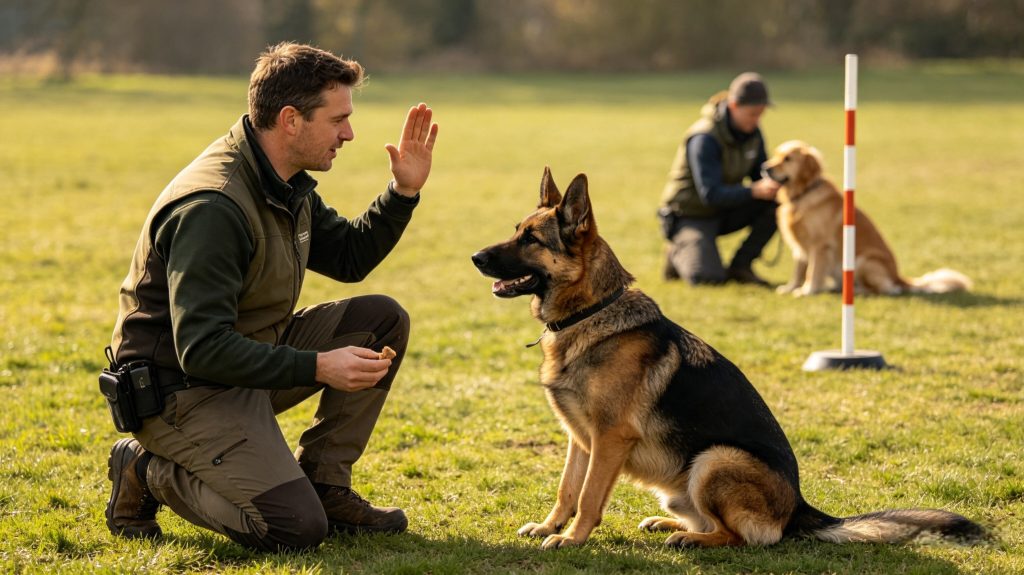
If your dog looks at another dog, person or moving object and then remains calm or looks back towards you, mark that behaviour and reward it.
This teaches your dog that noticing something does not automatically mean reacting to it.
3. Reward attention and calm behaviour
Reward the responses you want your dog to repeat.
This could include:
- Looking towards you
- Turning away from the distraction
- Walking calmly
- Remaining in position
- Responding to its name
- Following a simple cue
- Choosing not to approach the distraction
Food, toys, praise, play or appropriate access can all be used as rewards depending on what motivates your dog.
Timing is important. Reward the correct response as it happens.
4. Increase the difficulty gradually
Once your dog can cope with one level of distraction, make the situation slightly harder.
You can increase difficulty by changing:
- Distance
- Duration
- Movement
- Noise
- Number of distractions
- Environment
Do not increase everything at once.
For example, if your dog can calmly watch another dog from 20 metres away, you might gradually work at a shorter distance rather than immediately moving into a busy dog park.
How far away should my dog be from a distraction?
Your dog should be far enough away that it can notice the distraction and still respond to you.
There is no single distance that works for every dog.
If your dog is staring intensely, pulling, barking, lunging, ignoring you or refusing food, increase the distance.
The correct distance is one where your dog can still learn.
What should I do if my dog reacts to a distraction?
Do not continue moving towards the distraction.
Create distance and reduce the intensity of the situation.
Once your dog is calm enough to respond, reward an appropriate behaviour and either continue at the easier level or leave the situation.
If your dog repeatedly becomes overwhelmed, the training environment is too difficult and needs to be changed.
How do I stop my dog from reacting to other dogs?
Start far enough away that your dog can see another dog without immediately reacting.
Reward your dog for calmly observing, checking in with you and disengaging from the other dog.
Gradually work closer only when your dog remains responsive.
Do not force greetings as a way of teaching your dog to cope with other dogs. A dog can learn to calmly pass another dog without needing to interact with it.
If your dog is lunging, snapping or showing aggression, seek professional assessment rather than deliberately moving closer to other dogs.
How do I help my dog cope with people?
Use the same gradual approach.
Start at a distance where your dog can see people without becoming overwhelmed. Reward calm observation and attention towards you.
As your dog improves, practise around different people and environments.
If your dog becomes excited, worried or reactive, increase distance rather than forcing an interaction.
How do I help my dog cope with distractions on walks?
Walks provide many competing distractions, so begin in environments your dog can manage.
Use a suitable harness and lead to maintain safe control while you teach your dog to respond around distractions.
A short line can provide closer control when needed. A long line can provide greater freedom in an appropriate secure area once your dog has developed sufficient responsiveness.
The equipment should help you manage distance and movement while your dog learns. It should not be used to force your dog towards distractions.
Should I use treats when training around distractions?
Yes, food can be an effective reward when your dog is motivated by it and calm enough to eat.
However, food should not be used simply to lure an overwhelmed dog through a situation it cannot cope with.
If your dog will not take food, cannot respond or is becoming increasingly reactive, reduce the distraction and create more distance.
The aim is to teach the behaviour, not simply get the dog through the situation.
How do I teach my dog to focus on me around distractions?
Start without major distractions.
Teach your dog that responding to its name, looking towards you or checking in with you produces a rewarding outcome.
Then introduce mild distractions.
When your dog notices the distraction and chooses to return its attention to you, reward that choice.
Gradually make the distractions more difficult.
This creates a useful pattern:
Notice distraction → remain calm → respond → reward → continue.
What if my dog ignores commands around distractions?
If your dog ignores a familiar command around distractions, do not assume that it has forgotten the command.
The environment may simply be too difficult.
Reduce the distraction, increase your distance or return to an easier location.
Then practise the behaviour again and reward the successful response.
Repeatedly giving the same command while your dog is unable to respond can teach the dog that the cue can be ignored.
How do I progress distraction training?
Progress gradually from easy situations to more difficult ones.
A useful progression might be:
Quiet room → garden → quiet outdoor area → mild distractions → moderate distractions → busy environment.
Within each environment, you can also increase the difficulty gradually.
For example, your dog might first cope with a stationary person at a distance before progressing to a person walking past.
The objective is reliable behaviour under increasing levels of distraction, not simply completing the exercise once.
What equipment can help with distraction training?
The most useful equipment depends on the situation.
A suitable harness and lead can provide safe control during normal training. A short line can help when you need your dog closer to you, while a long line can provide controlled freedom in a suitable secure area.
A placemat can be useful for practising calm behaviour around household distractions, such as people moving around the home.
A crate can provide a secure recovery space if your dog becomes too stimulated to continue learning. It should be used for rest and recovery, not punishment.
Equipment should always support positive training and safe management rather than replace teaching.
What mistakes should I avoid?
Several common mistakes can make distraction training harder.
Starting too close to the distraction
If your dog immediately reacts, you have started at too high a level of difficulty.
Increasing difficulty too quickly
A dog that succeeds in a quiet environment may not be ready for a busy environment.
Repeating commands
Repeatedly saying a cue when your dog cannot respond does not improve understanding.
Allowing unwanted reactions to continue
If your dog repeatedly practises pulling, lunging or rushing towards distractions, the behaviour can become more established.
Expecting your dog to ignore everything
The goal is not to make your dog unaware of its surroundings. Your dog should be able to notice distractions and still make an appropriate choice.
How long does distraction training take?
There is no fixed timeframe.
Some distractions will become easy quickly, while others may require much more gradual training.
Progress depends on your dog’s temperament, previous learning, motivation, environment and the intensity of the distraction.
Short, successful training sessions are more useful than repeatedly allowing your dog to become overwhelmed.
When should I get professional help?
If your dog reacts aggressively, lunges at people or animals, cannot be safely controlled, or becomes extremely distressed around particular distractions, professional assessment is appropriate.
Do not deliberately increase exposure to a difficult trigger in the hope that your dog will simply get used to it.
A professional can help identify the appropriate training distance, management strategy and progression.
Conclusion
Helping your dog cope with distractions is about teaching it to notice the environment without automatically reacting to everything in it.
Start at a manageable distance, reward calm responses and attention, and gradually increase the difficulty. If your dog becomes overwhelmed, create more space and return to an easier level.
The aim is not to eliminate your dog’s interest in the world. It is to teach your dog that not every distraction requires a reaction.