Why Is My Dog Stubborn?
Why is my dog stubborn? What looks like stubborn behaviour is often caused by distraction, confusion, low motivation, stress, fear, excitement, discomfort or a behaviour that has not been fully trained. Before describing your dog as stubborn, look at what is preventing the desired behaviour and what your dog has learned from the situation.
What Does “Stubborn” Mean in a Dog?
Stubborn is not a precise description of a behaviour.
Owners may call a dog stubborn when it:
- Ignores a command
- Refuses to come back
- Pulls on the lead
- Will not leave something alone
- Refuses to move
- Stops during training
- Chooses something more interesting
- Behaves differently outside the home
These behaviours can have very different causes.
The important question is why is your dog choosing a different response?
Why Does My Dog Ignore Me?
Your dog may ignore you because the behaviour is not reliable in that particular situation.
A dog might respond to “come” in the garden but ignore the same cue when running around a busy park.
The environment may contain stronger distractions than the training situation your dog has previously experienced.
Make the situation easier and gradually build the behaviour around distractions.
Is My Dog Confused?
Sometimes.
A dog cannot reliably perform a behaviour it does not fully understand.
If a cue has been repeated inconsistently, trained in different ways or only practised occasionally, your dog may not understand exactly what is expected.
Teach the behaviour clearly, use the same cue consistently and reward the correct response.
Is My Dog Too Distracted?
Distraction is one of the most common reasons a dog appears stubborn.
Your dog may be interested in:
- Other dogs
- People
- Wildlife
- Smells
- Food
- Toys
- Movement
- New environments
If the distraction is stronger than your dog’s current ability to concentrate, the exercise is too difficult.
Increase distance, reduce the distraction and reward your dog for returning attention to you.
Could My Dog Be Bored?
A dog that is not receiving appropriate physical activity, mental stimulation or interaction may look difficult to manage.
However, simply adding more exercise is not always the answer.
Dogs also need opportunities to rest, settle, explore appropriately and learn useful behaviours.
Training should be balanced with appropriate activity and recovery.
Could My Dog Be Overexcited?
Yes.
An excited dog may appear to ignore commands because it is struggling to concentrate.
Signs can include:
- Fast movement
- Jumping
- Barking
- Pulling
- Mouthing
- Fixating on something
- Constantly changing focus
If your dog becomes too excited to respond, reduce stimulation and allow it to calm down before continuing.
Could Fear Make My Dog Look Stubborn?
Yes.
A dog that refuses to approach something, move forward or respond to a cue may be frightened rather than stubborn.
Look at the situation carefully.
Your dog may be:
- Avoiding something
- Freezing
- Retreating
- Trying to escape
- Barking
- Growling
- Showing other signs of discomfort
Do not force a fearful dog towards the thing causing the fear.
Increase distance and work gradually at a level the dog can manage.
Could Pain or Illness Make My Dog Seem Stubborn?
Yes.
A dog that suddenly refuses behaviours it previously performed may be experiencing pain or illness.
For example, reluctance to sit, lie down, jump, walk or move may have a physical cause.
A sudden or unexplained change in behaviour should not simply be labelled stubbornness.
Contact your vet if your dog’s behaviour changes suddenly or you suspect your dog may be uncomfortable or unwell.
Why Does My Dog Listen at Home but Not Outside?
Dogs do not automatically generalise their training to every environment.
Your home may be quiet and predictable, while outside there may be:
- People
- Dogs
- Traffic
- Wildlife
- Noise
- New smells
- Movement
Practise the behaviour in gradually more difficult environments.
Do not jump directly from a quiet room to the most distracting environment possible.
Could My Dog Have Learned That Ignoring Me Works?
Yes.
Dogs learn from consequences.
If ignoring a cue allows your dog to continue doing something it enjoys, the behaviour can become stronger.
For example, if your dog ignores recall and continues running towards something interesting, ignoring the recall has produced a useful outcome for the dog.
Manage the situation and practise the behaviour in conditions where you can reward successful responses.
How Do I Know If My Dog Is Actually Stubborn?
Look for a pattern.
Ask:
Does my dog understand the behaviour?
If not, more training is needed.
Can my dog perform it in easy environments?
If yes but not in difficult ones, generalisation or distraction may be the issue.
Does my dog respond when sufficiently motivated?
If yes, consider whether the reward or environment needs adjusting.
Has the behaviour changed suddenly?
If yes, consider health, pain, stress or another recent change.
These questions are more useful than simply calling the dog stubborn.
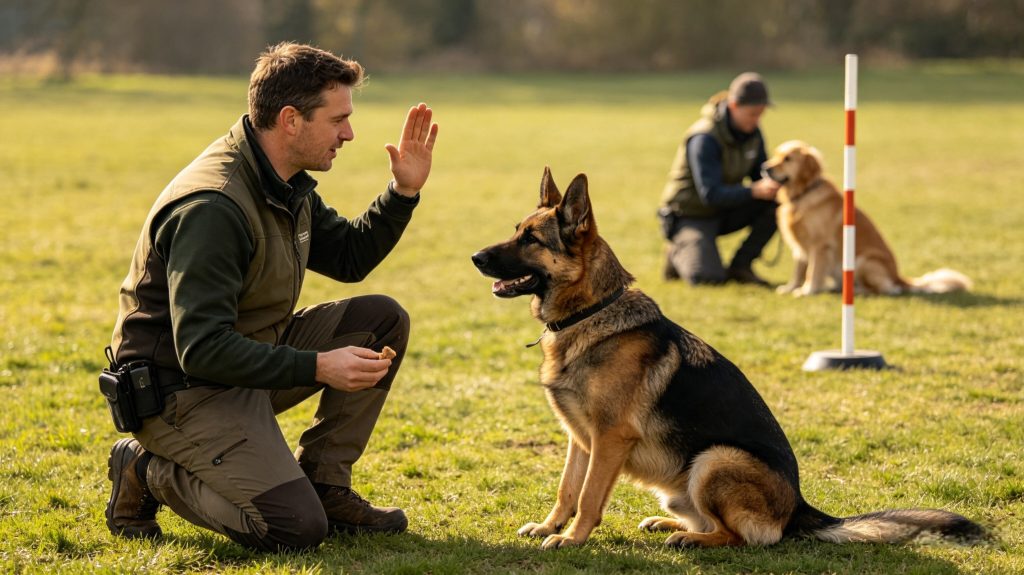
What Should I Do When My Dog Ignores a Command?
Do not repeatedly give the command.
Instead:
- Assess the situation.
- Reduce the difficulty if necessary.
- Give your dog another opportunity.
- Reward the correct response.
- Repeat in manageable conditions.
- Gradually increase distractions.
If your dog repeatedly fails, the training setup needs to change.
Should I Punish My Dog for Being Stubborn?
Punishment does not solve the reason your dog is failing to respond.
If the problem is confusion, fear, stress, pain or excessive distraction, punishment may make the situation worse.
Instead, identify the cause and teach the desired behaviour clearly.
The goal is to make the correct behaviour understandable, achievable and worthwhile.
How Can I Make My Dog More Responsive?
Build responsiveness through successful training.
Start in an easy environment and reward your dog for responding correctly.
Then gradually introduce:
- More distance
- Longer duration
- More distractions
- New environments
- More challenging situations
Change difficulty gradually rather than testing your dog at the highest level immediately.
Does Equipment Help With a Stubborn Dog?
Equipment can help with safe management while training, but it does not make a dog understand a behaviour.
A suitable harness and lead can provide safe control during walks.
A long line can provide controlled freedom in an appropriate area when practising recall.
Equipment should support training rather than replace it.
When Should I Get Professional Help?
Professional help is appropriate when your dog’s behaviour is persistent, worsening or difficult to manage safely.
Seek professional assessment for:
- Aggression
- Biting
- Severe fear
- Serious resource guarding
- Repeated lunging
- Dangerous behaviour
If your dog suddenly becomes less responsive or starts refusing behaviours it previously performed, speak to your vet to rule out pain or illness.
Conclusion
Your dog may not actually be stubborn.
What appears to be stubbornness can be caused by confusion, distraction, motivation, excitement, fear, stress, learning or physical discomfort.
Instead of repeatedly correcting the behaviour, identify why your dog is not responding, make the situation easier, teach the behaviour clearly and reward successful responses.
Understanding the reason behind the behaviour gives you a much better starting point for changing it.