How Do I Train a Strong-Willed Dog?
How do I train a strong-willed dog? Train a strong-willed dog by making expectations clear, rewarding the behaviour you want, controlling distractions and gradually increasing difficulty. A strong-willed dog often needs clearer training and better motivation rather than harsher correction. Start in an environment where your dog can succeed, then build reliable behaviour through consistent practice.
What Does Strong-Willed Mean in a Dog?
A strong-willed dog may appear determined, independent or difficult to persuade.
You may notice that your dog:
- Ignores cues when distracted
- Chooses its own activities
- Pulls towards something interesting
- Stops responding when excited
- Repeats behaviours that have worked before
- Finds it difficult to disengage from something rewarding
- Behaves differently in challenging environments
These behaviours do not necessarily mean your dog is deliberately being difficult.
The first step is to understand why your dog is choosing the alternative behaviour.
Why Is My Strong-Willed Dog Not Listening?
A dog may not respond because the behaviour is not sufficiently trained for the situation.
Your dog might understand a cue in a quiet room but struggle when faced with other dogs, people, wildlife, smells or movement.
Other possible reasons include:
- The cue is unclear
- The reward is not motivating
- The environment is too difficult
- Your dog is overexcited
- Your dog is worried or stressed
- The behaviour has not been generalised
- Your dog has learned that ignoring the cue produces a better outcome
Before increasing pressure, find out what is preventing the response.
How Do I Start Training a Strong-Willed Dog?
Start with one behaviour and one clear goal.
Decide exactly what you want your dog to do.
For example, instead of trying to stop your dog from pulling, teach loose lead walking. Instead of repeatedly calling a dog that ignores recall, build recall in controlled situations where successful responses can be rewarded.
A simple training process is:
Teach → reward → repeat → release → progress.
How Do I Train a Strong-Willed Dog Step by Step?
Step 1: Start Somewhere Easy
Choose a quiet environment with minimal distractions.
Your dog needs to be able to concentrate before you introduce difficult situations.
Step 2: Teach the Behaviour Clearly
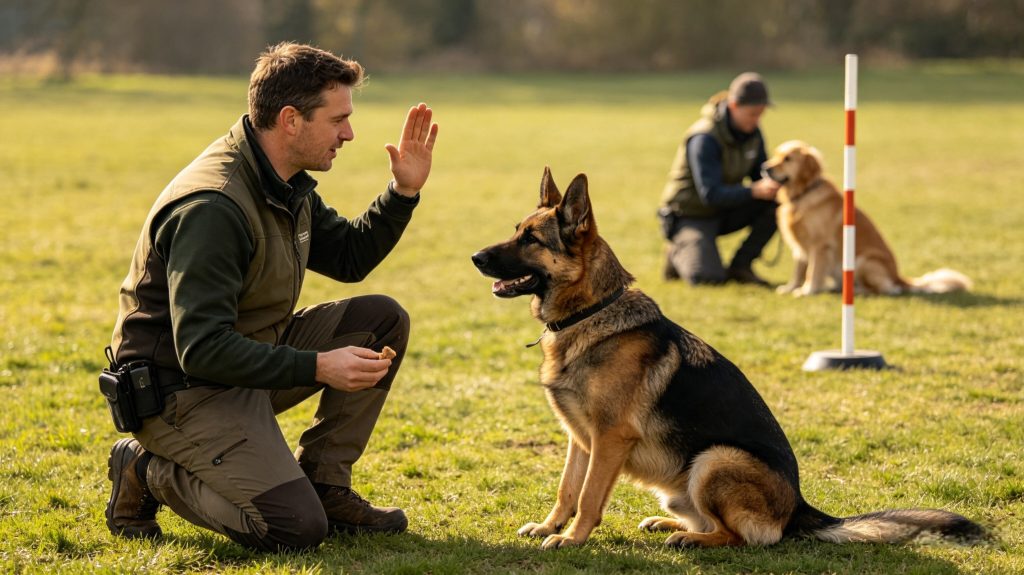
Use a consistent cue and give your dog time to respond.
Avoid changing the cue or giving several commands at once.
Step 3: Reward the Correct Response
Mark the correct behaviour and reward it immediately.
Depending on the dog and situation, rewards can include food, toys, play, praise, attention or access to something your dog wants.
The reward should be valuable enough to compete with the environment.
Step 4: Release and Reset
Once the exercise is complete, use a clear release or allow your dog to reset.
This helps your dog understand when the behaviour has finished.
Step 5: Increase Difficulty Gradually
Once the behaviour is reliable, introduce more difficult conditions.
Increase one factor at a time where possible, such as:
- Duration
- Distance
- Distractions
- Location
- Environmental activity
If your dog stops responding, make the exercise easier again.
How Do I Motivate a Strong-Willed Dog?
Find out what your dog actually values.
Some dogs work strongly for food. Others are more motivated by toys, play, praise, attention or access to something interesting.
Use the reward that makes sense for the situation.
For example, if your dog wants to investigate a particular area, calmly walking towards that area can sometimes become part of the reward for appropriate behaviour.
Motivation should make the desired behaviour worthwhile, not bribe the dog into responding every time.
Should I Use Food to Train a Strong-Willed Dog?
Food can be very useful when teaching new behaviours.
Initially, you can use food to help your dog understand what you want, then gradually reduce the dog’s dependence on seeing the food before responding.
The goal is for the dog to learn that responding to the cue reliably produces a worthwhile consequence.
If your dog suddenly refuses food during training, consider whether the environment is too stressful, distracting or exciting. If appetite has changed generally, speak to your vet.
How Do I Stop Repeating Commands?
Give the cue clearly and allow your dog an opportunity to respond.
If there is no response, do not simply repeat the same command several times.
Instead, assess the situation.
The exercise may be too difficult, the dog may be distracted or the behaviour may not yet be reliable.
Make the situation easier, regain your dog’s attention and give another opportunity to succeed.
Repeated commands can teach a dog that the first cue does not need to be followed.
How Do I Train a Strong-Willed Dog Around Distractions?
Start farther away from the distraction.
Reward your dog for remaining calm and responding appropriately while the distraction is present.
As your dog improves, gradually reduce the distance or increase the level of distraction.
If your dog becomes so focused on the distraction that it cannot respond, you have increased the difficulty too quickly.
Create more distance or reduce the distraction and try again.
How Do I Train a Strong-Willed Dog on the Lead?
Start loose lead training in an environment where your dog can concentrate.
Reward your dog for walking with a loose lead and checking in with you.
If something exciting appears, create enough distance for your dog to remain responsive before continuing.
A suitable harness and lead can provide safe control during training.
A long line can provide controlled freedom in an appropriate safe area when practising recall.
Equipment should support the training rather than replace it.
How Do I Train a Strong-Willed Dog to Recall?
Begin recall training somewhere secure and relatively quiet.
Call your dog when you have a high chance of success, then immediately reward the response.
Gradually increase distance and distractions.
Do not repeatedly call your dog when you already know it is unlikely to respond.
Build a strong history of successful recalls before testing the behaviour in increasingly difficult environments.
A long line can provide additional control during outdoor recall training in an appropriate safe area.
Should I Punish a Strong-Willed Dog?
Punishment is not the solution to a dog that appears determined or independent.
If the underlying problem is confusion, fear, stress, distraction or inadequate training, punishment does not address the cause.
It can also make some behaviour problems worse.
Instead, teach the desired behaviour clearly, manage the environment and reinforce successful responses.
What If My Dog Refuses to Cooperate?
Stop and assess the situation rather than immediately increasing pressure.
Ask:
- Does my dog understand the behaviour?
- Is the environment too distracting?
- Is my dog too excited?
- Is my dog worried?
- Is the reward motivating enough?
- Has the behaviour been practised in this environment?
- Could my dog be uncomfortable or unwell?
Once you identify the problem, change the training setup.
How Do I Know If Training Is Too Difficult?
Your dog may be struggling if it repeatedly:
- Ignores cues
- Loses focus
- Becomes highly excited
- Becomes frustrated
- Tries to escape
- Stops taking rewards
- Repeatedly performs the wrong behaviour
These are signs that you may need to reduce the difficulty.
Successful training requires your dog to be able to respond.
Progression should follow success, not failure.
How Long Does It Take to Train a Strong-Willed Dog?
There is no fixed timeframe.
The speed of progress depends on the behaviour, the dog’s history, motivation, environment and consistency of training.
Look for gradual improvements such as faster responses, longer periods of concentration, better recovery from distractions and greater reliability in different environments.
Do not judge progress only by whether your dog responds perfectly every time.
When Should I Get Professional Help?
Professional help is appropriate when your dog’s behaviour is persistent, worsening or difficult to manage safely.
Seek professional assessment for aggression, biting, severe fear, serious resource guarding, repeated lunging or other dangerous behaviour.
If your dog suddenly becomes unwilling to perform behaviours it previously knew, particularly alongside other changes in behaviour, contact your vet to rule out pain or illness.
Conclusion
Training a strong-willed dog is about clarity, motivation, consistency and progression.
Teach one behaviour at a time, start in an easy environment, reward the correct response and gradually introduce distractions. When your dog struggles, reduce the difficulty rather than simply repeating commands or increasing pressure.
A strong-willed dog does not need harsher training. It needs clear expectations, worthwhile rewards and enough successful practice for reliable behaviour to develop.