
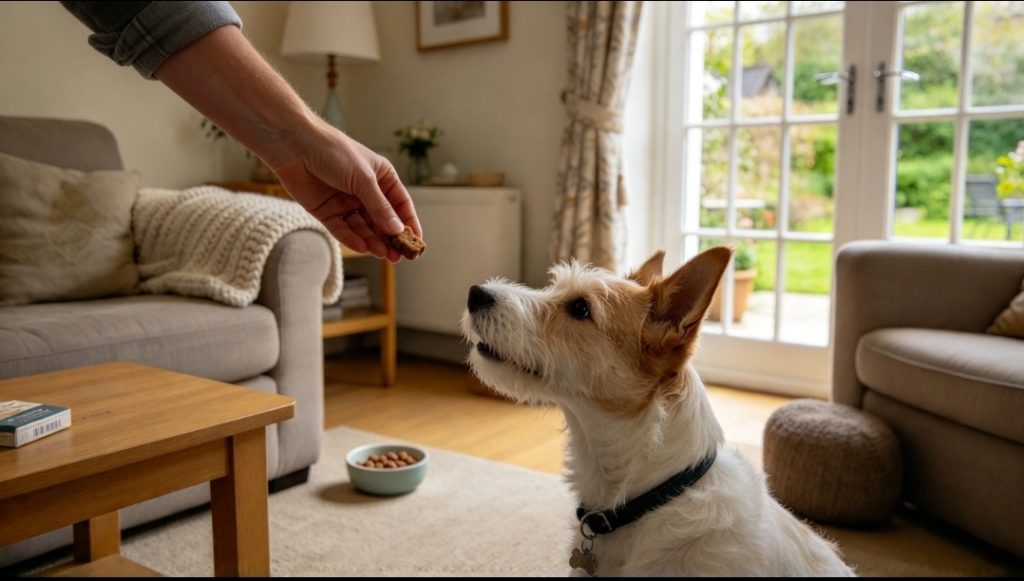
Why Does My Dog Not Care About Treats?
Why does my dog not care about treats? Dogs may ignore treats because they are distracted, stressed, nervous, too excited, too full, tired, uncomfortable, or simply do not find the food rewarding enough in that situation. Before changing the treat, look at the environment, your dog’s behaviour and the difficulty of the training.
RECOMMENDED PRODUCTS

Why does my dog not care about treats?
A dog that normally enjoys food but suddenly ignores treats may be finding the situation more important than the food. A busy environment, other dogs, people, unfamiliar places, loud noises or strong smells can all reduce your dog’s interest in eating.
Some dogs will also refuse treats when they are nervous, frightened or highly excited. In these situations, offering better food may not solve the problem because the main issue is the dog’s emotional state.
The aim is not to make your dog eat a treat. The aim is to create a situation where your dog is comfortable enough to learn and respond to a reward.
Is my dog not hungry enough for treats?
Possibly. If your dog has recently eaten a full meal, a small treat may not be very motivating.
However, deliberately making a dog excessively hungry is not necessary for training. Instead, consider using part of the dog’s normal daily food allowance during training, provided this is appropriate for the individual dog.
The size of the reward also matters. Training rewards should usually be small and quick to eat so your dog can return to the exercise without losing focus.
Why does my dog take treats at home but not outside?
If your dog takes treats at home but refuses them outside, the environment is probably making the exercise more difficult.
Outside, your dog may have to process:
- Other dogs
- People
- Traffic
- Noise
- New smells
- Movement
- Unfamiliar surroundings
- Exciting or worrying distractions
Instead of immediately finding a better treat, make the training easier.
Move further away from the distraction, choose a quieter area or return to an easier stage of training. Once your dog can concentrate again, reward the behaviour you want.
Why does my dog ignore treats around other dogs?
Other dogs can be more rewarding, exciting or worrying than food.
If your dog is staring, pulling, barking, whining, freezing or constantly trying to reach another dog, the problem may not be the treat. Your dog may simply be too focused on what is happening around them.
Increase the distance from the other dog until your dog can pay attention again. Then reward calm behaviour, looking back towards you or disengaging from the distraction.
Do not repeatedly offer food while your dog is overwhelmed. Change the situation first.
What should I do if my dog refuses treats during training?
Start by checking the difficulty of the exercise.
Step 1: Check the environment
Ask whether there is something around your dog that is more interesting, exciting or worrying than the food.
If there is, reduce the distraction or move to a quieter location.
Step 2: Check your dog’s emotional state
Look at your dog rather than focusing only on the food.
If your dog appears nervous, frightened, highly excited or overwhelmed, make the situation easier. A dog that cannot concentrate may not be ready to learn.
Step 3: Check the reward
Try a small, soft, safe food that your dog normally enjoys.
The reward should be easy to eat and valuable enough to matter in the current situation.
Step 4: Lower the difficulty
Ask for an easier behaviour that your dog already understands.
Reward successful responses and gradually increase the difficulty again.
Step 5: Reward immediately
When your dog performs the desired behaviour, mark or acknowledge it and provide the reward immediately.
The closer the reward is to the behaviour, the clearer the connection becomes.
Step 6: Reassess
If your dog starts taking food again, continue at that easier level before gradually progressing.
If your dog continues refusing food, stop trying to force the reward and reassess what may be causing the problem.
RECOMMENDED PRODUCTS
Should I use better treats if my dog ignores food?
Sometimes a higher-value reward can help, particularly when the environment is more difficult.
However, better treats are not always the answer.
If your dog is frightened, overwhelmed or extremely excited, even a favourite food may be ignored. Increasing the value of the food without changing the situation can miss the actual problem.
Use the reward that motivates your dog at that particular level of difficulty.
Can stress make a dog stop taking treats?
Yes. Stress can affect a dog’s appetite and ability to concentrate.
If your dog normally takes food but refuses it in a particular situation, pay attention to what is happening immediately before the refusal.
Signs such as increased tension, avoidance, freezing, excessive pulling, barking, panting or repeated scanning of the environment may indicate that the situation is too difficult.
Create more distance from the trigger, reduce the pressure and allow your dog to calm before trying again.
Should I force my dog to take a treat?
No. Do not force food into your dog’s mouth or repeatedly push treats towards them.
Food should remain a positive reward. If your dog does not want it, find out why rather than turning the reward into another source of pressure.
Training should build the dog’s willingness to participate, not force a response.
What if my dog suddenly stops taking treats?
A sudden change deserves attention, particularly if your dog normally enjoys food.
Check whether anything has changed, such as the environment, food, routine, exercise level or training situation.
If your dog is also refusing normal food, appears unwell, shows signs of pain, has vomiting or diarrhoea, or has other sudden changes in behaviour, contact your vet for advice.
A training problem should not automatically be assumed to be behavioural when there has been a sudden change in appetite or behaviour.
Do I need treats to train my dog?
No. Food is a useful training reward, but it is not the only option.
Depending on the individual dog and behaviour, rewards can include:
- Toys
- Play
- Praise and attention
- Access to something the dog wants
- Permission to continue an enjoyable activity
- Freedom to explore when appropriate
The important point is that the reward must actually matter to the dog.
If food is not motivating in a particular situation, another appropriate reward may work better.
How can I make treats more valuable during training?
Use food strategically rather than constantly increasing the amount.
Keep rewards small, use food your dog genuinely enjoys and match the value of the reward to the difficulty of the behaviour.
For easier exercises in familiar surroundings, normal food may be enough. More difficult situations may require a more valuable reward.
As your dog becomes reliable, you can vary the rewards rather than showing the dog food before every behaviour.
Common mistakes when a dog ignores treats
Several common mistakes can make the problem worse:
Repeating the command: Repeatedly asking for the same behaviour does not make the reward more valuable.
Moving closer to the distraction: If your dog is already struggling to concentrate, getting closer can make the situation even harder.
Constantly changing food: Different treats will not solve an underlying problem such as fear, stress or excessive excitement.
Forcing the food: Your dog should not be pressured to eat.
Training for too long: Fatigue can reduce concentration and motivation.
Progressing too quickly: A behaviour that works at home may need to be rebuilt gradually in more difficult environments.
When should I be concerned about my dog refusing treats?
Occasional refusal during a difficult training situation is not necessarily a problem.
The important question is whether your dog is refusing food only in certain situations or has generally lost interest in eating.
If the change is sudden, persistent or accompanied by other signs of illness, discomfort or unusual behaviour, seek veterinary advice.
Conclusion
Why does my dog not care about treats? Usually, the answer is not simply that your dog dislikes food. The environment, emotional state, distractions, hunger, reward value and difficulty of the exercise can all affect whether your dog wants to take a treat.
Start by observing what is happening, reduce the difficulty when necessary and use a reward your dog genuinely values. The goal is not to make your dog take the treat; the goal is to create the right conditions for your dog to learn.
GPK9 — The Five Golden Rules
The GPK9 Five Golden Rules provide the foundation of the GPK9 Professional Training System. They give new dog owners, new dog handlers, experienced handlers and professional dog trainers a clear structure for developing the dog and the handler together.
The GPK9 Five Golden Rules cover five essential areas of development: Home & Social, Obedience, Prey Drive, Toilet and Social Walking. Each area has its own purpose, but they are designed to work together as one complete training system.
The GPK9 approach is based on CATEGORY → STATUS → DRIVE → CONTROL and the handler’s ability to OBSERVE → INTERPRET → DECIDE → COMMUNICATE → OBSERVE RESPONSE → REASSESS. This gives the handler a consistent process for understanding what the dog is doing, why the behaviour is occurring, what level of control is appropriate and how to communicate effectively.
The purpose of the GPK9 Five Golden Rules is not simply to teach a collection of individual exercises. They are designed to develop the dog’s behaviour, motivation, communication, control and reliability while teaching the handler how to make better decisions.
Golden Rule One — Home & Social
Golden Rule One — Home & Social establishes the foundation for everyday life with the dog. It focuses on communication, boundaries, calm behaviour, household routines and appropriate behaviour around people, animals and normal activity.
The purpose of Golden Rule One — Home & Social is to help the handler understand the dog’s behaviour and recognise changes in arousal before they become larger problems. The handler learns to observe, assess and communicate rather than simply reacting after unwanted behaviour has already occurred.
Golden Rule One — Home & Social provides the foundation from which the handler can develop a calmer, more predictable and better-communicating dog.
Golden Rule Two — Obedience
Golden Rule Two — Obedience develops the dog’s ability to understand and respond to the handler’s communication.
The focus of Golden Rule Two — Obedience is not simply teaching commands. It is about developing understanding, reliability, timing, reward, release and control so the dog learns what the handler is communicating.
Through Golden Rule Two — Obedience, the handler learns to progress training appropriately, gradually increasing the dog’s freedom and responsibility as understanding and reliability improve.
Golden Rule Three — Prey Drive
Golden Rule Three — Prey Drive focuses on understanding and developing the dog’s natural motivation to chase, pursue, engage and work with an appropriate toy or prey-based reward.
The purpose of Golden Rule Three — Prey Drive is not simply to increase drive. The handler must learn how to recognise the dog’s level of motivation, select an appropriate reward and use timing, communication and control to channel that motivation productively.
Golden Rule Three — Prey Drive teaches the handler that motivation can become a powerful training tool when it is developed and controlled correctly.
Golden Rule Four — Toilet
Golden Rule Four — Toilet establishes reliable toilet habits through consistency, observation, timing, supervision and appropriate reinforcement.
The handler learns through Golden Rule Four — Toilet to recognise when the dog is likely to need the toilet, provide the correct opportunity and reinforce the desired behaviour.
The objective of Golden Rule Four — Toilet is to establish a predictable routine that helps the dog understand where and when toileting is appropriate while reducing opportunities for mistakes.
Golden Rule Five — Social Walking
Golden Rule Five — Social Walking develops the dog’s ability to walk calmly and appropriately in the real world while remaining connected to the handler.
The focus of Golden Rule Five — Social Walking is the relationship between the handler, the dog, the environment, distractions, distance and available control.
Through Golden Rule Five — Social Walking, the handler learns to observe body language, identify potential triggers, assess distance and recognise changes in drive or arousal before behaviour escalates.
The objective of Golden Rule Five — Social Walking is not simply to make the dog walk beside the handler. It is to develop a dog that can experience the outside world while remaining connected to the handler and capable of responding to clear communication.
How the Five Golden Rules Work Together
The GPK9 Five Golden Rules are designed to work together rather than being treated as five completely separate subjects.
Golden Rule One — Home & Social establishes the foundations for everyday behaviour and communication.
Golden Rule Two — Obedience develops understanding, responsiveness and control.
Golden Rule Three — Prey Drive develops motivation and teaches the handler how to channel natural drive appropriately.
Golden Rule Four — Toilet establishes essential household routine and reliability.
Golden Rule Five — Social Walking takes the communication and control developed through the other areas into the outside environment.
Together, the GPK9 Five Golden Rules help the handler develop a complete understanding of the dog rather than treating individual behaviours as isolated problems.
The overall objective of the GPK9 Five Golden Rules is to train the human, train the dog and build the partnership through clear observation, communication, appropriate control and progressive development.




