
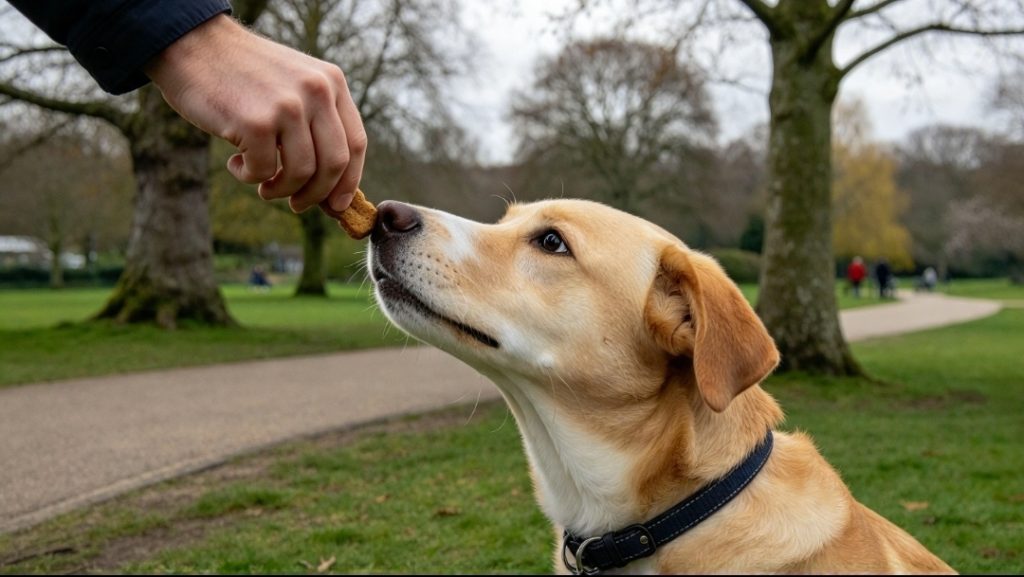
How Do I Increase My Dog’s Food Motivation?
How do I increase my dog’s food motivation? Start by making food more valuable and training easier, rather than simply giving your dog more treats. Use small, tasty rewards, control when food is available, reward at the right moment and gradually introduce distractions. If your dog is stressed, unwell or not interested in food generally, address that problem first.
RECOMMENDED PRODUCTS

What does food motivation mean in dog training?
Food motivation is how willing your dog is to work for food in a particular situation.
It can change depending on your dog’s hunger, the food being offered, the environment, the difficulty of the exercise and your dog’s emotional state.
A dog may be highly food motivated at home but ignore food outside because the environment is more distracting or stressful.
Food motivation is therefore not a fixed personality trait. It can change from one situation to another.
How can I make food more valuable to my dog?
Start with food your dog genuinely enjoys.
Training rewards should usually be:
- Small
- Tasty
- Easy to chew
- Safe for your dog
- Appropriate for your dog’s diet
- Valuable enough for the current exercise
You can use part of your dog’s normal daily food allowance for training or use suitable training treats.
For more difficult exercises, a higher-value reward may be appropriate.
The goal is not to keep increasing the amount of food. It is to make each reward meaningful.
Should I train my dog before meals?
Training before a normal meal can sometimes increase interest in food because your dog is more ready to eat.
However, you should not deliberately starve your dog to make training work.
Instead, consider using some of your dog’s normal daily food allowance during training. This can make food useful without unnecessarily increasing your dog’s total daily intake.
If your dog has specific dietary, medical or feeding requirements, follow your vet’s advice.
How do I use meals to increase food motivation?
You can make food part of the training routine rather than always giving every meal separately.
For example, you can set aside an appropriate portion of your dog’s normal food and use small amounts during short training sessions.
Your dog learns that responding to you can result in access to food.
Keep the sessions short enough that your dog remains interested rather than continuing until they lose concentration.
Should I stop leaving food available all day?
If food is constantly available, some dogs may have less interest in working for food during training.
If you currently leave food down throughout the day, discuss a more structured feeding routine with your vet if your dog’s needs require one.
A predictable feeding routine can make it easier to know when your dog is likely to be interested in food.
Do not restrict food unnecessarily simply to increase training motivation.
How important is the timing of the reward?
Timing is extremely important.
Your dog needs to understand which behaviour earned the food.
A simple training sequence is:
- Ask for or create the desired behaviour.
- Wait for your dog to perform it.
- Mark or acknowledge the correct response.
- Give the food immediately.
- Allow your dog to eat it.
- Release or reset before repeating.
The closer the reward is to the correct behaviour, the clearer the connection becomes.
How can I increase food motivation when my dog is distracted?
Reduce the difficulty first.
If your dog ignores food around other dogs, people, traffic or other distractions, moving closer to the distraction is unlikely to improve food motivation.
Instead, increase distance or choose a quieter environment.
Once your dog can concentrate and take food comfortably, reward simple behaviours and gradually increase the difficulty.
This teaches your dog that working with you remains worthwhile even when the environment becomes more challenging.
What if my dog is too excited to eat?
Extreme excitement can make food difficult for some dogs to use effectively.
If your dog is pulling, barking, jumping, scanning constantly or unable to focus, make the exercise easier.
Increase distance from the exciting stimulus and wait for your dog to become more settled before attempting further training.
Do not keep pushing food towards a dog that is too aroused to take it.
The problem may be the level of excitement rather than the value of the food.
RECOMMENDED PRODUCTS
What if my dog is nervous and won’t take food?
Nervousness can reduce a dog’s willingness to eat.
If your dog refuses food in a particular situation, observe their body language and consider whether they are uncomfortable.
Create more distance from whatever is worrying your dog and allow them time to settle.
Do not use food to force a frightened dog closer to something they are trying to avoid.
If fear or anxiety is frequent or severe, seek appropriate professional help.
Can I use play to increase food motivation?
Yes, but food does not need to become the only reward.
Some dogs are strongly motivated by toys, play, praise, attention, exploration or access to something they want.
You can use different rewards depending on the situation.
For example, food may work well for practising a calm behaviour at home, while access to sniffing or exploring may be useful during a walk.
The best reward is the one that genuinely reinforces the behaviour.
Should I show my dog the food before training?
Not necessarily.
Showing food before every exercise can create dependence on the visible reward.
Instead, once your dog understands the exercise, keep the food available but out of sight and reward the correct response afterwards.
Food can be used as a lure when teaching a new behaviour, but gradually reduce your reliance on the visible lure as your dog learns.
RECOMMENDED PRODUCTS
How do I build food motivation gradually?
Start somewhere your dog already feels comfortable.
Choose a simple behaviour that your dog knows well. Reward immediately when your dog responds correctly.
Once your dog is consistently interested in the food, gradually introduce small increases in difficulty.
You might progress from:
Quiet room → garden → quiet outdoor area → mild distractions → more difficult environments
Do not move to the next stage simply because your dog completed one repetition.
Progress when your dog can remain comfortable, engaged and successful.
What should I do if my dog suddenly loses food motivation?
A sudden change should not automatically be treated as a training problem.
Check whether your dog is eating normally outside training.
Changes in appetite can be associated with illness, pain, dental problems, medication, stress or other health issues.
If your dog suddenly refuses food generally, has other symptoms or you are concerned about the change, contact your vet.
Common mistakes when trying to increase food motivation
Giving larger treats: More food does not necessarily create more motivation.
Training when the environment is too difficult: Your dog may be unable to concentrate regardless of the reward.
Using food to lure constantly: This can make your dog dependent on seeing the food.
Forcing food: A dog that refuses food should not be pressured to eat.
Training for too long: Motivation can decrease when the session becomes tiring or repetitive.
Using the same reward for everything: Different behaviours and situations may require different rewards.
Ignoring stress or excitement: Food refusal can be a sign that the training environment is too difficult.
How do I know if my dog’s food motivation is improving?
Look for changes in your dog’s willingness to engage with you.
Your dog may begin taking food more readily, responding faster to known behaviours, maintaining attention for longer and working successfully in slightly more distracting environments.
The important measure is not how quickly your dog eats a treat at home.
The real goal is for your dog to remain willing and able to work for appropriate rewards as training gradually becomes more difficult.
Conclusion
To increase your dog’s food motivation, focus on reward value, timing, training difficulty and your dog’s emotional state rather than simply giving more food.
Use small, enjoyable rewards, train when your dog can concentrate, reward immediately and gradually introduce distractions. If your dog is stressed, uncomfortable or suddenly loses interest in food altogether, deal with the underlying issue rather than trying to make food more appealing.
GPK9 — The Five Golden Rules
The GPK9 Five Golden Rules provide the foundation of the GPK9 Professional Training System. They give new dog owners, new dog handlers, experienced handlers and professional dog trainers a clear structure for developing the dog and the handler together.
The GPK9 Five Golden Rules cover five essential areas of development: Home & Social, Obedience, Prey Drive, Toilet and Social Walking. Each area has its own purpose, but they are designed to work together as one complete training system.
The GPK9 approach is based on CATEGORY → STATUS → DRIVE → CONTROL and the handler’s ability to OBSERVE → INTERPRET → DECIDE → COMMUNICATE → OBSERVE RESPONSE → REASSESS. This gives the handler a consistent process for understanding what the dog is doing, why the behaviour is occurring, what level of control is appropriate and how to communicate effectively.
The purpose of the GPK9 Five Golden Rules is not simply to teach a collection of individual exercises. They are designed to develop the dog’s behaviour, motivation, communication, control and reliability while teaching the handler how to make better decisions.
Golden Rule One — Home & Social
Golden Rule One — Home & Social establishes the foundation for everyday life with the dog. It focuses on communication, boundaries, calm behaviour, household routines and appropriate behaviour around people, animals and normal activity.
The purpose of Golden Rule One — Home & Social is to help the handler understand the dog’s behaviour and recognise changes in arousal before they become larger problems. The handler learns to observe, assess and communicate rather than simply reacting after unwanted behaviour has already occurred.
Golden Rule One — Home & Social provides the foundation from which the handler can develop a calmer, more predictable and better-communicating dog.
Golden Rule Two — Obedience
Golden Rule Two — Obedience develops the dog’s ability to understand and respond to the handler’s communication.
The focus of Golden Rule Two — Obedience is not simply teaching commands. It is about developing understanding, reliability, timing, reward, release and control so the dog learns what the handler is communicating.
Through Golden Rule Two — Obedience, the handler learns to progress training appropriately, gradually increasing the dog’s freedom and responsibility as understanding and reliability improve.
Golden Rule Three — Prey Drive
Golden Rule Three — Prey Drive focuses on understanding and developing the dog’s natural motivation to chase, pursue, engage and work with an appropriate toy or prey-based reward.
The purpose of Golden Rule Three — Prey Drive is not simply to increase drive. The handler must learn how to recognise the dog’s level of motivation, select an appropriate reward and use timing, communication and control to channel that motivation productively.
Golden Rule Three — Prey Drive teaches the handler that motivation can become a powerful training tool when it is developed and controlled correctly.
Golden Rule Four — Toilet
Golden Rule Four — Toilet establishes reliable toilet habits through consistency, observation, timing, supervision and appropriate reinforcement.
The handler learns through Golden Rule Four — Toilet to recognise when the dog is likely to need the toilet, provide the correct opportunity and reinforce the desired behaviour.
The objective of Golden Rule Four — Toilet is to establish a predictable routine that helps the dog understand where and when toileting is appropriate while reducing opportunities for mistakes.
Golden Rule Five — Social Walking
Golden Rule Five — Social Walking develops the dog’s ability to walk calmly and appropriately in the real world while remaining connected to the handler.
The focus of Golden Rule Five — Social Walking is the relationship between the handler, the dog, the environment, distractions, distance and available control.
Through Golden Rule Five — Social Walking, the handler learns to observe body language, identify potential triggers, assess distance and recognise changes in drive or arousal before behaviour escalates.
The objective of Golden Rule Five — Social Walking is not simply to make the dog walk beside the handler. It is to develop a dog that can experience the outside world while remaining connected to the handler and capable of responding to clear communication.
How the Five Golden Rules Work Together
The GPK9 Five Golden Rules are designed to work together rather than being treated as five completely separate subjects.
Golden Rule One — Home & Social establishes the foundations for everyday behaviour and communication.
Golden Rule Two — Obedience develops understanding, responsiveness and control.
Golden Rule Three — Prey Drive develops motivation and teaches the handler how to channel natural drive appropriately.
Golden Rule Four — Toilet establishes essential household routine and reliability.
Golden Rule Five — Social Walking takes the communication and control developed through the other areas into the outside environment.
Together, the GPK9 Five Golden Rules help the handler develop a complete understanding of the dog rather than treating individual behaviours as isolated problems.
The overall objective of the GPK9 Five Golden Rules is to train the human, train the dog and build the partnership through clear observation, communication, appropriate control and progressive development.




