
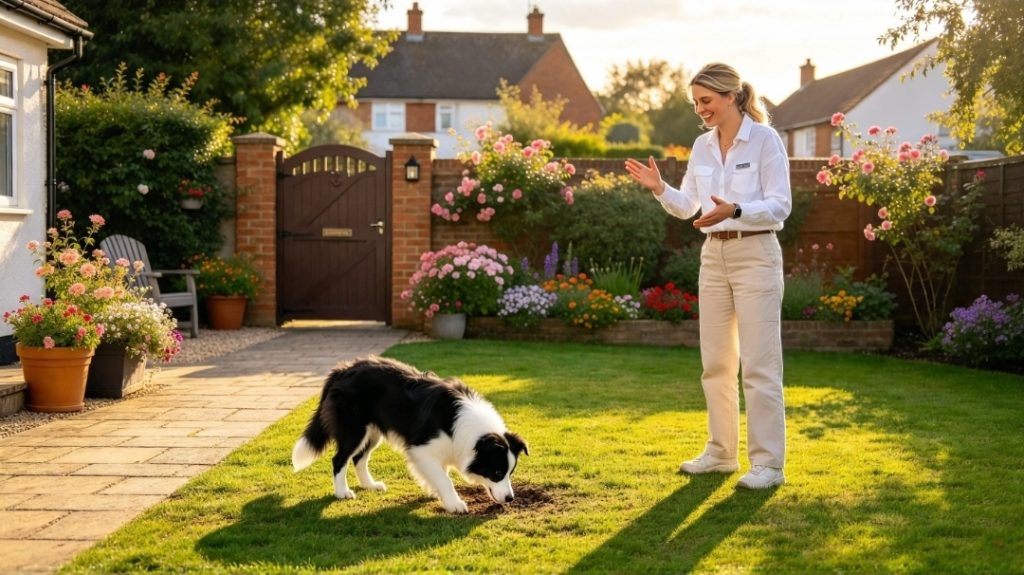
How do I teach a toilet command?
Teaching a toilet command is about creating a clear association between a consistent toilet location, a predictable routine and a simple verbal command. Rather than repeatedly saying a word and expecting the dog to immediately understand it, the command should become associated with the behaviour through repetition, timing and consistency. The aim is to help the dog understand what is expected while the handler observes the dog’s behaviour and manages the environment appropriately.
RECOMMENDED PRODUCTS

What is a toilet command?
A toilet command is a short, consistent word or phrase that the handler uses when the dog is in the appropriate location and is ready to toilet.
The important part is not the particular word chosen. The important part is that the same command is used consistently and becomes associated with the correct behaviour.
For example, a handler might choose a simple phrase such as:
- “Toilet”
- “Go toilet”
- “Busy”
- Another short phrase used consistently
Choose one command and use it consistently rather than changing the wording from one training session to another.
The dog does not initially understand the meaning of the word. The association is developed through repeated experience.
How does a dog learn the command?
The command should be connected to an existing behaviour rather than treated as a command that the dog is expected to understand immediately.
A simple process is:
ROUTINE → TOILET LOCATION → OBSERVE → COMMAND → TOILET → REINFORCE → REPEAT
Take the dog to the same suitable toilet location at appropriate times.
Once there, remain calm and allow the dog an opportunity to toilet. As the dog is preparing to toilet or begins the behaviour, use the chosen toilet command calmly and consistently.
After the dog has finished, provide appropriate positive reinforcement.
With repetition, the dog can begin to associate the command with the behaviour and location.
Why is consistency important?
Dogs learn through repeated associations.
If the dog is taken to a different location every time, given a different command, distracted during the process or allowed to treat the entire garden as a play area, the association can become less clear.
A consistent toilet routine can make the learning process easier to understand.
Consider keeping the following consistent:
- The toilet location
- The route to the toilet location
- The verbal command
- The timing of the routine
- The handler’s response
- The reinforcement following successful toileting
The objective is not to rush the dog. It is to create a predictable pattern that the dog can learn.
When should I use the toilet command?
The command is most useful when the dog is actually in the correct situation to toilet.
Avoid repeatedly saying the command while the dog is playing, exploring, jumping around or investigating distractions.
The command should have meaning.
A useful sequence is:
- Take the dog to the designated toilet area.
- Keep the environment calm.
- Allow the dog time to investigate the area.
- Observe the dog’s behaviour.
- Use the toilet command at the appropriate point.
- Allow the dog to toilet without unnecessary interruption.
- Reinforce the correct behaviour after completion.
- Return to the normal routine.
This helps prevent the command becoming background noise.
How do I know when my dog needs to toilet?
Observation is an important part of toilet training.
Dogs may display individual signs that they need to toilet. These can include:
- Sniffing the floor or ground
- Circling
- Searching for a suitable area
- Becoming restless
- Moving away from an activity
- Returning repeatedly to a particular area
- Showing changes in normal behaviour
- Suddenly becoming focused on the ground
The exact signs vary between individual dogs.
The handler’s role is to observe the dog’s behaviour and recognise patterns rather than relying exclusively on a fixed timetable.
Use the GPK9 decision process
The GPK9 PROFESSIONAL TRAINING SYSTEM uses:
OBSERVE → INTERPRET → DECIDE → ACT → REASSESS
This provides a practical way of looking at toilet training.
OBSERVE
Watch the dog.
Look at:
- Movement
- Attention
- Environmental awareness
- Changes in behaviour
- Responsiveness
- Ability to settle
- Interest in the toilet area
The objective is to identify what the dog is actually doing.
INTERPRET
Consider what the behaviour means in the current situation.
For example, if the dog suddenly becomes restless after eating, wakes from sleep and begins sniffing around, the handler may interpret these changes as signs that the dog may need an opportunity to toilet.
DECIDE
Decide what action is appropriate.
If the dog may need to toilet, take the dog to the appropriate location rather than waiting for an accident.
ACT
Use the established routine.
Take the dog to the toilet location, remain calm and use the chosen command at the appropriate point.
REASSESS
After the dog has toileted, observe again.
Consider whether the dog can return appropriately to the next part of the routine.
The process therefore becomes:
OBSERVE → INTERPRET → DECIDE → ACT → REASSESS
This is particularly useful because toilet training is not simply about repeating a word. It involves understanding what the dog is doing and responding appropriately.
What if my dog gets distracted?
Distractions can interfere with toilet training.
A garden can contain many things that are more interesting to a dog than toileting:
- Toys
- Other animals
- People
- Sounds
- Smells
- Movement
- Birds
- Other dogs
- Environmental activity
If the dog becomes distracted, the handler should avoid turning the toilet trip into an exciting play session.
Remain calm and give the dog an opportunity to return its attention to the purpose of the trip.
If the dog becomes increasingly distracted or struggles to settle, the situation may need to be reduced rather than adding more commands.
What if my dog does not toilet?
Do not assume that repeating the command more frequently will solve the problem.
First consider the situation.
Has the dog:
- Recently eaten?
- Recently woken?
- Recently played?
- Recently drunk?
- Already toileted?
- Been exposed to too much activity?
- Been distracted?
- Been taken to the correct location?
- Had enough time to settle?
The GPK9 approach is to observe the situation before deciding what to do next.
If the dog does not toilet, maintain the appropriate level of management and continue monitoring rather than immediately giving the dog unrestricted freedom indoors.
The exact management required will depend on the individual dog, its age, routine and circumstances.
RECOMMENDED PRODUCTS
What if my dog has an accident?
An accident is information.
Instead of simply correcting the dog after the event, consider what happened before the accident.
Ask:
- What was the dog doing?
- When did the dog last toilet?
- Did the dog show signs that were missed?
- Was the dog given too much freedom?
- Was the dog distracted?
- Was the normal routine changed?
- Was the dog taken to the correct toilet location?
The purpose of this assessment is to identify what can be changed.
If the dog is being given more freedom than it can currently manage successfully, reduce the level of freedom and return to an appropriate level of control.
How does control change during toilet training?
The GPK9 PROFESSIONAL TRAINING SYSTEM considers:
CATEGORY → STATUS → DRIVE → CONTROL
For toilet training, the relevant category is TOILET.
The dog’s current status then helps determine the appropriate response.
A dog that is calm, responsive and successfully following the routine may be able to continue.
A dog that is becoming distracted or struggling may require greater management.
A situation that has broken down may require the activity to stop, the dog to calm and the routine to be reset.
The important principle is that control should match the dog’s current ability to manage the situation.
More freedom requires more behavioural responsibility
As toilet training develops, the dog may be given greater freedom.
However, greater freedom should be introduced according to the dog’s demonstrated ability to behave appropriately.
If accidents repeatedly occur when freedom is increased, the solution may be to reduce freedom and rebuild the behaviour rather than continuing to increase access.
This follows the wider GPK9 principle:
MORE FREEDOM REQUIRES MORE BEHAVIOURAL RESPONSIBILITY.
The objective is progressive development rather than giving the dog unrestricted access before the behaviour is reliable.
How does drive affect toilet training?
Toilet training can involve several forms of motivation.
The GPK9 TOILET structure recognises:
- Low Prey Drive
- High Prey Drive
- Low Food Drive
- High Food Drive
Drive can influence how easily a dog becomes distracted and how the handler manages reinforcement.
For example, a dog with high prey drive may become highly interested in movement in the garden. A dog with high food drive may become very focused on food rather than the toilet routine.
The handler should therefore consider the individual dog rather than assuming every dog will respond to the same training environment.
What should I do when my dog successfully toilets?
Successful behaviour should be recognised and reinforced appropriately.
The timing is important.
The dog should experience a clear connection between successfully toileting and the positive outcome that follows.
Keep the response appropriate to the individual dog.
For some dogs, calm verbal praise may be sufficient. Food reinforcement can also be useful where appropriate.
The objective is to reinforce the correct behaviour without turning the toilet area into an unnecessarily exciting play environment.
How do I progress from a toilet routine to a toilet command?
Progress should happen gradually.
Initially, the dog may simply learn:
THIS LOCATION = TOILET
The next association becomes:
THIS ROUTINE + THIS LOCATION + THIS WORD = TOILET
With repetition, the command can become increasingly meaningful.
The handler should avoid assuming that because the dog has successfully toileted several times, the behaviour is automatically reliable in every environment.
Progress should be based on the dog’s actual behaviour.
What if the dog starts struggling?
Use the GPK9 status response system.
GREEN
OBSERVE → CONTINUE → PROGRESS
If the dog is calm, responsive and successfully following the toilet routine, continue appropriately.
AMBER
OBSERVE → ASSESS → REMOVE FROM DISTRACTION → CALM → REASSESS
If the dog is struggling, becoming distracted or unable to engage appropriately:
- Observe.
- Assess the situation.
- Remove the dog from the distraction where appropriate.
- Allow the dog to calm.
- Reassess.
If the dog returns to a calm state:
GREEN → CALM → CONTINUE → PROGRESS
RED
If the situation requires an immediate stop:
STOP WHAT YOU ARE DOING → OBSERVE → ASSESS → REMOVE FROM DISTRACTION → CALM → REASSESS
If the dog cannot reduce or calm:
RED → CANNOT REDUCE → CANNOT CALM → RETURN TO CRATE
The appropriate reset can then be:
RESET → TOILET → GREEN → OBSERVE → CONTINUE
The status response should always be applied according to the actual situation rather than simply labelling the dog.
Can I teach a toilet command to an older dog?
Yes, the principle of creating an association between a consistent command, location and behaviour can also be used with older dogs.
However, an older dog that suddenly develops toileting problems should not automatically be treated as a training problem.
A change in toileting behaviour can have different causes, and appropriate professional or veterinary advice may be required where there is a sudden or unexplained change.
Training should focus on the behaviour and routine while recognising when the situation requires additional assessment.
A simple toilet command training routine
A practical routine can be kept straightforward:
Step 1 — Establish the location
Choose a suitable toilet location and use it consistently.
Step 2 — Establish the routine
Take the dog to the location at appropriate times and when signs indicate that toileting may be required.
Step 3 — Observe
Watch the dog rather than continuously giving commands.
Step 4 — Introduce the command
Use the chosen toilet command calmly when the dog is in the appropriate situation.
Step 5 — Allow the behaviour
Give the dog time to toilet without unnecessary interruption.
Step 6 — Reinforce
Recognise and reinforce successful toileting appropriately.
Step 7 — Reassess
Observe the dog’s behaviour and determine what happens next.
Step 8 — Progress gradually
Increase freedom only when the dog demonstrates that it can manage the additional responsibility.
RECOMMENDED PRODUCTS
Common mistakes when teaching a toilet command
Repeating the command constantly
If the command is repeated without the dog toileting, it can lose its usefulness.
Changing the command
Using several different words can make the association less clear.
Turning the toilet trip into playtime
Excessive excitement can distract the dog from the purpose of the trip.
Giving too much freedom too soon
Freedom should reflect the dog’s current level of reliability.
Missing the dog’s signals
Observation is essential. The handler needs to learn the individual dog’s behaviour.
Focusing only on accidents
An accident should be used to review the routine and management rather than simply viewed as an isolated event.
Expecting instant results
A toilet command is developed through repetition, consistency and appropriate timing.




