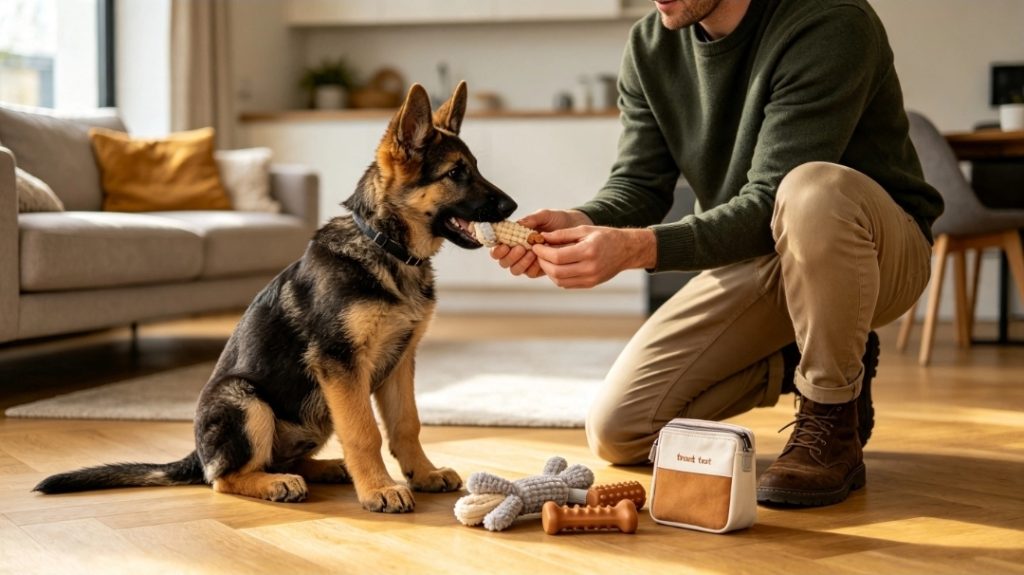
What should a puppy learn first?
A puppy should first learn how to live appropriately within its home environment. Before expecting a puppy to perform a large number of commands, establish suitable routines, boundaries, settling, controlled freedom and positive engagement. GPK9 starts training at home and uses observation, assessment, appropriate action and reassessment to determine what the puppy is ready to learn next. Positive reinforcement, food, patience and appropriate motivation provide the foundation for early learning.
RECOMMENDED PRODUCTS — Puppy Training
Start with the home environment
The first stage of puppy training should be establishing an appropriate home environment.
A new puppy is learning how to live with you, understand its surroundings and respond to the routines you establish.
The GPK9 Home & Social process uses three key areas:
- Crate
- Placemat
- Playpen
Each provides a different level of management and controlled freedom.
The crate provides a conditioned safe, rest, reset and routine space.
The placemat provides a place for stationing, duration and settling.
The playpen provides freedom within a boundary.
These areas help create a structured environment where the puppy can learn progressively.
Teach settling first
A puppy needs to learn that calm behaviour has a place within everyday life.
The placemat provides an appropriate area for stationing and settling.
Use positive reinforcement and food motivation to help the puppy engage with the placemat.
The aim is not to expect a young puppy to remain there for an extended period immediately. Instead, observe the puppy’s response and gradually develop the behaviour.
Teaching a puppy to settle provides an important foundation for future training.
Teach appropriate boundaries
A puppy should learn that freedom within the home develops progressively.
The playpen can provide controlled freedom within a boundary, while the crate provides a more controlled environment for rest and resetting.
The key GPK9 principle is:
MORE FREEDOM REQUIRES MORE BEHAVIOURAL RESPONSIBILITY.
Do not provide unrestricted freedom simply because the puppy has arrived home.
Allow the puppy’s behavioural responsibility to develop alongside its freedom.
Teach the crate as a safe space
The crate should become a conditioned safe, rest, reset and routine space.
A puppy should learn that the crate is part of its normal daily environment.
It can provide an appropriate place for rest and can also form part of the reset process when the puppy cannot continue appropriately.
The crate should therefore be introduced positively and consistently.
Teach positive engagement
Once an appropriate environment is established, build engagement with the puppy.
Food can be used as positive reinforcement and motivation.
Observe the puppy’s individual food drive:
- Low Food Drive
- High Food Drive
A puppy with high food drive may engage readily with food, while a puppy with low food drive may require the training environment and motivation to be assessed.
Do not assume that every puppy will respond in the same way.
Teach your puppy through observation
The first thing an owner needs to learn is how to observe their puppy.
Look at:
- Body posture
- Facial expression
- Ears and tail
- Movement
- Orientation
- Attention and engagement
- Arousal
- Settling
- Responsiveness
- Recovery
- Environmental awareness
- Social behaviour
- Changes in behaviour
- Learned criteria
These observations help determine what the puppy is ready to learn next.
Teach calm progression
Puppy training should develop gradually.
If the puppy is managing its current environment appropriately, progression can continue.
If the puppy becomes distracted, over-aroused or unable to engage appropriately, do not simply continue increasing the difficulty.
Observe.
Assess.
Remove unnecessary distractions where appropriate.
Allow the puppy to calm.
Then reassess.
The aim is to return the puppy to an appropriate training state before continuing.
Teach controlled freedom
A puppy should learn that freedom is earned through behavioural responsibility.
The GPK9 pathway is:
CRATE → PLACEMAT → PLAYPEN
This is not a fixed one-way progression.
A puppy may move back to an earlier stage when necessary.
For example, if increased freedom in the playpen becomes too difficult, return to a more controlled stage, reassess the puppy and progress again when appropriate.
Teach an appropriate routine
Consistency helps a puppy understand what is expected.
Build a predictable routine around:
- Rest
- Settling
- Controlled freedom
- Training
- Appropriate management
- Progression
The crate, placemat and playpen can each form part of this routine.
The objective is to give the puppy clear expectations while allowing it to develop progressively.
What about commands?
Commands are not necessarily the first priority.
A puppy first needs an appropriate foundation for learning.
That includes:
- Engagement
- Food motivation
- Settling
- Boundaries
- Controlled freedom
- Responsiveness
- Calmness
- Behavioural responsibility
Once these foundations are developing appropriately, structured obedience can be introduced progressively.
This avoids trying to teach a puppy numerous commands before it has learned how to engage appropriately within its environment.
Consider individual drive
Every puppy is an individual.
GPK9 considers:
- Low Prey Drive
- High Prey Drive
- Low Food Drive
- High Food Drive
Food motivation is particularly relevant to early obedience training, while prey drive can become increasingly relevant to play and prey-drive development.
Observe the puppy’s individual response rather than assuming a standard approach will work identically for every dog.
When should the puppy progress?
Progression should be based on the puppy’s response rather than age alone.
Use:
OBSERVE → INTERPRET → DECIDE → ACT → REASSESS
Observe what the puppy is doing.
Interpret what you are seeing.
Decide what action is appropriate.
Act accordingly.
Then reassess the response.
If the puppy is managing the current stage appropriately, continue and progress.
If the puppy is struggling, reassess the environment, reduce unnecessary distractions and return to a more controlled stage where appropriate.
RECOMMENDED COURSES
GOLDEN RULE 1 — HOME AND SOCIAL
The GOLDEN RULE 1 — HOME AND SOCIAL course is directly relevant to “What should a puppy learn first?” because the GPK9 training process begins with the home and social environment.
The course focuses on boundaries, controlled freedom, settling, calmness, the crate, placemat and playpen, resetting when necessary and progressive development.
The GPK9 PROFESSIONAL TRAINING SYSTEM is structured so that it can be followed by both first-time dog owners and professional trainers.
The traffic-light process helps determine the appropriate next step:
GREEN → OBSERVE → CONTINUE → PROGRESS
If the puppy requires further assessment:
AMBER → OBSERVE → ASSESS → REMOVE FROM DISTRACTION → CALM → REASSESS
If the puppy returns to calm, training can continue and progress.
If the puppy cannot reduce or cannot calm:
RED → STOP WHAT YOU ARE DOING → OBSERVE → ASSESS → REMOVE FROM DISTRACTION → CALM → REASSESS
If the puppy still cannot reduce or calm, return to the crate for a reset before returning to the relevant Golden Rule.
This gives the owner a simple, structured process for understanding what the puppy is showing, choosing the appropriate action, managing freedom and boundaries, resetting when necessary and continuing progression.
GPK9’S FIVE GOLDEN RULES
The GPK9 Five Golden Rules have been broken down into bite-sized, easy-to-understand sections so the wider GPK9 PROFESSIONAL TRAINING SYSTEM can be learned progressively. The Five Golden Rules are separate parts of one connected system, and no single Golden Rule course teaches the entire system. An individual course may provide useful information for a specific training requirement, such as establishing the first foundations of puppy training, but understanding how the complete GPK9 PROFESSIONAL TRAINING SYSTEM works as a whole requires understanding all five Golden Rules. The system is designed to be understandable and practical for both a first-time dog owner and a professional dog trainer. The bite-sized structure allows the information to be learned progressively, while the complete Five Golden Rules provide a broader understanding of how different areas of dog training connect within one professional system. One particular Golden Rule may be especially relevant to your current situation, but it represents only one part of the wider system. Learning all five provides the complete framework and a fuller understanding of how the GPK9 PROFESSIONAL TRAINING SYSTEM can be applied across different training situations.