
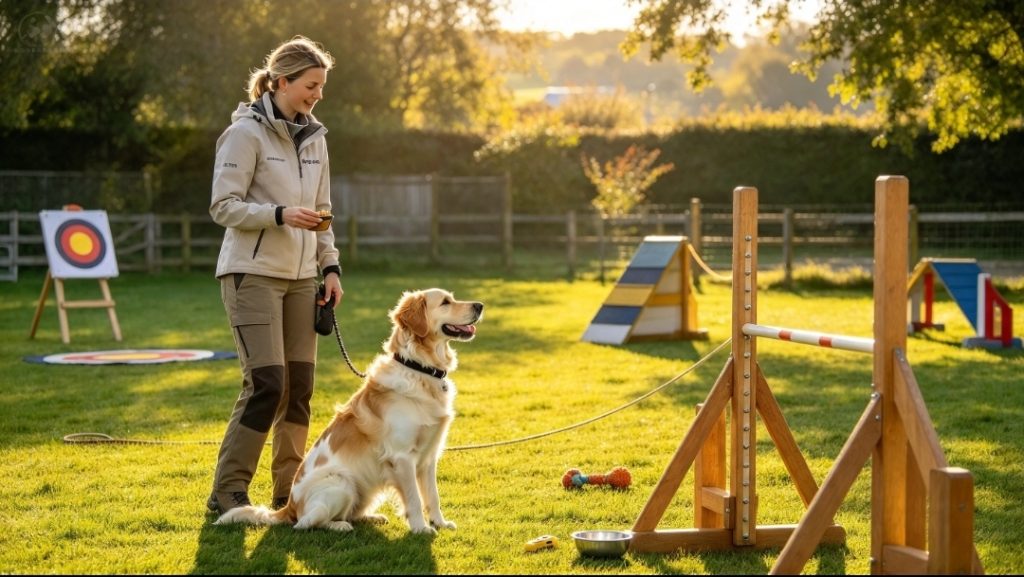
Which Dog Training Method Should I Use?
Which dog training method should I use? Use a reward-based training approach that teaches your dog what you want it to do, reinforces the correct behaviour and gradually reduces help as your dog becomes more reliable. The specific technique you use should depend on the behaviour you are teaching, your dog’s motivation, the environment and how well your dog can concentrate.
RECOMMENDED PRODUCTS

What Is the Best Dog Training Method?
There is no single technique that is best for every training exercise.
Reward-based training provides a useful foundation because it allows you to reinforce behaviours you want your dog to repeat. Within that approach, you can use different techniques such as luring, capturing, shaping and marker training.
The method should match the behaviour rather than forcing every exercise into the same training process.
When Should I Use Lure Training?
Use lure training when you need to guide your dog into a new movement or position.
Food can be used to guide behaviours such as:
- Sit
- Down
- Turning
- Following your hand
- Moving into position
- Beginning loose lead work
Once your dog understands the movement, gradually fade the lure.
The goal is for the dog to respond to your cue rather than waiting to see the food.
When Should I Use Capturing?
Use capturing when your dog naturally performs a behaviour that you want to encourage.
For example, if your dog naturally lies down and settles calmly, you can mark and reward that behaviour.
Capturing can be particularly useful for behaviours such as:
- Settling
- Looking towards you
- Calmly lying down
- Checking in with you
- Naturally choosing an appropriate behaviour
You are rewarding something the dog has already offered rather than guiding it into position.
When Should I Use Shaping?
Use shaping when you want your dog to gradually work out a behaviour through small steps.
Instead of guiding the dog directly into the finished behaviour, you reinforce successive approximations.
For example, when teaching a dog to interact with an object, you might reward:
Looking at it → approaching it → touching it → interacting with it.
Shaping can be useful for more complex behaviours and can encourage the dog to actively work out what produces the reward.
When Should I Use Marker Training?
Use marker training when precise communication about the moment of success would be helpful.
A verbal marker or click can identify the exact moment your dog performs the desired behaviour.
The sequence becomes:
Behaviour → marker → reward.
Marker training can be combined with luring, capturing or shaping rather than being treated as a completely separate training system.
RECOMMENDED PRODUCTS
Should I Use Food or Toys?
Use whichever reward your dog values and can work calmly for.
Food is often useful for teaching precise movements because it can be delivered quickly and easily.
Toys can be effective for dogs that are strongly motivated by play.
However, a highly exciting reward can make some dogs too aroused to concentrate. If this happens, use a calmer reward or reduce the difficulty of the exercise.
The reward should help the dog learn rather than make learning harder.
Should I Use Treats for Every Behaviour?
No. Treats can be useful, but your dog does not need to see food before performing every behaviour.
Once a behaviour is established, give the cue first and reward the correct response afterwards.
This prevents the dog from becoming dependent on a visible treat.
You can also use other rewards, such as toys, play, praise, attention or access to something the dog wants.
Which Method Should I Use to Teach Basic Commands?
For basic commands, start with the simplest method that helps your dog understand the behaviour.
For a new movement, luring may be useful.
Once the dog understands the movement, use a hand signal or verbal cue and reward the response.
Marker training can then help improve the precision of your timing.
A simple progression might be:
Guide → perform → mark → reward → fade the guide → respond to cue.
Which Method Should I Use for Recall?
Recall training should focus on making returning to you highly rewarding while gradually increasing distractions.
Early training can use food, toys or play to make coming towards you valuable.
As the dog improves, give the recall cue before producing the reward.
When practising outdoors, use appropriate physical management and increase distractions gradually. A long line can provide additional control while you build reliability before allowing greater freedom.
Do not test an unreliable recall in situations where the dog could run into danger.
Which Method Should I Use for Loose Lead Walking?
Use reward-based training to reinforce the walking behaviour you want.
A food lure can initially help show the dog where you want it to walk, but the lure should gradually be faded.
A suitable lead and harness can provide safe physical management while the behaviour is being taught.
Reward your dog for maintaining the desired position and gradually practise in more distracting environments.
Equipment should support the training rather than become the method itself.
Which Method Should I Use for Training Around Distractions?
Use gradual progression and environmental management.
Do not start by putting your dog directly into the most distracting environment and expecting perfect obedience.
Instead:
- Start at a manageable distance from the distraction.
- Reward appropriate behaviour.
- Allow your dog to settle and refocus.
- Gradually reduce the distance or increase the difficulty.
- Increase the challenge only when your dog is coping successfully.
If your dog can no longer respond to you, make the exercise easier.
Which Method Should I Use for an Overexcited Dog?
First identify what is causing the increased excitement and whether the dog is still capable of learning.
Reduce the intensity of the situation and create enough space for the dog to regain focus.
Reward calm behaviour when the dog is able to offer it.
Do not continue making the exercise harder when the dog is already struggling to concentrate.
Training becomes more effective when the dog is in a state where it can process information and respond to you.
RECOMMENDED PRODUCTS
Which Method Should I Use for a Nervous or Fearful Dog?
Use gradual exposure combined with positive reinforcement rather than forcing the dog into situations it finds frightening.
Work at a distance or intensity where your dog can remain relatively comfortable and still respond.
Reward calm behaviour and gradually increase the difficulty as the dog becomes more confident.
If the dog is highly fearful, repeatedly panics or cannot cope with the situation, seek professional guidance rather than trying to force progress.
Which Method Should I Use for a Reactive Dog?
There is no single generic training method that should be applied to every reactive dog.
The first priority is safe management and understanding what is triggering the reaction.
Increase distance from the trigger, avoid situations the dog cannot cope with and use appropriate equipment for safe handling.
Reward desirable responses when the dog is able to remain calm enough to learn.
For significant reactivity, particularly where there is a risk of aggression or biting, professional assessment is appropriate.
Should I Use a Crate, Playpen or Placemat?
These are management and training tools rather than complete training methods.
A placemat can provide a clear place for a dog to practise calm settling.
A playpen can provide a controlled area when greater physical separation or management is needed.
A crate can provide a secure recovery or resting space when introduced positively and used appropriately.
None of these should be used as punishment or as a substitute for teaching the desired behaviour.
Do I Need to Use One Training Method?
No. You can combine different techniques when doing so makes the training clearer.
For example, you could use a food lure to introduce a movement, a marker to identify the correct moment and food to reinforce the completed behaviour.
You might then fade the lure, establish a verbal cue and use environmental management while practising the behaviour around distractions.
The techniques are tools that can be selected according to the learning task.
How Do I Know If My Training Method Is Working?
Look at your dog’s behaviour rather than simply how many repetitions you have completed.
A useful training method should result in your dog gradually:
- Understanding what is expected.
- Responding more consistently.
- Needing less physical or visual guidance.
- Working successfully in different environments.
- Coping with gradually increasing distractions.
- Requiring less help to perform the behaviour.
If your dog repeatedly fails, becomes confused or becomes too distracted to respond, the exercise may be too difficult or the method may need adjusting.
What Should I Do If a Training Method Is Not Working?
Do not simply repeat the same exercise more forcefully or for longer.
First consider:
- Is the behaviour clearly defined?
- Does the dog understand the cue?
- Is the reward valuable enough?
- Is the timing accurate?
- Is the environment too distracting?
- Is the exercise too difficult?
- Has the lure been faded too quickly?
- Is the training session too long?
Make the exercise easier, improve the clarity of the communication and reward successful responses.
If the problem involves serious aggression, biting, severe fear or significant behavioural distress, seek professional help.
Which Dog Training Method Should I Choose?
Start with reward-based training, then choose the specific technique according to what you are trying to teach.
Use luring to guide new movements, capturing to reinforce naturally offered behaviour, shaping for gradual learning and marker training when precise timing is useful.
Then progress the behaviour by fading assistance and gradually increasing difficulty.
The best method is not necessarily the one with the most complicated technique. It is the method that clearly communicates the desired behaviour, allows your dog to succeed and can be progressed appropriately.
Conclusion
The dog training method you should use depends on what you are teaching, what motivates your dog and how difficult the current situation is.
Reward-based training can provide the foundation, while luring, capturing, shaping, marker training and environmental management can be selected when they are appropriate.
Start with the simplest approach that helps your dog understand, reward the behaviour you want and gradually reduce assistance as your dog’s reliability improves.
GPK9 — The Five Golden Rules
The GPK9 Five Golden Rules provide the foundation of the GPK9 Professional Training System. They give new dog owners, new dog handlers, experienced handlers and professional dog trainers a clear structure for developing the dog and the handler together.
The GPK9 Five Golden Rules cover five essential areas of development: Home & Social, Obedience, Prey Drive, Toilet and Social Walking. Each area has its own purpose, but they are designed to work together as one complete training system.
The GPK9 approach is based on CATEGORY → STATUS → DRIVE → CONTROL and the handler’s ability to OBSERVE → INTERPRET → DECIDE → COMMUNICATE → OBSERVE RESPONSE → REASSESS. This gives the handler a consistent process for understanding what the dog is doing, why the behaviour is occurring, what level of control is appropriate and how to communicate effectively.
The purpose of the GPK9 Five Golden Rules is not simply to teach a collection of individual exercises. They are designed to develop the dog’s behaviour, motivation, communication, control and reliability while teaching the handler how to make better decisions.
Golden Rule One — Home & Social
Golden Rule One — Home & Social establishes the foundation for everyday life with the dog. It focuses on communication, boundaries, calm behaviour, household routines and appropriate behaviour around people, animals and normal activity.
The purpose of Golden Rule One — Home & Social is to help the handler understand the dog’s behaviour and recognise changes in arousal before they become larger problems. The handler learns to observe, assess and communicate rather than simply reacting after unwanted behaviour has already occurred.
Golden Rule One — Home & Social provides the foundation from which the handler can develop a calmer, more predictable and better-communicating dog.
Golden Rule Two — Obedience
Golden Rule Two — Obedience develops the dog’s ability to understand and respond to the handler’s communication.
The focus of Golden Rule Two — Obedience is not simply teaching commands. It is about developing understanding, reliability, timing, reward, release and control so the dog learns what the handler is communicating.
Through Golden Rule Two — Obedience, the handler learns to progress training appropriately, gradually increasing the dog’s freedom and responsibility as understanding and reliability improve.
Golden Rule Three — Prey Drive
Golden Rule Three — Prey Drive focuses on understanding and developing the dog’s natural motivation to chase, pursue, engage and work with an appropriate toy or prey-based reward.
The purpose of Golden Rule Three — Prey Drive is not simply to increase drive. The handler must learn how to recognise the dog’s level of motivation, select an appropriate reward and use timing, communication and control to channel that motivation productively.
Golden Rule Three — Prey Drive teaches the handler that motivation can become a powerful training tool when it is developed and controlled correctly.
Golden Rule Four — Toilet
Golden Rule Four — Toilet establishes reliable toilet habits through consistency, observation, timing, supervision and appropriate reinforcement.
The handler learns through Golden Rule Four — Toilet to recognise when the dog is likely to need the toilet, provide the correct opportunity and reinforce the desired behaviour.
The objective of Golden Rule Four — Toilet is to establish a predictable routine that helps the dog understand where and when toileting is appropriate while reducing opportunities for mistakes.
Golden Rule Five — Social Walking
Golden Rule Five — Social Walking develops the dog’s ability to walk calmly and appropriately in the real world while remaining connected to the handler.
The focus of Golden Rule Five — Social Walking is the relationship between the handler, the dog, the environment, distractions, distance and available control.
Through Golden Rule Five — Social Walking, the handler learns to observe body language, identify potential triggers, assess distance and recognise changes in drive or arousal before behaviour escalates.
The objective of Golden Rule Five — Social Walking is not simply to make the dog walk beside the handler. It is to develop a dog that can experience the outside world while remaining connected to the handler and capable of responding to clear communication.
How the Five Golden Rules Work Together
The GPK9 Five Golden Rules are designed to work together rather than being treated as five completely separate subjects.
Golden Rule One — Home & Social establishes the foundations for everyday behaviour and communication.
Golden Rule Two — Obedience develops understanding, responsiveness and control.
Golden Rule Three — Prey Drive develops motivation and teaches the handler how to channel natural drive appropriately.
Golden Rule Four — Toilet establishes essential household routine and reliability.
Golden Rule Five — Social Walking takes the communication and control developed through the other areas into the outside environment.
Together, the GPK9 Five Golden Rules help the handler develop a complete understanding of the dog rather than treating individual behaviours as isolated problems.
The overall objective of the GPK9 Five Golden Rules is to train the human, train the dog and build the partnership through clear observation, communication, appropriate control and progressive development.




