How often should I train my dog?
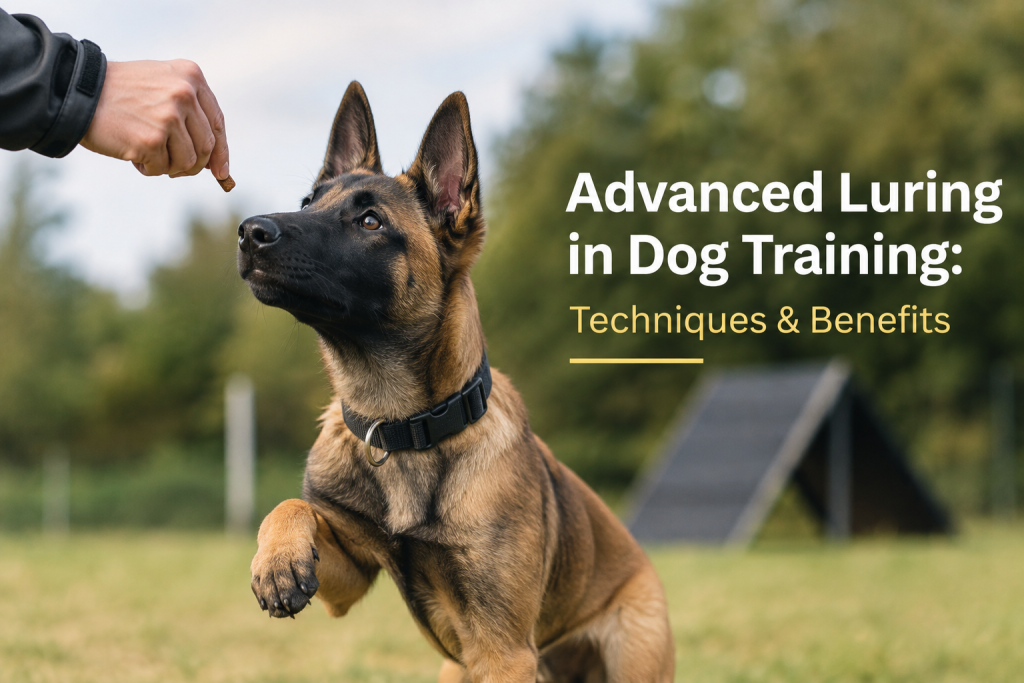
Create a professional, realistic photograph showing a dog owner training their dog during a calm, structured training session at home. The dog should be an attentive adult dog with a relaxed expression, focused naturally on the handler while responding to a simple training exercise. Show the handler using positive reinforcement and food motivation, with a training treat pouch accessible at their side. Include a placemat in the training area, with a crate and playpen positioned naturally within the room to represent appropriate management, controlled freedom and resetting. Include a suitable lead and harness nearby. The room should be clean, practical and uncluttered, with enough space for the handler and dog to train comfortably. The scene should communicate regular, consistent training rather than one long intensive session. The dog should appear engaged and comfortable, with the handler demonstrating patience and clear communication. No logos, written text, watermarks or branding.
RECOMMENDED PRODUCTS

HOW OFTEN SHOULD I TRAIN MY DOG?
Dog training should be regular and consistent rather than based on occasional long training sessions. The appropriate frequency depends on the individual dog, the behaviour being taught, the training environment and how well the dog is responding. Training should provide repeated opportunities to learn, while allowing the dog to remain engaged and able to respond appropriately. Positive reinforcement, food, patience and suitable motivation can all be used to make regular training productive.
FOCUS ON CONSISTENCY
Regular training gives your dog repeated opportunities to understand and practise the behaviour you are teaching.
Consistency is more important than simply trying to complete as much training as possible in one session. A dog needs time to learn the behaviour, respond to the handler and gradually develop reliability.
Training should therefore become part of the dog’s normal routine rather than something that only happens occasionally.
KEEP TRAINING APPROPRIATE FOR YOUR DOG
There is no single training frequency that is suitable for every dog.
Consider the dog’s individual food drive, prey drive, previous learning, environment and ability to remain engaged.
A dog with a high food drive may remain motivated during food-based training, while a dog with a lower food drive may require greater consideration of motivation and the training environment.
The same principle applies to prey drive when play or movement is being used as part of training.
Observe how your dog responds and use that information to determine whether the current training is appropriate.
A training pouch can keep rewards readily available and make regular training easier to incorporate into everyday activities.
TRAIN REGULARLY RATHER THAN ONLY WHEN THERE IS A PROBLEM
Training should not only happen when your dog is doing something you do not want.
Regular practice allows you to reinforce appropriate behaviour before problems develop and helps the dog understand what is expected.
Training can be incorporated into everyday situations, provided the environment and level of difficulty are appropriate.
The objective is to create repeated opportunities for successful learning rather than waiting for a behaviour to become difficult before addressing it.
START IN A CONTROLLED ENVIRONMENT
Training frequency is closely connected to the quality of each training opportunity.
A calm home environment may provide a useful starting point because unnecessary distractions can be controlled. Once your dog is responding reliably, you can gradually introduce different environments and distractions.
If the dog begins struggling, assess the situation rather than simply training more frequently.
Removing unnecessary distractions and returning to a more manageable environment may be more useful than increasing the amount of training.
KNOW WHEN YOUR DOG IS READY TO CONTINUE
Watch your dog’s response during training.
If the dog remains engaged, responds appropriately and is able to perform the behaviour, you can continue developing the exercise.
If the dog becomes distracted or struggles to respond, assess what has changed. The environment may be too difficult, the level of freedom may be too high or the dog may need to calm before continuing.
Where appropriate, toys and rewards can provide additional motivation during training, particularly for dogs that respond strongly to play or prey-drive-based activities.
USE APPROPRIATE CONTROL AND MANAGEMENT
Regular training should take place within an appropriate level of control.
A short line may be appropriate for some training exercises, while a harness can provide suitable management where required. A long line can provide increased movement while maintaining an appropriate level of control.
Free roam should be introduced when the dog’s behaviour is sufficiently reliable for the environment.
Increased freedom should be accompanied by appropriate behavioural responsibility.
Leads and long lines can support regular training by providing different levels of control as your dog’s reliability develops and freedom is gradually increased.
RECOMMENDED PRODUCTS
USE THE HOME ENVIRONMENT BETWEEN TRAINING SESSIONS
The learning process does not stop when a formal training exercise finishes.
A placemat can provide opportunities to practise stationing, settling and controlled freedom within the home. A playpen can provide controlled freedom within a defined boundary, while a crate can form part of appropriate management, rest, routine and resetting.
These forms of management can help reinforce the structure of the training environment throughout everyday life.
Crates and pens can provide appropriate management between and during training activities, particularly when a dog needs defined boundaries, rest or controlled freedom.
DON’T CONTINUE WHEN TRAINING IS NO LONGER PRODUCTIVE
Training more often does not necessarily mean training more effectively.
If your dog is no longer responding appropriately, stop and assess the situation. Continuing to repeat the exercise while the dog is struggling may not provide a useful learning opportunity.
Remove unnecessary distractions, allow the dog to calm and reassess.
Where appropriate, use a reset before returning to the relevant training exercise at a level the dog can manage.
PROGRESS GRADUALLY
As your dog becomes more reliable, training can progress by gradually increasing the difficulty.
This could mean changing the environment, introducing distractions, increasing distance or allowing greater freedom.
Do not increase several areas of difficulty unnecessarily at the same time.
Observe the dog’s response after each change. If the dog continues to respond appropriately, you can continue progressing. If the dog struggles, reduce the difficulty and rebuild from a successful stage.
HOW DO I KNOW IF I AM TRAINING ENOUGH?
The most useful measure is not simply the number of training sessions completed.
Look at the dog’s behaviour and ask whether the dog is learning, becoming more reliable and successfully applying the behaviour in the situations where it is required.
If the dog is progressing, the current training process may be appropriate.
If progress has stopped, assess the motivation, environment, difficulty and management rather than automatically increasing the amount of training.
WHEN SHOULD I REDUCE OR CHANGE TRAINING?
If your dog repeatedly struggles to respond, becomes distracted or cannot maintain the behaviour, reassess the current training process.
The solution may be to reduce environmental difficulty, change the level of control, improve the training environment, allow the dog to calm or return to an earlier stage.
Once the dog is responding appropriately again, continue the relevant exercise and progress gradually.
Training should remain productive and appropriate for the individual dog.