
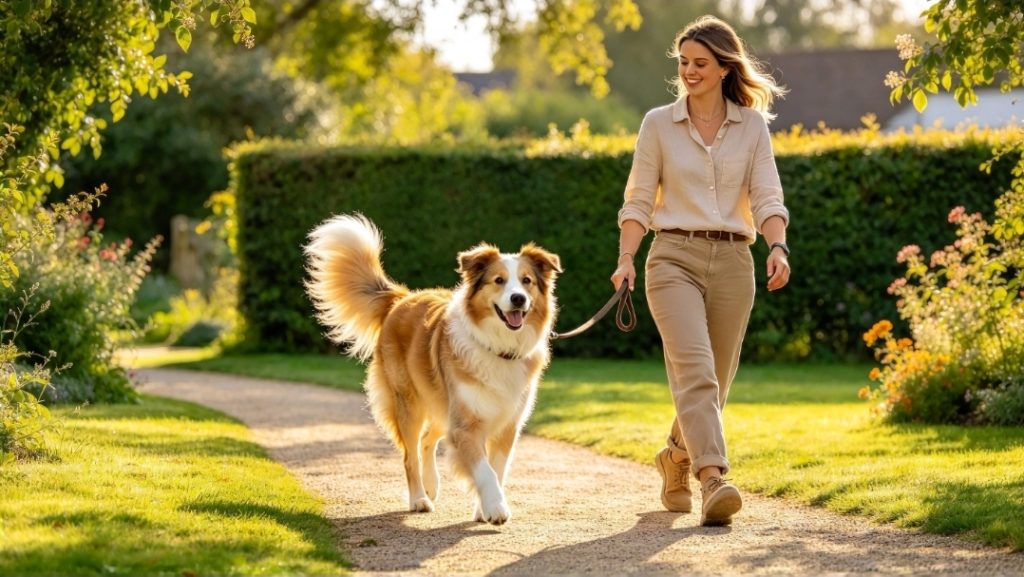
How Long Does It Take to Retrain an Older Dog?
How long does it take to retrain an older dog? There is no fixed timeframe because it depends on the behaviour, how long the dog has practised it, its ability to learn, and how consistently you train. A simple behaviour may improve quickly, while an established habit can take weeks or months to change.
RECOMMENDED PRODUCTS

How quickly can an older dog learn?
An older dog can learn new behaviours just as it can learn new commands.
Age alone does not determine how quickly a dog learns. The difficulty of the behaviour, the dog’s previous learning, motivation and the training environment can all affect progress.
A behaviour that your dog already understands but has become unreliable may be easier to rebuild than a behaviour that has been repeated incorrectly for years.
Why can retraining take longer than normal training?
Retraining often means changing an existing response rather than teaching something completely new.
If your dog has repeatedly pulled on the lead, ignored recall or jumped at people, that behaviour may have become well established.
You therefore need to teach an alternative behaviour while also preventing the unwanted behaviour from being repeatedly practised.
What affects how long retraining takes?
Several factors can influence progress.
The behaviour
Simple behaviours such as responding to a name or sitting may improve relatively quickly.
More complicated behaviours such as reliable recall, calm greetings or reacting to other dogs can take considerably longer.
How long the behaviour has been happening
A behaviour repeated for years may require more consistent retraining than a recently developed habit.
Your dog’s motivation
Dogs learn more effectively when the reward is meaningful to them.
Food, toys, praise or another appropriate reward can be used depending on the individual dog.
The training environment
A dog may learn a behaviour in a quiet room but struggle to perform it around people, dogs, traffic or other distractions.
Progress therefore depends partly on how gradually you increase difficulty.
Consistency
Training once a week is very different from practising appropriate behaviour regularly.
Short, consistent sessions give your dog more opportunities to learn and repeat the correct response.
How should I retrain an older dog?
Start with an easy version of the behaviour
Begin somewhere your dog can succeed.
Do not immediately test the behaviour in the most difficult environment.
Reward the correct response
Use positive reinforcement immediately after your dog performs the behaviour you want.
Good timing helps your dog understand exactly what earned the reward.
Prevent unnecessary repetition of the unwanted behaviour
Management is important while retraining.
For example, if your dog jumps at visitors, manage access to visitors while teaching your dog how to greet calmly.
Increase difficulty gradually
Once your dog is reliable at an easier level, gradually introduce distractions, distance or duration.
If performance deteriorates, reduce the difficulty rather than simply repeating the command.
How long does it take to retrain an older dog to walk nicely?
Lead walking can improve relatively quickly, but reliable behaviour in different environments may take longer.
Start in a quiet area and reward appropriate lead behaviour.
Once your dog is consistent, gradually introduce more distractions and busier locations.
A comfortable harness and lead can help with management while training, and a short line may provide closer control when appropriate.
How long does it take to retrain an older dog’s recall?
Recall can take considerable time if it has become unreliable.
Start in a secure environment and reward your dog for returning to you.
A long line can provide additional control while you gradually increase distance and distractions.
Do not rely on an unreliable recall in an uncontrolled environment.
How long does it take to change barking or jumping?
The timeframe depends on why the behaviour happens and how established it is.
For jumping, teach and reward an alternative calm behaviour while preventing people from accidentally rewarding the jumping.
For barking, identify the trigger and teach an appropriate response rather than simply trying to suppress the noise.
The more consistently the unwanted behaviour has been practised, the more important management becomes during retraining.
RECOMMENDED PRODUCTS
How long does it take to retrain a reactive older dog?
Reactivity can take longer to change because the training needs to be carefully controlled around triggers.
Start at a distance where your dog can remain sufficiently calm to learn.
Reward appropriate responses and gradually work towards greater levels of difficulty.
Do not deliberately push your dog into a reaction to see whether it has improved.
If there is aggression, attempted biting or a significant safety concern, seek professional behavioural support.
What if my older dog is not improving?
Do not automatically assume your dog needs more repetition.
Review the training difficulty, rewards, timing and environment.
Ask whether your dog understands what you are asking and whether the behaviour is physically comfortable.
If an older dog suddenly changes behaviour or stops responding to previously understood commands, consider a veterinary assessment. Pain, hearing loss, vision problems or other health issues can affect training.
Should I train for a long time each day?
Not necessarily.
Short, regular training sessions are usually more useful than exhausting your dog with long sessions.
End sessions while your dog is still able to concentrate and perform the behaviour successfully.
Training can also be incorporated into normal daily routines rather than being limited to formal sessions.
Should I punish my older dog during retraining?
No.
Punishment does not teach your dog the behaviour you want instead.
Focus on managing the unwanted behaviour, teaching an appropriate alternative and rewarding your dog when it makes the correct choice.
When should I get professional help?
Seek professional help if the behaviour involves aggression, biting, severe fear, significant reactivity or another safety concern.
Professional support can also be useful when you have trained consistently but cannot identify why the behaviour is not improving.
Conclusion
There is no set amount of time required to retrain an older dog. Some behaviours may improve quickly, while established habits can take weeks or months of consistent training.
Start with an easy version of the behaviour, reward the correct response, prevent unnecessary repetition of the unwanted behaviour and increase difficulty gradually.
The goal is not to rush the process. The goal is to build reliable behaviour that your older dog can continue to perform in everyday situations.
GPK9 — The Five Golden Rules
The GPK9 Five Golden Rules provide the foundation of the GPK9 Professional Training System. They give new dog owners, new dog handlers, experienced handlers and professional dog trainers a clear structure for developing the dog and the handler together.
The GPK9 Five Golden Rules cover five essential areas of development: Home & Social, Obedience, Prey Drive, Toilet and Social Walking. Each area has its own purpose, but they are designed to work together as one complete training system.
The GPK9 approach is based on CATEGORY → STATUS → DRIVE → CONTROL and the handler’s ability to OBSERVE → INTERPRET → DECIDE → COMMUNICATE → OBSERVE RESPONSE → REASSESS. This gives the handler a consistent process for understanding what the dog is doing, why the behaviour is occurring, what level of control is appropriate and how to communicate effectively.
The purpose of the GPK9 Five Golden Rules is not simply to teach a collection of individual exercises. They are designed to develop the dog’s behaviour, motivation, communication, control and reliability while teaching the handler how to make better decisions.
Golden Rule One — Home & Social
Golden Rule One — Home & Social establishes the foundation for everyday life with the dog. It focuses on communication, boundaries, calm behaviour, household routines and appropriate behaviour around people, animals and normal activity.
The purpose of Golden Rule One — Home & Social is to help the handler understand the dog’s behaviour and recognise changes in arousal before they become larger problems. The handler learns to observe, assess and communicate rather than simply reacting after unwanted behaviour has already occurred.
Golden Rule One — Home & Social provides the foundation from which the handler can develop a calmer, more predictable and better-communicating dog.
Golden Rule Two — Obedience
Golden Rule Two — Obedience develops the dog’s ability to understand and respond to the handler’s communication.
The focus of Golden Rule Two — Obedience is not simply teaching commands. It is about developing understanding, reliability, timing, reward, release and control so the dog learns what the handler is communicating.
Through Golden Rule Two — Obedience, the handler learns to progress training appropriately, gradually increasing the dog’s freedom and responsibility as understanding and reliability improve.
Golden Rule Three — Prey Drive
Golden Rule Three — Prey Drive focuses on understanding and developing the dog’s natural motivation to chase, pursue, engage and work with an appropriate toy or prey-based reward.
The purpose of Golden Rule Three — Prey Drive is not simply to increase drive. The handler must learn how to recognise the dog’s level of motivation, select an appropriate reward and use timing, communication and control to channel that motivation productively.
Golden Rule Three — Prey Drive teaches the handler that motivation can become a powerful training tool when it is developed and controlled correctly.
Golden Rule Four — Toilet
Golden Rule Four — Toilet establishes reliable toilet habits through consistency, observation, timing, supervision and appropriate reinforcement.
The handler learns through Golden Rule Four — Toilet to recognise when the dog is likely to need the toilet, provide the correct opportunity and reinforce the desired behaviour.
The objective of Golden Rule Four — Toilet is to establish a predictable routine that helps the dog understand where and when toileting is appropriate while reducing opportunities for mistakes.
Golden Rule Five — Social Walking
Golden Rule Five — Social Walking develops the dog’s ability to walk calmly and appropriately in the real world while remaining connected to the handler.
The focus of Golden Rule Five — Social Walking is the relationship between the handler, the dog, the environment, distractions, distance and available control.
Through Golden Rule Five — Social Walking, the handler learns to observe body language, identify potential triggers, assess distance and recognise changes in drive or arousal before behaviour escalates.
The objective of Golden Rule Five — Social Walking is not simply to make the dog walk beside the handler. It is to develop a dog that can experience the outside world while remaining connected to the handler and capable of responding to clear communication.
How the Five Golden Rules Work Together
The GPK9 Five Golden Rules are designed to work together rather than being treated as five completely separate subjects.
Golden Rule One — Home & Social establishes the foundations for everyday behaviour and communication.
Golden Rule Two — Obedience develops understanding, responsiveness and control.
Golden Rule Three — Prey Drive develops motivation and teaches the handler how to channel natural drive appropriately.
Golden Rule Four — Toilet establishes essential household routine and reliability.
Golden Rule Five — Social Walking takes the communication and control developed through the other areas into the outside environment.
Together, the GPK9 Five Golden Rules help the handler develop a complete understanding of the dog rather than treating individual behaviours as isolated problems.
The overall objective of the GPK9 Five Golden Rules is to train the human, train the dog and build the partnership through clear observation, communication, appropriate control and progressive development.




