
How Do You Train a Dog?
How do you train a dog? You train a dog by building clear communication, using positive reinforcement, developing reliable behaviours through repetition and timing, and learning to recognise what the dog is communicating through its body language and behaviour. Effective dog training is not simply about teaching commands; it is about helping the dog understand what behaviour is expected, rewarding the correct response, remaining patient and calm, and gradually increasing the level of difficulty as the dog becomes more reliable.
RECOMMENDED PRODUCTS

What Does Dog Training Involve?
Dog training involves teaching the dog how to understand and respond to information provided by the handler. This can include voice commands, hand signals, eye contact, touch, food, toys, markers, release cues, movement, equipment and access to different environments.
Training should be based on the individual dog. The handler needs to observe the dog’s behaviour, understand its level of motivation and assess its response before deciding what to do next.
The GPK9 approach uses:
CATEGORY → STATUS → DRIVE → CONTROL
The handler then uses:
OBSERVE → INTERPRET → DECIDE → COMMUNICATE → OBSERVE RESPONSE → REASSESS
This gives the handler a structured process rather than simply reacting to whatever the dog does.
Start With Communication
Before expecting a dog to perform complicated behaviours, the handler needs to establish clear communication.
Communication can involve:
- Voice
- Eye contact
- Touch
- Food
- Toys
- Markers
- Timing
- Movement
- Body position
- Equipment
- Reward
- Release
The dog needs to understand what the handler is communicating and what behaviour produces the desired outcome.
A handler should therefore avoid constantly changing signals or expectations. Consistency helps the dog understand what is being asked.
Observe the Dog Before Training
A handler should observe the dog before deciding how to train.
Look at:
- Body language
- Attention
- Movement
- Energy
- Motivation
- Food drive
- Toy or prey drive
- Environmental interest
- Distance from distractions
- Ability to remain focused
- Changes in arousal
The same exercise may produce different results depending on the dog’s current state.
A dog that is calm and engaged may be ready to learn. A dog that is highly distracted or increasingly aroused may require the handler to reduce difficulty, increase distance or change the training environment.
Observation comes before communication.
RECOMMENDED PRODUCTS
Positive Reinforcement
Positive reinforcement is an important part of dog training because it allows the handler to strengthen behaviours that the dog performs correctly.
When the dog produces the desired behaviour, the handler can provide an appropriate reward.
Rewards may include:
- Food
- Kibble
- A toy
- Play
- Access to something the dog wants
- Handler interaction
The reward needs to be appropriate for the individual dog and the situation.
A food-motivated dog may respond strongly to food, while another dog may work more effectively for a toy or play.
The important part is understanding what motivates the dog and using that motivation appropriately.
Timing Is Important
The timing of reinforcement matters.
The handler needs to understand what the dog is doing at the moment the reward or marker is provided.
If the dog performs the desired behaviour and the reward is delivered at the correct time, the dog has a clearer opportunity to understand what behaviour produced the reinforcement.
Good timing helps create clear communication.
Be Patient
Training should not become a battle between the handler and the dog.
If the dog does not understand something, the handler should remain calm and consider whether the exercise is too difficult, whether the communication is unclear or whether the environment contains too many distractions.
Patience allows the handler to reassess rather than becoming frustrated.
Do not allow frustration to replace communication.
Use the Dog’s Body Language
A dog communicates continuously through its body language.
The handler should observe changes in:
- Body position
- Ears
- Eyes
- Mouth
- Tail
- Movement
- Muscle tension
- Attention
- Distance
- General arousal
These observations help the handler understand whether the dog is engaged, distracted, uncertain, excited or becoming increasingly difficult to control.
The handler can then adjust the training accordingly.
Training should respond to the dog rather than forcing the dog through an exercise when it is no longer able to respond appropriately.
Teach One Behaviour Clearly
When introducing a new behaviour, the handler should make the exercise understandable.
The dog needs to learn:
- What behaviour is being requested.
- What response is correct.
- What happens when the correct response occurs.
- When the behaviour has finished.
- When the behaviour can be performed again.
The handler can then repeat the exercise and gradually develop reliability.
Reward the Behaviour You Want
The handler should be clear about exactly what behaviour is being reinforced.
If the dog is being taught to remain still, the handler should understand when the dog is correctly performing the behaviour.
If the dog is being taught to return to the handler, the handler needs to recognise and reward the correct return.
If the dog is being taught to walk calmly, the handler should reinforce the appropriate behaviour rather than waiting until the dog has already become highly distracted.
Reward the behaviour you want the dog to repeat.
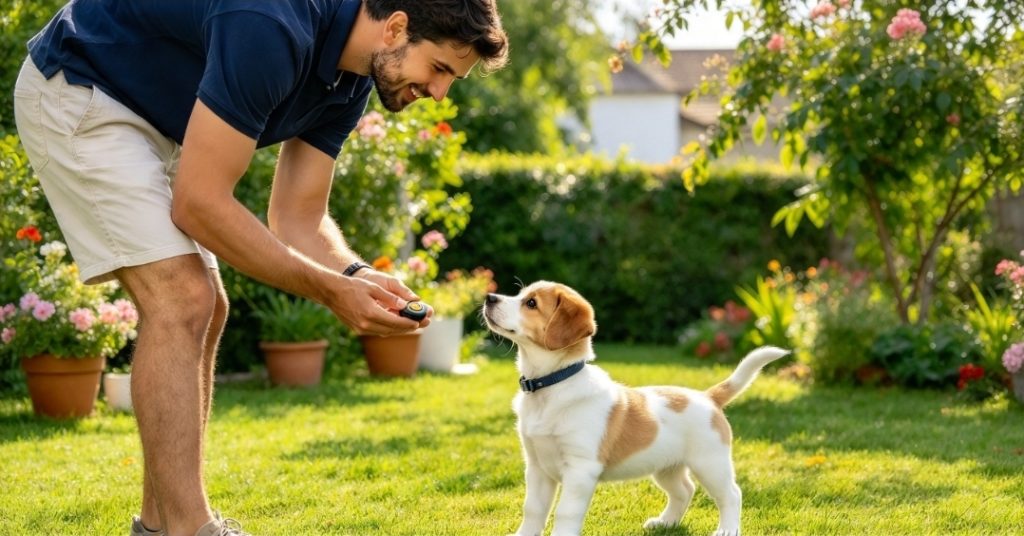
Use Markers When Appropriate
A marker can help communicate to the dog that it has performed the desired behaviour.
A marker may be verbal or may involve a clicker.
The important factor is timing and consistency.
The handler must understand what behaviour is being marked so that the dog receives clear information.
A clicker can therefore be useful when the handler understands how to use it correctly. It is not the clicker itself that trains the dog; it is the communication, timing and reinforcement surrounding its use.
Use Food Correctly
Food can be a powerful training tool.
Food may be used to:
- Encourage engagement
- Lure a behaviour
- Reinforce a completed behaviour
- Maintain attention
- Develop motivation
- Build repetition
- Reward appropriate responses
Food should not simply be given randomly throughout training.
The handler should understand what behaviour the food is reinforcing.
As training develops, the handler can adjust how food is used so the dog learns to respond to communication rather than simply following food continuously.
Use Toys and Prey-Based Rewards
Some dogs are highly motivated by toys and play.
A toy can provide reinforcement while also developing motivation and engagement.
Prey-based activity needs to be appropriate to the individual dog and controlled by the handler.
The handler should observe the dog’s level of drive and understand when motivation is helping training and when increasing arousal is making communication more difficult.
Drive can become a powerful training tool when it is developed and controlled correctly.
RECOMMENDED PRODUCTS
Use a Crate Correctly
A crate can form part of a dog’s management and training environment.
The crate should provide a controlled space where the dog can settle and recover when appropriate.
It should not be used as a substitute for teaching the dog how to behave.
The handler should understand the difference between training a behaviour and managing the environment.
The crate can therefore support training by helping the handler control the environment while the dog learns.
Use a Place Mat
A place mat can be used as a defined area for calm behaviour.
The handler can teach the dog that the mat is associated with remaining settled and responding appropriately to communication.
The place mat can help establish a clear location for calm behaviour within the training environment.
As with any training tool, the mat should support communication rather than replace it.
Use a Playpen
A playpen can provide another controlled area when the handler needs to manage the dog’s environment.
It can be useful when the dog needs more space than a crate while still requiring a controlled area.
The handler should understand why the dog is being placed in the area and what behaviour is expected.
Management should support training rather than become the entire training process.
Use a Harness
A harness can provide an appropriate method of controlling the dog during training and movement.
The handler should select equipment appropriate to the dog’s circumstances and understand how the equipment affects the level of control available.
Equipment does not teach the dog by itself.
The handler still needs to communicate clearly and observe the dog’s response.
Use a Short Line
A short line can provide closer control when teaching behaviours or working in environments where greater control is required.
It allows the handler to maintain a connection with the dog while developing understanding and reliability.
The handler should avoid using equipment as a substitute for training.
The objective is to develop the dog’s ability to respond to communication while using an appropriate level of control.
Use a Long Line
A long line can provide additional freedom while maintaining a physical connection to the dog.
It can be useful when progressing training into larger areas and gradually increasing distance.
The principle is:
More freedom requires more behavioural responsibility.
As the dog’s reliability improves, the handler can gradually provide greater freedom.
Use a Muzzle When Appropriate
A muzzle may be required in situations where additional safety and control are necessary.
Where a muzzle is used, the handler should understand that it is a management tool rather than a replacement for training.
The dog should still be observed and trained appropriately.
The handler must consider the dog’s body language, environment and level of control rather than relying on the equipment alone.
Progress Training Gradually
Once the dog understands a behaviour, the handler can gradually increase difficulty.
This may involve changing:
- Distance
- Duration
- Distractions
- Environment
- Handler movement
- Reward
- Level of freedom
- Amount of control
The handler should avoid changing everything at once.
If the dog is successful, training can progress.
If the dog struggles, the handler should observe, assess the situation and adjust the difficulty.
Progression should be earned through understanding and reliability.
RECOMMENDED PRODUCTS
Train in Different Environments
A dog may understand a behaviour inside the home but struggle to perform the same behaviour outside.
This does not necessarily mean the dog has forgotten the behaviour.
The environment may contain different distractions, smells, people, animals, movement and levels of stimulation.
The handler should therefore gradually introduce new environments and assess the dog’s response.
Training should progress from appropriate levels of difficulty rather than expecting immediate reliability everywhere.
Keep Training Sessions Appropriate
Training should be structured around the dog’s ability to remain engaged.
The handler should observe the dog rather than continuing simply because a predetermined amount of time has passed.
If attention decreases, communication becomes less effective or the dog becomes increasingly distracted, the handler should reassess.
Quality of training is more important than simply continuing for longer.
Repeat and Reinforce
Dogs learn through repetition and reinforcement.
The handler should provide repeated opportunities for the dog to perform the desired behaviour correctly.
However, repetition should not mean endlessly repeating a command when the dog is not responding.
If the dog does not respond, the handler should consider:
- Was the communication clear?
- Was the behaviour properly taught?
- Was the environment too difficult?
- Was the reward appropriate?
- Was the dog sufficiently motivated?
- Was the dog becoming distracted?
- Was the level of control appropriate?
The answer may be to adjust the training rather than simply repeat the same command.
Build Reliability Before Increasing Freedom
A dog should not automatically receive greater freedom simply because it has performed a behaviour correctly once.
Reliability needs to develop through repetition and different environments.
The handler should progressively increase responsibility as the dog’s understanding improves.
This allows freedom and control to develop together.
More freedom requires more behavioural responsibility.
What If the Dog Gets It Wrong?
A mistake should be treated as information.
The handler should observe what happened and determine why the dog did not respond as expected.
The problem may be:
- Unclear communication
- Excessive distraction
- Insufficient motivation
- Incorrect timing
- Excessive distance
- Excessive freedom
- Too much difficulty
- Insufficient understanding
The handler should then adjust the training and try again at an appropriate level.
Observe the response, reassess and communicate again.
Train the Human as Well as the Dog
Effective dog training requires the handler to learn as well.
The handler needs to understand:
- What the dog is doing
- Why the dog is doing it
- What the dog is communicating
- What motivates the dog
- What level of control is appropriate
- How to communicate
- When to reward
- When to release
- When to increase difficulty
- When to reduce difficulty
Dog training is therefore a partnership between the dog and the handler.
The GPK9 Training Process
The GPK9 Professional Training System provides a structured approach to training.
The handler begins with:
CATEGORY → STATUS → DRIVE → CONTROL
The handler then applies:
OBSERVE → INTERPRET → DECIDE → COMMUNICATE → OBSERVE RESPONSE → REASSESS
This means the handler does not simply issue commands and hope the dog responds.
The handler observes the dog, interprets what is happening, decides what action is appropriate, communicates clearly, observes the response and reassesses the situation.
This process can be applied across different training environments and behaviours.
How Do You Train a Dog Successfully?
To train a dog successfully, the handler needs to develop clear communication, appropriate motivation, good timing, patience, consistency and progressive control.
The handler should observe the dog before deciding what to do, use positive reinforcement to strengthen appropriate behaviour, remain calm when training becomes difficult and adjust the level of difficulty according to the dog’s response.
Training should develop from simple communication into increasingly reliable behaviour.
The objective is not simply to make a dog perform commands.
The objective is to develop understanding, communication, motivation, control and reliability while building the partnership between the dog and handler.
GPK9 — The Five Golden Rules
The GPK9 Five Golden Rules provide the foundation of the GPK9 Professional Training System. They give new dog owners, new dog handlers, experienced handlers and professional dog trainers a clear structure for developing the dog and the handler together.
The GPK9 Five Golden Rules cover five essential areas of development: Home & Social, Obedience, Prey Drive, Toilet and Social Walking. Each area has its own purpose, but they are designed to work together as one complete training system.
The GPK9 approach is based on CATEGORY → STATUS → DRIVE → CONTROL and the handler’s ability to OBSERVE → INTERPRET → DECIDE → COMMUNICATE → OBSERVE RESPONSE → REASSESS. This gives the handler a consistent process for understanding what the dog is doing, why the behaviour is occurring, what level of control is appropriate and how to communicate effectively.
The purpose of the GPK9 Five Golden Rules is not simply to teach a collection of individual exercises. They are designed to develop the dog’s behaviour, motivation, communication, control and reliability while teaching the handler how to make better decisions.
Golden Rule One — Home & Social
Golden Rule One — Home & Social establishes the foundation for everyday life with the dog. It focuses on communication, boundaries, calm behaviour, household routines and appropriate behaviour around people, animals and normal activity.
The purpose of Golden Rule One — Home & Social is to help the handler understand the dog’s behaviour and recognise changes in arousal before they become larger problems. The handler learns to observe, assess and communicate rather than simply reacting after unwanted behaviour has already occurred.
Golden Rule One — Home & Social provides the foundation from which the handler can develop a calmer, more predictable and better-communicating dog.
Golden Rule Two — Obedience
Golden Rule Two — Obedience develops the dog’s ability to understand and respond to the handler’s communication.
The focus of Golden Rule Two — Obedience is not simply teaching commands. It is about developing understanding, reliability, timing, reward, release and control so the dog learns what the handler is communicating.
Through Golden Rule Two — Obedience, the handler learns to progress training appropriately, gradually increasing the dog’s freedom and responsibility as understanding and reliability improve.
Golden Rule Three — Prey Drive
Golden Rule Three — Prey Drive focuses on understanding and developing the dog’s natural motivation to chase, pursue, engage and work with an appropriate toy or prey-based reward.
The purpose of Golden Rule Three — Prey Drive is not simply to increase drive. The handler must learn how to recognise the dog’s level of motivation, select an appropriate reward and use timing, communication and control to channel that motivation productively.
Golden Rule Three — Prey Drive teaches the handler that motivation can become a powerful training tool when it is developed and controlled correctly.
Golden Rule Four — Toilet
Golden Rule Four — Toilet establishes reliable toilet habits through consistency, observation, timing, supervision and appropriate reinforcement.
The handler learns through Golden Rule Four — Toilet to recognise when the dog is likely to need the toilet, provide the correct opportunity and reinforce the desired behaviour.
The objective of Golden Rule Four — Toilet is to establish a predictable routine that helps the dog understand where and when toileting is appropriate while reducing opportunities for mistakes.
Golden Rule Five — Social Walking
Golden Rule Five — Social Walking develops the dog’s ability to walk calmly and appropriately in the real world while remaining connected to the handler.
The focus of Golden Rule Five — Social Walking is the relationship between the handler, the dog, the environment, distractions, distance and available control.
Through Golden Rule Five — Social Walking, the handler learns to observe body language, identify potential triggers, assess distance and recognise changes in drive or arousal before behaviour escalates.
The objective of Golden Rule Five — Social Walking is not simply to make the dog walk beside the handler. It is to develop a dog that can experience the outside world while remaining connected to the handler and capable of responding to clear communication.
How the Five Golden Rules Work Together
The GPK9 Five Golden Rules are designed to work together rather than being treated as five completely separate subjects.
Golden Rule One — Home & Social establishes the foundations for everyday behaviour and communication.
Golden Rule Two — Obedience develops understanding, responsiveness and control.
Golden Rule Three — Prey Drive develops motivation and teaches the handler how to channel natural drive appropriately.
Golden Rule Four — Toilet establishes essential household routine and reliability.
Golden Rule Five — Social Walking takes the communication and control developed through the other areas into the outside environment.
Together, the GPK9 Five Golden Rules help the handler develop a complete understanding of the dog rather than treating individual behaviours as isolated problems.
The overall objective of the GPK9 Five Golden Rules is to train the human, train the dog and build the partnership through clear observation, communication, appropriate control and progressive development.




