
How Do I Teach My Dog to Wait?
How do I teach my dog to wait? Teach your dog to wait by starting with a very short pause, rewarding your dog for remaining still, and gradually increasing the time and difficulty. Begin in a quiet environment, use a clear release word to tell your dog when the wait has finished, and only increase the duration when your dog is consistently successful.
RECOMMENDED PRODUCTS

What Does “Wait” Mean?
“Wait” means your dog should pause and remain where they are until you give them permission to move. It is different from asking your dog to stay for a long period.
The aim is to teach your dog that hearing the word wait means there is a temporary pause before they can continue. Your dog should learn to remain calm rather than anticipating when the reward will arrive.
How Do I Teach My Dog to Wait Step by Step?
Step 1: Start With a Very Short Wait
Ask your dog to sit or stand in front of you. Say “wait” clearly and calmly, then pause for just one or two seconds.
If your dog remains in position, immediately reward them. The reward should come while your dog is still waiting so they understand exactly what behaviour earned it.
Do not begin with a long wait. A short successful repetition teaches your dog more effectively than asking for a duration they cannot manage.
Step 2: Introduce a Release Word
Once your dog understands that “wait” means pause, introduce a consistent release word such as “free” or “okay.”
Say the release word and then allow your dog to move.
The sequence should be clear:
Wait → pause → reward → release.
Your dog should learn that the wait does not end simply because they decide to move. It ends when you give the release.
Step 3: Gradually Increase the Duration
When your dog can comfortably wait for a few seconds, gradually increase the duration.
For example:
- Wait for 2 seconds.
- Reward and release.
- Wait for 3 seconds.
- Reward and release.
- Gradually increase the time as your dog becomes reliable.
Do not increase the duration every time. Sometimes return to an easier repetition so your dog continues to experience frequent success.
Step 4: Increase Distance
Once your dog can wait beside you, begin taking a small step away.
Ask your dog to wait, take one step backwards, return to your dog, reward them, and release.
Gradually increase the distance only when your dog can remain calm and successful.
The difficulty should increase in small stages. Increasing duration and distance at the same time can make the exercise unnecessarily difficult.
Step 5: Add Distractions
Once your dog can wait reliably in a quiet environment, gradually introduce distractions.
You could practise while:
- A family member walks past.
- A toy is placed nearby.
- A door is opened.
- You move around the room.
- Your dog is waiting before going outside.
Start with mild distractions and increase the difficulty gradually.
If your dog breaks the wait repeatedly, the exercise has probably become too difficult. Reduce the distraction, shorten the duration, or move closer to your dog before trying again.
How Should I Reward My Dog for Waiting?
Reward your dog immediately when they successfully complete the required wait.
Food can be useful because it allows you to reinforce the behaviour quickly and clearly. You can also use praise, a toy, access to something your dog wants, or another appropriate reward.
The important part is timing. Your dog needs to understand which behaviour earned the reward.
If you want your dog to remain still, reward the waiting behaviour rather than rewarding after your dog has already moved.
When Should I Use the Release Word?
Use the release word when you deliberately want the wait to end.
For example, if your dog is waiting before going through a doorway, you can ask them to wait, open the door, and then release them when you are ready for them to move.
This teaches your dog that waiting does not mean they will never get access to what they want. It means they must pause until you communicate that they can continue.
What Should I Do If My Dog Breaks the Wait?
If your dog moves before being released, stay calm and avoid turning the mistake into a confrontation.
Return to an easier version of the exercise. Ask for a shorter wait, reduce the distance, remove the distraction, or move closer.
For example, if your dog can wait for five seconds but immediately moves when you step away, go back to one or two seconds with only a small amount of distance.
Make the exercise easier before trying to make it harder again.
How Do I Stop My Dog From Moving Before the Release?
The best way to prevent early movement is to build the behaviour gradually rather than repeatedly correcting your dog after they fail.
Keep the early exercises short. Reward successful waiting frequently and use the same release word consistently.
Your dog should learn through repetition that remaining in position produces rewards and that movement happens when you give the release.
If your dog repeatedly moves early, consider whether the duration, distance, distraction, or environment is too difficult.
How Can I Teach My Puppy to Wait?
Puppies should learn waiting through very short, simple exercises.
Ask for only a brief pause, reward immediately, and release. As the puppy becomes more reliable, gradually increase the duration.
Puppies have limited attention spans, so several short training sessions are generally more useful than one long session.
The objective is to build understanding and reliability without making the exercise unnecessarily difficult.
Can I Teach My Dog to Wait Before Food?
Yes. Waiting before food can be a useful everyday exercise.
Place the food down while your dog remains calm, ask for the wait, and release your dog when you are ready for them to eat.
Start with a very short pause. If your dog becomes overly excited, increase the distance from the food or make the exercise easier rather than expecting a long wait immediately.
The goal is controlled waiting, not frustration.
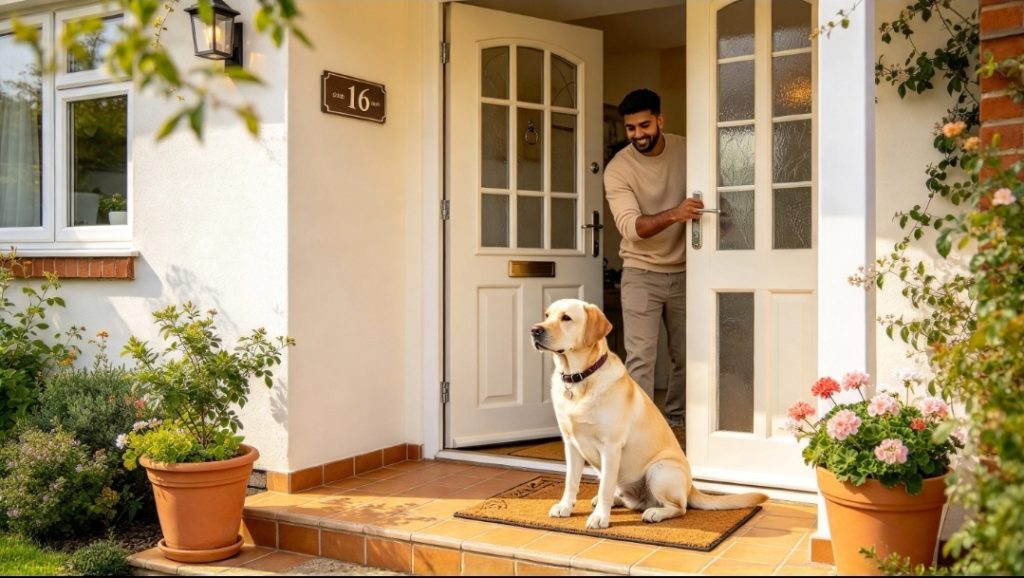
Can I Teach My Dog to Wait at a Door?
Yes. Doorways provide a useful real-life opportunity to practise waiting.
Ask your dog to wait before opening the door. Open it slightly, then close it if your dog attempts to rush through. Repeat at an easier level until your dog can remain in position.
When your dog is calm and waiting, give the release word and allow them through.
This teaches your dog that the door opens through controlled behaviour rather than rushing.
What Equipment Do I Need to Teach a Dog to Wait?
You do not need complicated equipment to teach a basic wait.
A short line and suitable harness can provide additional control during practical exercises where there is a risk of your dog rushing away or moving into an unsafe area. The equipment should support communication and safety rather than being used to punish your dog.
A placemat can also be useful when teaching a dog to wait calmly in a specific location, particularly during household activities. The dog can learn that remaining on the mat produces rewards and that the exercise ends when released.
A crate should be used as a safe management and recovery space, not as punishment for breaking a wait.
Only use equipment when it genuinely improves safety, control, or clarity during the exercise.
How Do I Make the Wait More Difficult?
Progress one element at a time.
You can gradually increase:
- Duration — ask your dog to wait for longer.
- Distance — move further away.
- Distraction — introduce more activity around your dog.
- Environment — practise in different locations.
- Real-life situations — use waiting around doors, food, toys and everyday activities.
Do not increase everything at once.
If your dog succeeds with a five-second wait beside you, that does not automatically mean they can wait for five minutes while you walk away in a busy environment.
RECOMMENDED PRODUCTS
What Are the Most Common Mistakes When Teaching Wait?
One common mistake is asking for too much too soon. If your dog understands a two-second wait, immediately asking for thirty seconds can create unnecessary failure.
Another mistake is poor timing. If you reward after your dog has already moved, your dog may not understand what behaviour you intended to reinforce.
Inconsistent release words can also create confusion. Choose one clear release word and use it consistently.
Finally, avoid repeating “wait” over and over. Give the instruction clearly, then observe your dog. If they are struggling, make the exercise easier rather than simply repeating the command.
How Often Should I Practise Waiting?
Practise waiting regularly in short sessions rather than relying on one long training session.
You can incorporate brief waits into everyday activities such as going through doors, receiving food, preparing for a walk, getting into the car, or beginning play.
The more naturally waiting becomes part of everyday life, the more useful the behaviour becomes.
How Do I Know When My Dog Is Ready to Progress?
Your dog is ready to progress when they can repeatedly complete the current level calmly and reliably.
Do not judge progress by one successful attempt. Look for consistent behaviour across several repetitions.
If your dog begins struggling, return to the previous successful level and rebuild from there.
Training should progress according to your dog’s behaviour, not according to an arbitrary timetable.
Frequently Asked Questions
How long should a dog wait?
There is no single correct duration for every dog or situation. Begin with a duration your dog can successfully manage and gradually increase it as their reliability improves.
Should I reward my dog during the wait?
Yes. Rewarding your dog while they are successfully waiting helps reinforce the behaviour. As the behaviour becomes reliable, you can vary the rewards while maintaining the expectation that your dog waits for the release.
What if my dog gets up when I move away?
Reduce the distance and practise again. Take a smaller step away, return quickly, reward the successful wait, and gradually build the distance.
RECOMMENDED PRODUCTS
Is “wait” the same as “stay”?
They can be taught as separate cues. “Wait” is commonly used to tell a dog to pause temporarily, while “stay” can be used to maintain a position until released. The important thing is that your chosen cue has a clear and consistent meaning.
Can an older dog learn to wait?
Yes. Older dogs can learn new behaviours through the same basic process of clear communication, appropriate rewards, repetition and gradual progression.
Conclusion
Teaching your dog to wait is about building a clear understanding that waiting is rewarded and movement happens when you give the release. Start with very short pauses, reward successful waiting, introduce a consistent release word, and gradually increase duration, distance and distractions.
Keep the training simple, progress at your dog’s pace, and make the exercise easier whenever your dog begins to struggle. With consistent practice, waiting can become a reliable behaviour that your dog uses throughout everyday life.




