How Do I Change My Dog’s Behaviour?
How do I change my dog’s behaviour? Start by identifying what is causing the behaviour, manage the situations that trigger it, teach your dog a clear alternative and consistently reward the behaviour you want. Changing behaviour takes repeated practice in manageable situations, rather than trying to force an immediate change.
What Causes My Dog’s Behaviour?
Before changing a behaviour, understand what is happening around it.
Look at:
- What happens immediately before the behaviour
- What your dog does
- What happens immediately afterwards
- What your dog appears to gain or avoid
- Whether your dog is excited, frustrated, nervous, frightened or confused
- Whether the behaviour happens in particular places or situations
The same behaviour can have different causes.
For example, barking at another dog could be caused by excitement, frustration or fear. The training approach needs to reflect the reason.
How Do I Start Changing My Dog’s Behaviour?
Start with one specific behaviour.
Define exactly what you want to change and what you want your dog to do instead.
For example, rather than simply deciding that you want to “stop jumping”, choose an alternative such as standing calmly with four paws on the floor.
Then use this process:
Identify → manage → teach → reward → repeat → progress.
This gives your dog a clear alternative instead of simply removing an unwanted behaviour.
How Do I Stop My Dog Practising Unwanted Behaviour?
Management is important because repeated behaviour can become more established.
If your dog jumps at visitors, manage greetings so your dog cannot repeatedly practise jumping.
If your dog steals objects, prevent access to items they regularly take.
If your dog reacts to other dogs, create enough distance for your dog to remain responsive.
Management does not replace training. It creates better conditions for training to succeed.
How Do I Teach My Dog a Different Behaviour?
Choose an alternative that your dog can realistically perform in the situation.
For example:
- Jumping → calm standing
- Pulling → loose lead walking
- Stealing → releasing the object
- Barking for attention → calm attention
- Rushing towards distractions → disengaging and returning attention to you
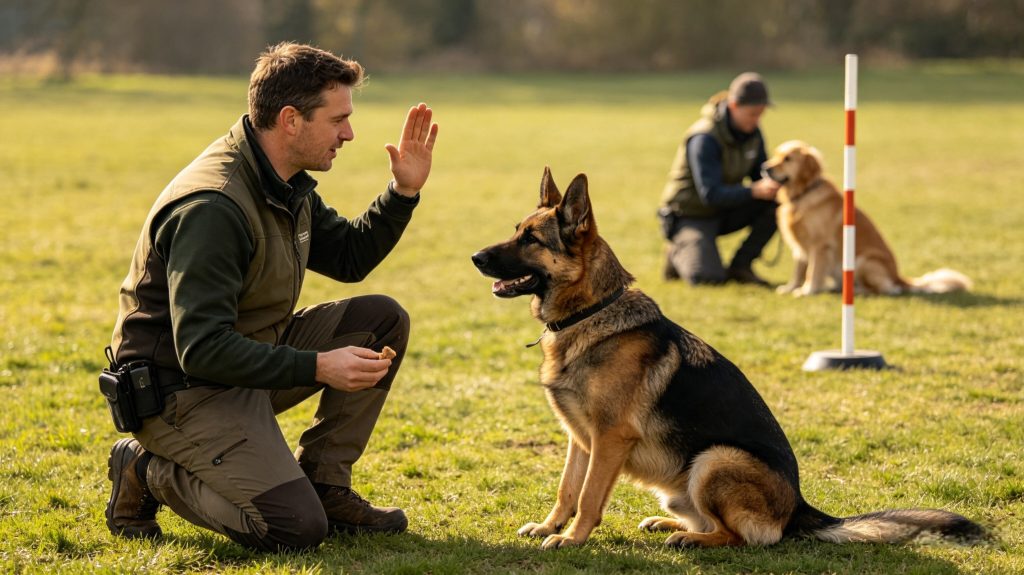
Practise the alternative in an easy environment first.
Once your dog understands it, gradually introduce the situations where the unwanted behaviour normally occurs.
Should I Reward Good Behaviour?
Yes.
Your dog needs a reason to repeat the behaviour you want.
Reward appropriate behaviour immediately after it occurs.
Rewards can include:
- Food
- Toys
- Play
- Praise
- Attention
- Access to something your dog wants
- Freedom to explore
Choose a reward that is valuable to your dog and appropriate for the situation.
How Important Is Timing?
Timing helps your dog understand exactly which behaviour produced the reward.
If your dog calmly looks at you after seeing another dog, mark and reward that response immediately.
If you wait until your dog has started barking or pulling, the connection becomes less clear.
The closer the reward is to the correct behaviour, the easier it is for your dog to understand what you want.
Should I Punish My Dog to Change Its Behaviour?
Punishment is not the only way to change behaviour and can make some problems worse.
If a dog is frightened, for example, punishing its reaction does not remove the fear.
Instead, identify the trigger, reduce the difficulty and teach a more appropriate response.
The aim is to change the underlying behaviour pattern through training and appropriate reinforcement, rather than simply suppressing the outward behaviour.
Why Does My Dog Behave Differently in Different Places?
Dogs do not automatically generalise every behaviour to every environment.
A dog may respond perfectly at home but struggle in a busy park because the environment contains more smells, people, dogs, movement and noise.
Practise in several environments and increase difficulty gradually.
Do not move directly from a quiet room to the most distracting environment and expect identical behaviour.
How Do I Change My Dog’s Behaviour Around Other Dogs?
Start at a distance where your dog can still think and respond.
If your dog is staring, pulling, barking or lunging, you are probably too close to the trigger.
Increase distance and reward calm behaviour and appropriate disengagement.
Gradually reduce the distance only when your dog can remain comfortable and responsive.
If your dog shows aggression or there is a risk of biting, seek professional behavioural assessment.
How Do I Change an Overexcited Dog’s Behaviour?
Teach your dog how to switch from excitement to calmness.
Watch for early signs such as faster movement, jumping, barking, mouthing, fixation or difficulty responding.
Intervene before your dog becomes overwhelmed.
Reduce stimulation, pause the activity or increase distance from the trigger. Once your dog is calm enough to respond, reward appropriate behaviour.
Short, controlled exposure is usually more useful than allowing your dog to become completely overwhelmed.
How Do I Change My Dog’s Behaviour on Walks?
Identify what causes the unwanted behaviour.
Your dog may be reacting to other dogs, people, wildlife, traffic, smells or the anticipation of certain activities.
Use appropriate equipment to maintain safety while training.
A harness and lead can help with normal management, while a long line can provide controlled freedom in suitable environments.
Reward the behaviour you want, such as walking with a loose lead, checking in with you or calmly moving past a distraction.
How Long Does It Take to Change a Dog’s Behaviour?
There is no single timeframe.
It depends on the behaviour, how long it has been occurring, how strongly it has been reinforced, your dog’s emotional response and how consistently the training is applied.
Look for gradual improvement rather than expecting the behaviour to disappear immediately.
Progress should be measured by things such as:
- Your dog responding sooner
- Recovering more quickly
- Remaining calmer for longer
- Needing less distance
- Responding successfully around greater distractions
What If My Dog Keeps Failing?
Make the exercise easier.
If your dog repeatedly cannot perform the desired behaviour, the situation may be too difficult.
Reduce distractions, increase distance, shorten the session or return to an easier environment.
Reward successful responses and gradually build the difficulty again.
Repeated failure does not mean your dog is unwilling to learn. It often means the training needs adjusting.
How Do I Make Behaviour Changes Last?
Practise the behaviour in different situations.
Once your dog understands the behaviour, gradually vary:
- Location
- Distance
- Duration
- Distractions
- Rewards
- Level of difficulty
Continue reinforcing the behaviour even after it becomes reliable.
A behaviour that is never reinforced can become less reliable, particularly when the environment becomes more challenging.
What If My Dog’s Behaviour Suddenly Changes?
A sudden change should not automatically be treated as a training problem.
Pain, illness, discomfort or other health issues can affect behaviour.
If your dog suddenly becomes unusually aggressive, fearful, withdrawn, restless or difficult to handle, speak to your vet.
This is particularly important when there has been no obvious change in training or environment.
When Should I Get Professional Help?
Professional help is appropriate when behaviour is severe, persistent, worsening or creates a safety concern.
Seek professional assessment for aggression, biting, serious resource guarding, severe fear, repeated lunging or behaviour that you cannot safely manage.
Professional guidance can help identify the cause of the behaviour and establish a suitable training and management plan.
Conclusion
Changing your dog’s behaviour starts with understanding why the behaviour is happening.
Manage the trigger, prevent unnecessary repetition, teach a clear alternative and reward the behaviour you want. Start in situations where your dog can succeed and gradually increase the difficulty.
The goal is not simply to stop a behaviour. It is to replace unwanted behaviour with reliable, appropriate behaviour that your dog can use in real-life situations.