Can you train an older dog?
Yes, you can train an older dog. An older dog can learn new behaviours, develop existing behaviours and be retrained when previous training is no longer reliable. The important consideration is not simply the dog’s age, but the dog’s individual motivation, previous learning, environment and ability to respond appropriately to the training process. Training should be patient, progressive and based on positive reinforcement, food and appropriate motivation.
RECOMMENDED PRODUCTS

START WITH THE DOG YOU HAVE
Training an older dog should begin by understanding the dog’s current behaviour rather than assuming that previous learning will automatically remain reliable.
Observe how the dog responds to you, the environment, food, movement and the behaviour you are asking for. Consider what the dog already understands and where the problems occur.
An older dog may already have established behaviours, so retraining may require you to change the environment, improve motivation or return to an easier stage before progressing again.
The aim is to identify the dog’s current starting point and build from there.
USE POSITIVE REINFORCEMENT AND FOOD MOTIVATION
Food can be a useful way to motivate an older dog during training. Some dogs have a high food drive and respond readily to rewards, while others have a lower food drive and may require more careful consideration of motivation and training conditions.
Use food appropriately to encourage and reinforce the behaviour you want the dog to repeat. Where luring is useful, it can help introduce or guide a behaviour before gradually developing greater reliability.
Training should remain patient and clear. If the dog does not understand what is being asked, repeating the same instruction will not necessarily solve the problem. Assess the situation and adjust the training process.
RECOMMENDED PRODUCTS — TRAINING POUCHES
A training pouch keeps rewards accessible and can make it easier to reward an older dog at the correct moment during training.
MAKE TRAINING EASIER TO UNDERSTAND
An older dog may have years of previous experiences and learned behaviours. This does not mean that training is no longer possible.
Start with behaviours the dog can reasonably achieve and reinforce successful responses. Once the dog understands the exercise, gradually increase the difficulty.
Avoid introducing several new challenges at the same time. If the dog is struggling, reduce the difficulty and return to an easier stage where successful learning is possible.
Progress should be based on the dog’s response rather than simply moving forward because a certain amount of time has passed.
CONSIDER THE TRAINING ENVIRONMENT
The environment can affect an older dog’s ability to learn and respond.
A quiet home environment may provide a useful starting point because unnecessary distractions can be controlled. Once the dog is responding reliably, training can gradually be introduced into more demanding environments.
If the dog becomes distracted or stops responding, assess what has changed. Removing unnecessary distractions and returning to a calmer environment may allow the dog to regain focus.
After making an adjustment, reassess the dog’s response before continuing.
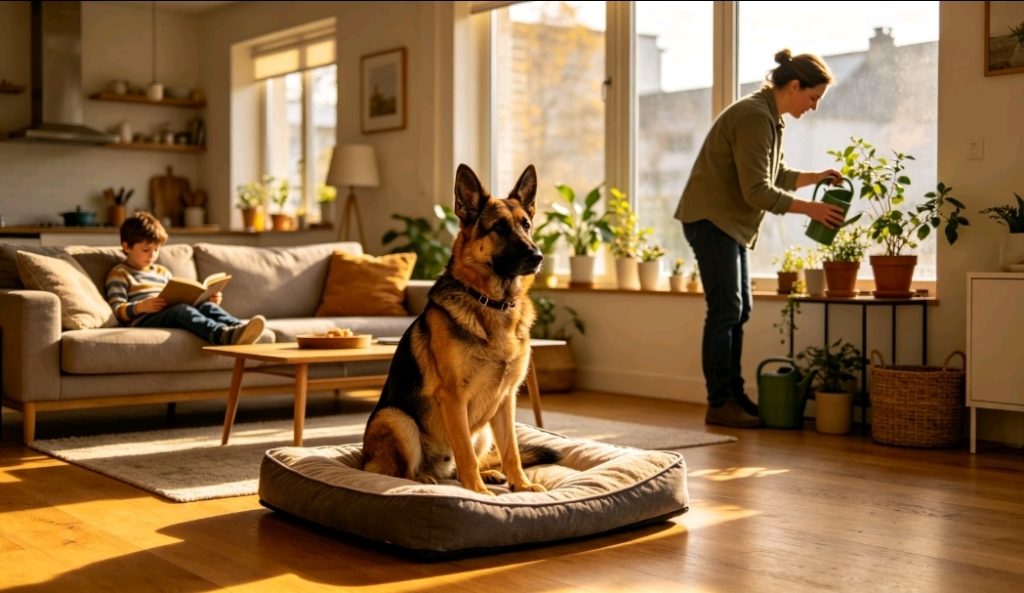
An appropriate resting area can support a calm training environment by giving the dog a consistent place to settle between training activities.
USE APPROPRIATE CONTROL AND MANAGEMENT
Older dogs can still benefit from appropriate management while learning.
A short line may provide additional control during suitable training exercises. A harness may be appropriate for managing the dog during training or walking. A long line can provide increased freedom while maintaining an appropriate level of control.
Free roam should be introduced or increased when the dog’s behaviour is reliable enough for the environment.
The principle remains simple: increased freedom should be accompanied by appropriate behavioural responsibility.
Leads and long lines can provide different levels of control while an older dog develops or rebuilds reliable behaviour.
USE THE HOME ENVIRONMENT EFFECTIVELY
Training does not need to take place only during formal exercises.
An older dog can continue learning through the way the home environment is managed. A placemat can be used for stationing and settling, while a playpen can provide controlled freedom within a defined boundary.
A crate can also form part of appropriate management, rest, routine and resetting when required.
These management tools should not replace training. They help create an environment in which the dog can practise appropriate behaviour and gradually develop greater responsibility.
Crates and pens can provide appropriate management while an older dog is learning or being retrained, particularly when additional control or boundaries are required.
GIVE THE DOG TIME TO LEARN
Older dogs may need time to adjust when you introduce a new behaviour or change an established routine.
Patience is important. Avoid unnecessary difficulty and give the dog repeated opportunities to understand and perform the required behaviour.
If the dog struggles, assess the situation rather than simply continuing. Reduce distractions, simplify the exercise, allow the dog to calm if necessary and reassess before continuing.
If the dog is able to respond successfully, gradually build the next stage of training.
RECOMMENDED PRODUCTS
RETRAINING AN OLDER DOG
Retraining is possible when an older dog has previously learned a behaviour but is no longer responding reliably.
Begin by identifying where the behaviour is breaking down. Consider whether the environment has changed, whether there are additional distractions, whether the dog is sufficiently motivated and whether the level of freedom or difficulty is appropriate.
Return to a stage where the dog can succeed and rebuild the behaviour progressively.
Once the behaviour becomes reliable again, gradually introduce the situations where you need the dog to perform it.
KNOW WHEN TO RESET
Training should not continue simply because you started an exercise.
If the dog is no longer able to respond appropriately, continuing may make the training situation less productive. Remove unnecessary distractions, allow the dog to calm and return to an environment where the dog can regain an appropriate training state.
After the dog has settled, reassess and return to the relevant exercise at a suitable level.
A reset is not a failure. It is part of a structured training process that allows the dog to return to learning when the current situation has become too difficult.
WHEN PROFESSIONAL SUPPORT MAY BE APPROPRIATE
Training an older dog yourself is possible, but some situations require additional expertise.
If an older dog displays significant aggression, reactivity, attempts to bite or behaviour that creates a safety concern, professional assessment should be considered.
Professional support may also be appropriate when you have repeatedly attempted to change a behaviour but cannot identify why the dog is struggling.
The purpose of professional support is to help assess the situation, identify an appropriate training process and provide suitable guidance for progressing safely.