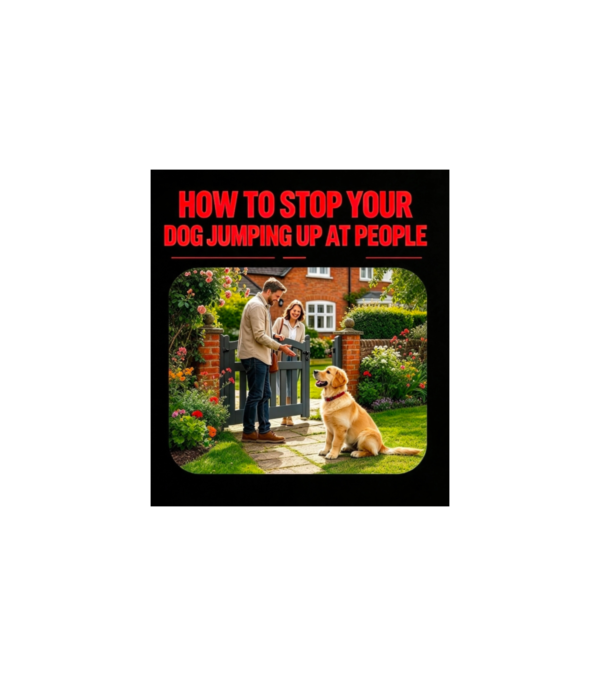
How to Stop Your Dog Jumping Up at People

£19.99
How to Stop Your Dog Jumping Up at People
Course Price: £19.99
Introduction to Preventing Jumping Up at People
GPK9 How to Stop Your Dog Jumping Up at People is designed to help handlers understand why dogs jump up at people and how to develop calmer, more appropriate greeting behaviour through positive reinforcement.
Jumping can develop for several different reasons, including excitement, attention-seeking, social interaction and the anticipation of receiving attention from people. Understanding what motivates an individual dog to jump is an important part of selecting the right training techniques and establishing more appropriate behaviour.
This training programme introduces practical methods for recognising the early signs of jumping, identifying common triggers and teaching alternative behaviours that encourage dogs to remain grounded when interacting with people.
Handlers will learn how to use food rewards, food placement, luring, hand-feeding, hand targeting, movement and appropriate toys to reinforce desirable greeting behaviour.
The objective is to help handlers develop a consistent approach to managing jumping, improve communication with their dogs and establish calmer interactions during everyday situations.
What Is Jumping Behaviour Training?
Jumping behaviour training is the process of teaching dogs to interact with people without repeatedly jumping up against them.
Dogs can learn that jumping produces attention, physical contact, excitement or interaction. Even when people attempt to discourage the behaviour, their reactions can sometimes provide the attention that maintains it.
GPK9 focuses on understanding why the behaviour occurs and teaching alternative responses that can be positively reinforced.
These alternatives may include remaining standing with all four paws on the ground, sitting when appropriate, maintaining attention towards the handler or responding to a hand target.
Through consistent reinforcement, appropriate reward placement and gradual progression, handlers can help dogs develop more manageable greeting habits.
What Will You Learn?
Understanding Why Dogs Jump Up at People
Understand the different motivations that contribute to jumping behaviour.
Recognise how excitement, attention-seeking and social interaction can influence jumping.
Understand how previous experiences and human responses can reinforce the behaviour.
Learn why individual motivations should be considered when selecting training techniques.
Recognising the Early Signs of Jumping
Understand how dogs communicate through posture, movement and body language before jumping.
Recognise early changes in attention, positioning and physical movement.
Learn how to anticipate jumping when someone approaches.
Understand how early intervention creates opportunities to reinforce alternative behaviour.
Understanding How Human Attention Reinforces Jumping
Understand how talking, touching, eye contact and physical interaction can reinforce jumping.
Recognise why pushing a dog away or repeatedly telling it to get down may maintain unwanted interaction.
Learn how to manage human attention and reinforce appropriate greetings.
Understand the importance of consistency between handlers, family members and visitors.
Identifying Different Jumping Triggers and Situations
Recognise common situations that encourage jumping.
Understand how approaching people, movement, excitement and environmental distractions influence behaviour.
Learn why dogs may respond differently depending on the person and surroundings.
Understand how to adapt training to different greeting situations.
Establishing Alternative Behaviours to Replace Jumping
Understand how to introduce desirable behaviours that replace jumping.
Learn how to encourage standing calmly, maintaining ground-level behaviour and responding to handler communication.
Understand how alternative behaviours can be reinforced through positive reinforcement.
Recognise the importance of developing these behaviours before introducing more challenging greetings.
Teaching Your Dog to Remain Grounded When Someone Approaches
Learn how to reinforce four paws remaining on the ground when people approach.
Understand how to introduce approaching people gradually.
Recognise when to reward appropriate behaviour before jumping occurs.
Learn how to manage the distance, movement and timing of greetings.
Preparing Food Rewards and Selecting Suitable Training Locations
Understand how to select appropriate food rewards for the individual dog.
Learn why training locations should initially minimise unnecessary distractions.
Recognise how reward preparation and environmental conditions influence training.
Understand how to introduce more challenging surroundings as the dog becomes consistent.
Using Food Rewards to Reinforce Ground-Level Behaviour
Learn how small, frequent food rewards can reinforce appropriate positioning.
Understand the importance of reward timing and delivery.
Recognise how consistent reinforcement helps establish desirable greeting behaviour.
Learn how to adjust reward frequency as the dog develops greater consistency.
Using Food Placement to Prevent Jumping
Understand how the position of food rewards influences the dog’s physical positioning.
Learn how to deliver rewards at ground level to encourage appropriate behaviour.
Recognise how food placement can help prevent the dog from repeatedly moving upwards towards the handler.
Understand how to use reward positioning consistently during greetings.
Using Food Luring to Introduce a Calm Standing Position
Learn how to use food luring to introduce and encourage a suitable standing position.
Understand how to guide the dog’s movement without physical force.
Recognise when to reward the dog for maintaining the desired position.
Learn how to gradually reduce dependence on the food lure.
Teaching a Reliable Sit as an Alternative to Jumping
Understand how to introduce sitting as an alternative greeting behaviour.
Learn how to use food rewards to reinforce the sit.
Recognise when sitting is appropriate and when a calm standing position may be more suitable.
Understand how to maintain the behaviour when people approach.
Using Hand-Feeding to Encourage Attention During Greetings
Learn how hand-feeding can encourage engagement and appropriate interaction.
Understand how to deliver food rewards while maintaining ground-level behaviour.
Recognise how hand-feeding can help redirect attention towards the handler.
Learn how to introduce hand-feeding during controlled greeting situations.
Using Hand Targeting to Redirect Your Dog Away from Jumping
Understand how to introduce hand targeting through positive reinforcement.
Learn how to encourage the dog to touch the handler’s hand rather than jumping towards people.
Recognise how targeting can redirect attention and movement.
Understand how to use hand targeting to support controlled greetings.
Using Movement to Encourage Ground-Level Behaviour
Understand how handler movement can influence the dog’s positioning.
Learn how to use appropriate movement to encourage the dog to remain grounded.
Recognise how changes in direction and positioning can help redirect attention.
Understand how to reinforce appropriate movement during greeting exercises.
Using Ball Rewards to Reinforce Appropriate Greeting Behaviour
Understand how ball rewards can motivate dogs that respond strongly to play.
Learn how to introduce ball rewards following appropriate ground-level behaviour.
Recognise how reward timing and controlled movement influence the exercise.
Understand how to use play without encouraging excessive excitement during greetings.
Using Tug Toys and Toy Exchanges to Develop Controlled Interaction
Understand how tug toys can be incorporated into positive reinforcement training.
Learn how to use controlled tug play to reward appropriate behaviour.
Recognise the importance of introducing clear toy exchanges.
Understand how to manage excitement and maintain appropriate interaction during play-based training.
The GPK9 Approach to Training
GPK9 places importance on understanding the individual dog before selecting the most appropriate training technique.
Jumping behaviour is addressed through positive reinforcement, suitable motivation, clear communication and consistent reward delivery.
The training process uses the GPK9 Green, Amber and Red system to help handlers recognise behaviour and make appropriate decisions.
Green: The dog is demonstrating appropriate ground-level behaviour, responding to the handler and remaining settled during the exercise. Continue reinforcing the behaviour and gradually introduce progression.
Amber: The dog is becoming excited, showing early signs of jumping or struggling to maintain appropriate behaviour. Observe and assess the situation, remove or reduce distractions where possible, allow the dog to settle and reassess before continuing.
Red: The dog is displaying behaviour that makes the interaction unsuitable or unsafe to continue. Stop the exercise, identify the problem, remove the dog from the situation, allow recovery and reassess before considering further training.
This approach encourages handlers to respond to the dog’s behaviour rather than relying on repeated instructions or physical corrections.
Why Positive Reinforcement Matters
Positive reinforcement helps dogs understand which behaviours are desirable by providing rewards when appropriate behaviour occurs.
Food rewards can encourage ground-level positioning, reinforce attention and introduce alternative greeting behaviours. Food luring, hand-feeding and hand targeting provide additional ways to develop communication and engagement.
For dogs motivated by play, balls and tug toys can provide alternative rewards when used appropriately.
The most suitable reward depends on the individual dog’s motivation, the environment and the behaviour being developed.
The objective is to build desirable greeting habits through positive experiences rather than shouting, punishment, pushing or physical corrections.
Who Is This Course For?
This training programme may be suitable for:
Dog owners whose dogs regularly jump up at family members, visitors or unfamiliar people.
Owners who want to develop calmer greetings and more appropriate social interactions.
Handlers whose dogs become excited when people approach.
Owners who want to understand why their dogs jump and how to address the behaviour.
Handlers interested in using food rewards, luring, hand targeting and play-based reinforcement.
Learners who want practical positive reinforcement techniques that can be incorporated into everyday dog training.
Training techniques should always be adapted to the individual dog’s behaviour, motivation and ability to cope with the situation.
Important Training and Safety Information
Training should begin in suitable environments where the dog can concentrate without unnecessary distractions.
Handlers should avoid deliberately encouraging excessive excitement or placing dogs in greeting situations that exceed their current ability.
Children and vulnerable individuals should not be used as training participants where jumping could cause injury.
Dogs displaying aggression, threatening behaviour or significant fear around people should receive an appropriate professional assessment.
Training should prioritise the dog’s welfare, the handler’s safety and the safety of everyone involved.
What Should You Take Away from This Training?
By studying this programme, learners should develop a clearer understanding of:
Why dogs jump up at people and the motivations behind the behaviour.
How to recognise early signs and identify common jumping triggers.
How human attention can reinforce unwanted jumping.
How to establish alternative greeting behaviours.
How to use food rewards, food placement and luring effectively.
How hand-feeding and hand targeting can encourage appropriate interaction.
How movement, balls and tug toys can reinforce desirable behaviour.
How to encourage calmer greetings through consistent positive reinforcement.
How to recognise Green, Amber and Red behaviour during training.
Develop Better Greeting Habits with GPK9
Teaching a dog to greet people appropriately requires patience, observation, consistency and an understanding of individual motivation.
By identifying why jumping occurs and introducing suitable alternative behaviours, handlers can help their dogs develop more manageable and positive interactions with people.
GPK9 provides practical positive reinforcement techniques to help owners improve communication, encourage ground-level behaviour and establish calmer everyday greetings.
Course: How to Stop Your Dog Jumping Up at People
Training Focus: Preventing jumping and developing appropriate greeting behaviour.
Price: £19.99 — one-off purchase
Start developing calmer greetings, improve your communication with your dog and encourage more appropriate interactions with people through GPK9 training.
Related products
-
Online Course
One to One Dog Training Sessions
£75.00 – £700.00Price range: £75.00 through £700.00 Select options This product has multiple variants. The options may be chosen on the product page