
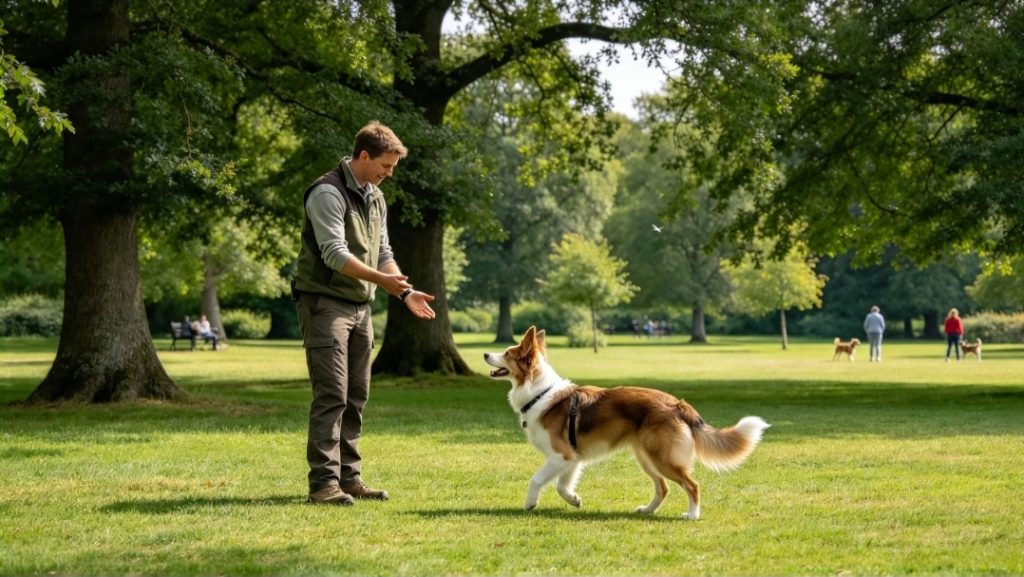
How Do I Improve My Dog’s Obedience and Responsiveness?
Improving your dog’s obedience and responsiveness means building on skills they already understand, practising them consistently and gradually introducing more challenging situations. A dog that responds reliably in a quiet room may need further training to respond around distractions, at a greater distance or in unfamiliar environments.
The key is to develop each skill at a pace your dog can manage. Focus on clear communication, appropriate rewards, consistent handling and regular practice. Before increasing the difficulty, make sure your dog understands what you are asking and can perform the behaviour successfully at the current level.
What Does Better Obedience and Responsiveness Look Like?
Obedience is more than teaching a dog to follow commands. It involves developing a clear understanding between dog and handler so the dog can respond appropriately in different situations.
Improved responsiveness may include your dog:
- Paying attention when you give a familiar cue.
- Responding consistently to commands they have learned.
- Maintaining engagement with you during training.
- Returning when called in appropriately controlled environments.
- Following familiar instructions when mild distractions are present.
- Settling or waiting when asked, rather than acting impulsively.
- Recovering focus after their attention has been drawn elsewhere.
These abilities develop through practice rather than simply repeating commands more frequently. Your dog needs to understand the behaviour, recognise the cue and have sufficient experience performing it in different situations.
The goal is not to make every exercise harder as quickly as possible. It is to build reliable responses that can be maintained as the challenge increases.
How Do I Build on My Dog’s Existing Obedience Skills?
Start by reviewing what your dog can already do confidently. Identify which behaviours are well established, which need more practice and which become unreliable when the environment changes.
For example, your dog may respond to a sit cue in the kitchen but struggle to maintain attention when another person enters the room. This does not necessarily mean they have forgotten the command. The added distraction may make the exercise more difficult.
Work through the following steps.
1. Strengthen the Foundations
Before introducing more advanced exercises, make sure your dog understands the basic cues you intend to develop.
Practise familiar behaviours such as sit, down, stay, recall and walking with you, where appropriate to your dog’s training stage. Keep the instructions clear and avoid repeatedly changing the cue or adding unnecessary words.
If your dog is still learning what a cue means, return to simpler exercises rather than expecting a reliable response in a challenging environment.
The Fundamentals 1 course — Building the Foundations of Obedience provides the starting point for developing engagement, basic obedience and the communication needed for continued training.
2. Improve Consistency
Dogs learn through repeated experiences. If the same cue is sometimes followed by one response and sometimes by another, understanding and reliability can take longer to develop.
Aim to make your handling consistent by:
- Using familiar cues clearly.
- Rewarding the behaviour you want to encourage.
- Practising exercises regularly in short, focused sessions.
- Avoiding unnecessary repetition of commands.
- Keeping expectations appropriate to your dog’s current ability.
- Ensuring everyone involved in training understands the cues being used.
Consistency does not mean expecting identical performance in every environment. It means providing clear information and adjusting the difficulty to suit the situation.
3. Develop Engagement
Engagement means your dog is willing and able to participate in the training activity with you. It helps create the conditions for learning and can make it easier to guide your dog through an exercise.
Use rewards that suit your dog and the task. Food, play, praise and other suitable forms of reinforcement may help maintain motivation, depending on the individual dog and the environment.
Keep sessions manageable. If your dog becomes distracted, frustrated or disengaged, consider whether the exercise is too difficult, the session is too long or the reward is not sufficiently motivating.
Rather than continually repeating a command, simplify the exercise and help your dog succeed before building up again.
How Can I Make My Dog More Reliable Around Distractions?
One of the biggest challenges in obedience training is transferring a learned behaviour from a familiar setting to real-life situations.
A dog may respond well at home but struggle in a park, around other dogs or when something exciting happens. This is because the environment introduces competing information and additional demands on attention.
Increase Difficulty Gradually
Change one aspect of an exercise at a time wherever possible. This makes it easier to identify what your dog can manage and where further practice is needed.
You might progress by adjusting:
- Environment: Move from a quiet room to a familiar garden, then to a suitable outdoor location.
- Distraction: Begin with minimal distractions before introducing more noticeable activity.
- Distance: Gradually increase the distance between you and your dog when the exercise allows.
- Duration: Extend how long your dog maintains a behaviour, in small increments.
- Complexity: Combine familiar skills only when your dog can perform them individually.
You do not need to increase every element simultaneously. If your dog struggles when you change the environment, keep the duration and distance easier until they become more comfortable with the new setting.
Reward the Response You Want
Reward timing can influence how clearly your dog understands which behaviour is being reinforced.
For example, if you are practising recall, reward your dog when they return to you rather than waiting until they have become distracted again. During a stay exercise, reinforce the position you are teaching while ensuring the duration remains achievable.
Choose rewards that fit the exercise and your dog’s motivation. The purpose is to make successful responses worthwhile and help your dog understand what you are asking.
Avoid Testing Skills Before They Are Ready
A single successful response does not mean a behaviour is reliable in every situation.
If your dog responds correctly in a quiet environment, that is useful progress. It does not automatically mean they are ready to perform the same exercise around intense distractions or at a much greater distance.
Build experience gradually and use suitable management to prevent situations from becoming unsafe or overwhelming. For example, practise recall in secure areas or with appropriate lead management rather than relying on an unproven recall near roads or other hazards.
How Do I Know When My Dog Is Ready to Progress?
Progression should be based on demonstrated ability, not simply on how long you have been training.
Look for signs that your dog understands the exercise and can repeat it with reasonable consistency under the current conditions.
Your dog may be ready for a small increase in difficulty when they can:
- Respond to the familiar cue without repeated prompting.
- Perform the behaviour correctly across multiple repetitions.
- Maintain engagement for the length of the exercise.
- Recover their attention after minor distractions.
- Work comfortably without becoming increasingly frustrated or unsettled.
- Repeat the skill across more than one suitable setting.
These are practical indicators rather than a rigid checklist. Different dogs develop at different rates, and the same dog may perform differently depending on fatigue, arousal, environment and competing distractions.
If performance becomes inconsistent, reduce the difficulty and reinforce the earlier stage. This is not failure; it is a sensible way to identify what your dog needs before progressing further.
The Training Progression and Advancement course — Understanding Training Progression explores the importance of developing skills gradually and recognising when further progression is appropriate.
What Should I Do If My Dog Stops Responding?
When a dog that previously responded well begins to struggle, repeating the same command more forcefully is unlikely to address the underlying problem.
Instead, consider what has changed.
Check the Environment
A new location, nearby dog, unfamiliar person, noise or exciting activity may be competing for your dog’s attention. Increase the distance from the distraction or move to a quieter area where your dog can concentrate.
Check the Difficulty
You may have increased the distance, duration or complexity too quickly. Return to the last level at which your dog could perform the behaviour successfully, then rebuild from there.
Check Motivation and Timing
Consider whether your dog understands the exercise, whether the reward is appropriate and whether your timing is clear. If the task has become repetitive or difficult, a short break or simpler exercise may help.
Check Your Dog’s State
Fatigue, discomfort, fear, stress or overexcitement can affect responsiveness. Give your dog time and space when needed rather than forcing the exercise to continue.
If a change in responsiveness is sudden, persistent or accompanied by signs of pain or illness, seek veterinary advice. If your dog displays aggression or behaviour that creates a safety risk, obtain an appropriate professional assessment.
A useful training decision is to make the next repetition easier when the current one becomes unreliable. This allows you to rebuild understanding rather than repeatedly practising unsuccessful responses.
How Does Fundamentals 2 Build on Earlier Training?
The Fundamentals 2 course — Developing Intermediate Obedience Skills builds on earlier learning, with a focus on developing stronger obedience, responsiveness and control as your dog matures.
The emphasis at this stage is not simply on adding more commands. It is on developing greater consistency and helping your dog apply established skills in more demanding everyday situations.
This means continuing to work on communication, engagement, impulse control and reliable responses while adapting training to your dog’s individual needs.
If your dog is not yet confident with the earlier foundations, revisit the relevant skills before increasing the challenge. A solid understanding at the previous stage makes it easier to identify what needs to improve and helps prevent progression from becoming rushed.
Fundamentals 2 should be approached as a continuation of learning. Regular practice and sensible adjustments to difficulty remain important throughout the process.
What Comes After Fundamentals 2?
Once your dog has developed the necessary intermediate skills, the next step is to assess whether they are ready for more advanced obedience work.
The Fundamentals 3 course — Progressing to the Next Training Stage continues the structured pathway towards more precise obedience, stronger handler communication and more dependable performance in everyday environments.
Progressing does not mean abandoning the skills you have already taught. Earlier behaviours remain important and should continue to be practised and maintained as new challenges are introduced.
Before moving forward, consider:
- Can your dog perform the established exercises consistently?
- Can you communicate clearly without relying on repeated cues?
- Can your dog maintain focus under the level of distraction you currently introduce?
- Can you recognise when an exercise is too difficult and adjust it appropriately?
- Are you continuing to reinforce previously learned behaviours?
If important skills remain inconsistent, continue developing them before moving on. The right pace is the one that allows both you and your dog to understand the work and build on it successfully.
A Simple Routine for Improving Obedience
You can develop better responsiveness through short, purposeful training sessions rather than relying on occasional long sessions.
A practical session might include:
- Begin with engagement. Give your dog an opportunity to focus and participate.
- Practise familiar skills. Start with exercises your dog understands.
- Choose one area to improve. For example, work on response speed, duration or mild distractions.
- Reward successful responses. Make it clear which behaviour you want to reinforce.
- Adjust the difficulty. If your dog struggles, simplify the task.
- Finish on a manageable exercise. End with something your dog can perform comfortably.
Keep a simple record of what you practised, the conditions involved and how your dog responded. This can help you identify patterns and decide what to work on next.
Regular, well-managed practice is generally more useful than repeatedly testing a difficult exercise without a clear plan.
Frequently Asked Questions
How long does it take to improve a dog’s obedience?
There is no single timeframe. Progress depends on your dog’s age, previous learning, motivation, temperament, the skills being taught and how consistently you practise. Some improvements may appear quickly, while reliable responses around distractions can take considerably longer to develop.
Should I repeat a command if my dog ignores me?
Avoid repeatedly saying the same command. First consider whether your dog understands the cue and whether the environment is too difficult. Make the exercise easier, regain your dog’s attention and practise again when the conditions are suitable.
Does my dog need to be perfect before progressing?
No. Training does not require flawless performance in every situation. However, your dog should demonstrate a suitable level of understanding and consistency at the current stage before you increase the challenge significantly. Progress in small steps and return to easier exercises when needed.
Why does my dog listen at home but not outside?
Outdoor environments often contain more distractions, competing rewards and unfamiliar experiences. Your dog may understand the cue but need more practice applying it in those conditions. Begin at a manageable distance from distractions and gradually build reliability.
Should I move straight from Fundamentals 2 to Fundamentals 3?
Consider your dog’s demonstrated skills and the requirements of the next stage. If your dog is ready for more advanced learning, Fundamentals 3 offers the next step in the pathway. If important intermediate skills remain unreliable, continue practising them first.
Improving Obedience Through Consistent Progression
Improving your dog’s obedience and responsiveness is an ongoing process of teaching, practising, observing and adjusting. Clear cues, suitable rewards and consistent handling help your dog understand what is expected, while gradual increases in difficulty develop more dependable behaviour.
Build on the skills your dog already understands, recognise where further practice is needed and progress when the evidence shows your dog is ready.
The GPK9 Fundamentals pathway provides a structured route from initial obedience learning through intermediate development and towards more advanced skills. Choose the stage that matches your dog’s experience, keep training purposeful and continue maintaining the behaviours you have already established.




