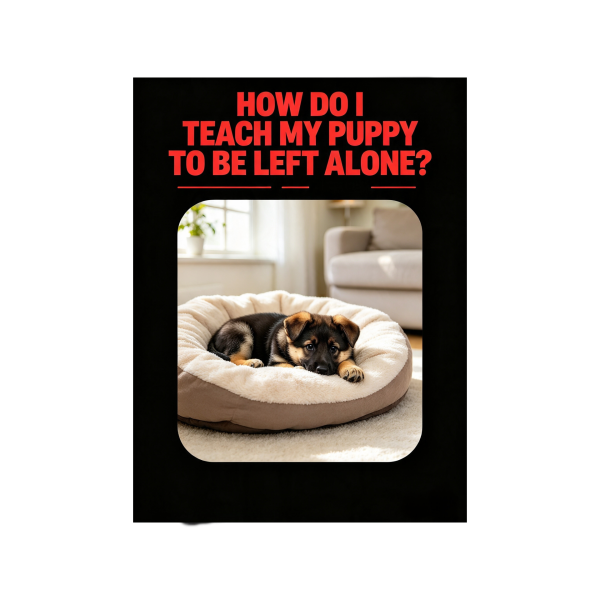
How Do I Teach My Puppy to Be Left Alone?
Teaching a puppy to be comfortable when left alone is an important part of developing independence, confidence and calm behaviour.
This detailed online lesson explains how to gradually teach your puppy to spend time without you, starting with simple separation exercises inside the home and progressing towards appropriate periods of being alone.
Rather than expecting a puppy to suddenly cope with being left for long periods, this lesson shows you how to build the behaviour progressively, observe your puppy’s response and adjust the training according to what your puppy is actually communicating.
What This Lesson Covers
This lesson provides a detailed guide to developing your puppy’s ability to remain calm and comfortable when separated from you.
You will learn about:
- Understanding why puppies need to learn independence.
- Why being left alone is a learned skill.
- How to begin separation training while you are still at home.
- Teaching your puppy to settle independently.
- Creating an appropriate resting and management area.
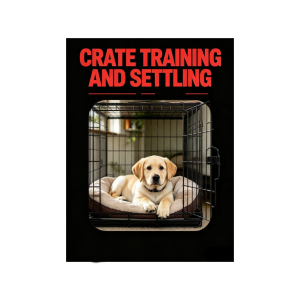
- Using a crate appropriately as a safe resting space.
- Using controlled areas to help develop independence.
- Teaching your puppy that following you is not always necessary.
- Building independence into normal everyday routines.
- Starting with very short periods of separation.
- Gradually increasing distance and duration.
- Progressing from separation inside the home towards brief departures.
- Changing one difficulty at a time.
- Recognising when your puppy is ready to progress.
- Recognising when your puppy is finding the exercise too difficult.
- Understanding the difference between normal puppy behaviour and possible distress.
- Using positive reinforcement to develop calm independent behaviour.
- Using food and enrichment appropriately.
- Understanding why enrichment should not be used to hide significant distress.
- Considering your puppy’s toilet needs before separation.
- Understanding how sleep, exercise, activity and routine affect alone-time training.
- Avoiding unnecessary reliance on exhaustion.
- Observing what your puppy does after you leave.
- Understanding vocalisation, pacing, scratching and destructive behaviour.
- Understanding accidents as information rather than something to punish.
- Avoiding punishment for behaviour that occurs while you are away.
- Gradually increasing freedom as your puppy becomes more responsible.
- Understanding why one successful attempt does not mean your puppy is fully trained.
- Knowing when to stop, simplify and reassess.
- Recognising when additional behavioural support may be appropriate.
Learn How to Build Independence Gradually
One of the most important parts of this lesson is understanding progression.
Your puppy does not need to begin by being left alone for a long period.
Instead, you can begin with simple exercises such as:
Owner nearby → owner moves away → owner leaves view → owner leaves the room → brief departure → gradual increase
The lesson explains how to develop each stage according to your puppy’s individual response.
This helps prevent the common mistake of progressing too quickly simply because the puppy managed one successful attempt.
Learn to Read Your Puppy
Being able to tell whether your puppy is coping is just as important as knowing what exercise to perform.
The lesson teaches you to observe:
- body language;
- attention;
- settling;
- movement;
- vocalisation;
- engagement;
- ability to relax;
- attempts to follow;
- pacing;
- scratching;
- escape behaviour;
- destructive behaviour;
- changes in normal eating or enrichment behaviour.
The objective is to understand what your puppy is communicating through its behaviour.
If your puppy is comfortable, you can gradually develop the exercise.
If your puppy is struggling, you learn how to reduce the difficulty and reassess.
Positive Reinforcement and Calm Independence
The lesson explains how positive reinforcement can be used to strengthen appropriate independent behaviour.
You will learn how to reinforce behaviours such as:
- settling;
- remaining in a resting area;
- calmly occupying itself;
- remaining relaxed while you move around;
- staying settled while you briefly leave the room.
The emphasis is on developing calm behaviour, rather than simply making the puppy excited about receiving a reward.
Understand the Difference Between Management and Training
Good management can make learning easier.
The lesson explains how appropriate use of:
- resting areas;
- puppy-safe spaces;
- controlled freedom;
- crates;
- playpens;
- suitable enrichment;
can help create an environment where your puppy has a realistic opportunity to succeed.
Management is not a replacement for training.
It gives the puppy an environment in which appropriate behaviour can be developed safely.
More Freedom Requires More Behavioural Responsibility
As your puppy becomes more reliable, freedom can gradually increase.
However, being able to remain alone comfortably does not automatically mean your puppy is ready to have unrestricted access to the entire home.
The lesson explains how to consider both:
Can my puppy remain alone comfortably?
and:
Can my puppy manage the environment responsibly while alone?
Freedom should develop alongside behavioural responsibility.
Learn What To Do When Things Go Wrong
Puppies will not always progress perfectly.
Your puppy may:
- cry;
- follow you;
- become restless;
- chew something inappropriate;
- have an accident;
- struggle to settle;
- become too excited;
- show signs of distress.
The lesson explains how to look at these behaviours as information.
Rather than immediately punishing the puppy or simply increasing the amount of time alone, you will learn to consider what may have caused the difficulty.
You may need to:
- reduce the duration;
- return to an easier stage;
- reduce distractions;
- improve management;
- consider toilet needs;
- allow the puppy to settle;
- change the training environment;
- reassess the progression.
Learn When Not to Progress
A major part of effective puppy training is knowing when not to make the exercise harder.
If your puppy is relaxed, comfortable and consistently successful, you may be ready to introduce a small progression.
If your puppy is becoming increasingly distressed, the current level may be beyond its ability.
The answer is not automatically more repetition.
Sometimes the correct training decision is to make the exercise easier.
A Practical Training Framework
Throughout the lesson, you will learn to approach alone-time training through a simple process:
OBSERVE → INTERPRET → DECIDE → COMMUNICATE → OBSERVE RESPONSE → REASSESS
This encourages you to work with the puppy in front of you rather than following a rigid timetable.
You learn to:
Observe what your puppy is doing.
Interpret what the behaviour may be communicating.
Decide what the appropriate next step should be.
Communicate through appropriate training, management, timing and reinforcement.
Observe the response to see whether the puppy is coping.
Reassess before deciding whether to continue, progress or simplify.
Who Is This Lesson For?
This lesson is particularly useful for:
- New puppy owners.
- Owners preparing a puppy for periods of independence.
- Owners whose puppy follows them everywhere.
- Owners whose puppy struggles when they leave the room.
- Owners wanting to establish calm independent behaviour.
- Owners wanting to prevent poor alone-time habits developing.
- Owners who want a structured approach to gradually increasing separation.
- Anyone who wants to understand their puppy’s behaviour rather than simply expecting it to cope.
What You Will Take Away
By completing this lesson, you will have a clearer understanding of how to develop your puppy’s ability to be alone through gradual, positive and carefully observed training.
You will understand that successful alone-time training is not about forcing a puppy to cope.
It is about creating successful experiences and gradually increasing what the puppy can manage.
You will learn to recognise:
When to continue.
When to progress.
When to simplify.
When to stop.
When further assessment may be required.
A Focused Lesson for a Real-Life Puppy Skill
Being able to remain comfortable when alone is an important life skill.
It can help your puppy develop greater independence and prepare for the normal periods of separation that occur throughout everyday life.
The key is to begin at an appropriate level, progress gradually and continually observe your puppy’s response.
Start small.
Build confidence.
Reward appropriate independence.
Increase difficulty gradually.
Observe the puppy.
Adjust when necessary.
Online Lesson Price: £7.99
A focused, detailed and practical lesson designed to help puppy owners understand how to teach a puppy to be left alone without rushing the process or relying on unnecessary pressure.