
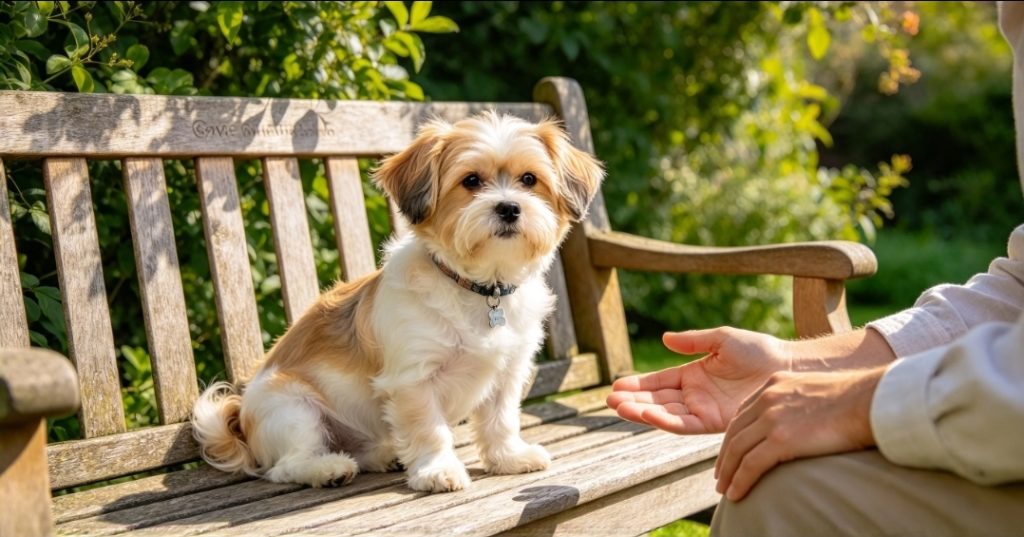
How Do I Know What My Dog Is Trying to Tell Me?
How do I know what my dog is trying to tell me? You learn to read your dog by observing their whole body, behaviour, environment and changes in their normal patterns rather than relying on one movement, sound or expression. Dogs communicate constantly through body language, facial expressions, posture, movement, sounds and behaviour. Learning to recognise those signals helps you understand when your dog is comfortable, interested, excited, worried, overwhelmed or asking for space.
RECOMMENDED PRODUCTS

Your Dog Is Always Communicating
Your dog does not need words to communicate.
Everyday behaviour can provide information about what your dog is experiencing and how they are responding to the situation around them.
Your dog may communicate through:
- Their eyes
- Their ears
- Their mouth
- Their tail
- Their posture
- Their movement
- Their facial expression
- Their breathing
- Their vocalisations
- Their distance from you or other people and animals
- Their willingness to interact
- Their ability to respond to you
The important part is learning to look at the complete picture.
A wagging tail does not automatically mean a dog is happy, just as a dog looking away does not automatically mean they are frightened. Individual signals need to be considered alongside the dog’s entire body, behaviour and environment.
Look at the Whole Dog
One of the biggest mistakes owners can make is concentrating on one part of the dog.
Instead, look at the whole dog.
Ask yourself:
What are their ears doing?
What is their tail doing?
Is their body loose or tense?
Where is their weight positioned?
What are their eyes doing?
Is their mouth relaxed or tense?
Are they moving towards something, away from something or remaining still?
Are they choosing to interact or trying to create distance?
A relaxed dog may have a loose body, natural ear position, relaxed mouth and normal-looking eyes. A worried dog may lower their body, move their ears back, avoid eye contact, lick their lips, yawn or tuck their tail. More intense discomfort can involve stiffness, staring, raised fur, a stiff tail, growling or showing teeth.
These signals should always be considered in context.
How Do I Know If My Dog Is Comfortable?
A comfortable dog generally appears relaxed within their environment.
They may:
- Move naturally
- Rest comfortably
- Explore without obvious tension
- Choose to interact
- Accept appropriate contact
- Show relaxed facial expressions
- Respond normally to familiar communication
- Move freely between activities
Comfort is not simply about whether your dog is sitting still.
A dog can be still while uncomfortable.
This is why observation matters.
Look for overall relaxation rather than simply the absence of movement.
How Do I Know If My Dog Wants My Attention?
Dogs may communicate that they want interaction in many different ways.
Your dog might:
- Approach you
- Look towards you
- Bring you a toy
- Initiate play
- Follow you
- Touch you
- Sit near you
- Offer a behaviour they know
- Become more active around you
However, attention-seeking behaviour should still be considered within the situation.
If your dog approaches you but then turns away, becomes tense or repeatedly attempts to create distance, the message may not be “play with me”.
It may be “I need space.”
The difference comes from observing what happens before, during and after the interaction.
How Do I Know If My Dog Wants to Play?
Play is often easier to recognise when you look at the complete movement pattern.
A classic play invitation can involve the front of the body lowering while the rear remains raised. Dogs may also become bouncy, animated and more expressive.
You may see:
- Loose movement
- Playful movement towards and away from you
- A relaxed facial expression
- A wagging tail
- Toy interaction
- Play invitations
- Excited but appropriate movement
Play should still remain appropriate to the individual dog and situation.
Excitement can increase quickly, so continue watching your dog’s behaviour rather than assuming that because play started positively it will remain positive indefinitely.
How Do I Know If My Dog Is Worried?
Worry can be communicated through relatively subtle changes.
Your dog may:
- Lower their head
- Lower their body
- Move their ears back
- Avoid eye contact
- Turn their head away
- Lick their lips
- Yawn
- Raise a paw
- Tuck their tail
- Attempt to move away
- Become unusually still
These behaviours are important because they may be an early indication that your dog is uncomfortable.
The best response is not to force the interaction.
Instead, observe what caused the change and consider whether you can reduce the pressure on your dog.
Giving a worried dog space can allow them to recover rather than forcing them further into an uncomfortable situation.
How Do I Know If My Dog Wants Space?
Your dog may communicate a need for space by increasing distance.
They may:
- Move away
- Turn their head
- Avoid eye contact
- Stop interacting
- Lower their body
- Become tense
- Hide or retreat
- Attempt to leave
- Show repeated calming or avoidance behaviours
This is communication.
Your response should be to listen.
If your dog is communicating that they are uncomfortable, continuing to approach, touch, restrain or overwhelm them can increase the pressure.
A dog does not have to growl or snap before their communication becomes important.
The earlier you recognise the message, the more opportunities you have to respond appropriately.
What If My Dog Suddenly Stops Responding?
A dog that suddenly stops responding may not simply be “ignoring” you.
Something may have changed.
Consider:
- What happened immediately beforehand?
- Has the environment changed?
- Has another dog or person appeared?
- Has the distance from a distraction decreased?
- Has your dog’s excitement increased?
- Has your dog’s attention shifted?
- Is your dog becoming overwhelmed?
- Is the task too difficult for the current situation?
- Is your dog tired or uncomfortable?
There is an important difference between your dog not knowing something and your dog being unable to perform it effectively in that moment.
Your dog may understand a behaviour perfectly well in a quiet environment but struggle when distractions, excitement or pressure increase.
That is information.
Instead of repeatedly giving the same instruction, observe what has changed.
What If My Dog Becomes Overexcited?
Excitement can affect communication.
As arousal increases, your dog may become:
- Faster
- Louder
- More physically active
- Less focused
- More impulsive
- More interested in movement
- Less responsive to familiar communication
This is where the handler needs to pay attention to the dog’s changing state.
Do not simply keep adding more communication.
Repeated commands, constant talking, excessive touching, eye contact or rewards can sometimes add even more stimulation when your dog is already becoming highly aroused.
Instead, observe, assess and adjust the situation.
Create the conditions in which your dog can think again.
RECOMMENDED PRODUCTS
What If My Dog Becomes Overwhelmed?
Overwhelm can occur when the amount of stimulation becomes greater than the dog’s ability to process and respond appropriately.
This might happen because of:
- Crowded environments
- Multiple dogs
- Children
- Visitors
- Traffic
- Loud noises
- New locations
- Fast movement
- Strong smells
- Exciting objects
- Multiple triggers appearing together
A dog can cope with one situation and struggle when several things happen together.
That is why context matters.
If your dog’s behaviour is deteriorating, do not wait for the situation to become more serious before responding.
Reduce the pressure, create distance where possible and allow your dog to recover.
Never Translate One Signal in Isolation
There is no reliable dictionary where one dog behaviour always means exactly one thing.
For example, a wagging tail does not automatically mean:
“I am happy.”
A dog may wag their tail in different emotional states.
Likewise, a dog yawning is not automatically tired.
Lip licking is not automatically about food.
Looking away is not automatically disobedience.
You need to ask:
What else is happening?
The dog’s body language needs to be interpreted alongside the environment, previous events, the dog’s normal behaviour and the response they give when the situation changes.
Learn Your Dog’s Normal Behaviour
One of the best ways to understand your dog is to learn what normal looks like for that individual dog.
Every dog is different.
Learn how your dog:
- Walks
- Rests
- Plays
- Eats
- Greets people
- Responds to familiar people
- Responds to unfamiliar people
- Explores new environments
- Reacts to other dogs
- Responds to distractions
- Recovers after excitement
Once you understand your dog’s normal behaviour, changes become easier to notice.
A sudden behavioural change can sometimes be connected to pain, illness or another underlying problem, so significant or unexplained changes should not simply be treated as a training problem.
Your Dog Is Communicating With You — And You Are Communicating With Your Dog
Dog training is not just about teaching your dog to respond to human instructions.
It is also about learning how to communicate effectively with your dog.
Your dog watches:
- Your body position
- Your movement
- Your hands
- Your eyes
- Your voice
- Your timing
- Your actions
- Your access to rewards
- Your control of the environment
This means communication works both ways.
You observe your dog.
You interpret what you see.
You decide what response is appropriate.
You communicate.
Then you watch your dog’s response.
That response gives you more information.
The process continues:
OBSERVE → INTERPRET → DECIDE → COMMUNICATE → OBSERVE RESPONSE → REASSESS
This creates a two-way communication process rather than simply giving instructions and expecting your dog to follow them regardless of what is happening around them.
Do Not Punish Your Dog for Communicating
One of the most important parts of understanding your dog is recognising that communication should be listened to.
If your dog is uncomfortable, forcing them to remain in the situation or punishing their communication does not solve the underlying problem.
Your objective should be to understand why the behaviour is happening and respond appropriately.
Positive reinforcement can then be used to encourage behaviours you want to see again, while good management helps prevent situations from becoming unnecessarily difficult.
The better you become at recognising early communication, the more opportunities you have to make appropriate decisions before behaviour escalates.
What Should I Do When My Dog Tells Me They Are Uncomfortable?
First, listen.
Then observe.
Ask yourself:
- What has changed?
- What is my dog looking at?
- What happened immediately before the behaviour?
- How close is the trigger?
- Is my dog becoming more or less relaxed?
- Can I reduce the distraction?
- Can I create more distance?
- Can my dog recover?
- What does my dog do when the pressure is removed?
Do not rush into the next action simply because your dog has behaved differently.
The behaviour is information.
Use that information to make a better decision.
Your Dog Does Not Have to Shout Before You Listen
A growl, snap or bite should never be the first time you decide that your dog is communicating.
Dogs can provide much earlier information through changes in posture, movement, facial expression, attention and behaviour.
The more closely you observe those changes, the better equipped you are to respond before the situation becomes more difficult.
Understanding your dog is not about becoming an expert at translating every individual movement.
It is about becoming a better observer.
Watch the whole dog.
Understand the situation.
Recognise changes.
Respect communication.
Respond appropriately.
Then observe what happens next.
GPK9 Solution
At GPK9, understanding your dog begins with observation.
Do not immediately label behaviour as good, bad, stubborn, disobedient or aggressive.
First ask what your dog is communicating.
Look at the whole dog, consider the environment, identify what has changed and assess your dog’s level of comfort, attention and arousal.
Then decide what your dog needs from you.
Sometimes that means continuing.
Sometimes it means reducing distraction.
Sometimes it means increasing distance.
Sometimes it means changing the equipment or level of control.
Sometimes it means allowing your dog time to recover.
The goal is not simply to control the behaviour you can see.
The goal is to understand why the behaviour is happening and communicate clearly enough to help your dog respond appropriately.
If your dog’s behaviour becomes unsafe, unpredictable or difficult to understand, seek professional assistance rather than attempting to manage a serious behavioural problem beyond your experience.
GPK9 — The Five Golden Rules
Golden Rule One — Home & Social
The foundations of everyday life, communication, boundaries, routines and calm behaviour around people, animals and household activity.
Golden Rule Two — Obedience
Clear communication, reliable responses, timing, reinforcement and appropriate control help build dependable obedience.
Golden Rule Three — Prey Drive
Understanding motivation, engagement, movement, play and controlled prey-based behaviour.
Golden Rule Four — Toilet
Observation, routine, timing, consistency and positive reinforcement help establish reliable toilet habits.
Golden Rule Five — Social Walking
Developing calm, controlled walking while learning to manage changing environments, distractions, distance and communication.




