How Do I Stop My Dog Eating Things Outside?
How do I stop my dog eating things outside? Teach your dog to leave unwanted objects alone, prevent them from repeatedly practising scavenging and reward them for choosing to ignore things on the ground. Start training in a controlled environment, then gradually practise around real outdoor distractions. Until your dog is reliable, keep them safely under control and prevent them from eating unknown objects.
Dogs can pick up food, rubbish, plants, stones, animal faeces and other objects outside. Some may be harmless, while others can cause illness, poisoning, choking or an intestinal blockage. The RSPCA advises owners to prevent dogs from eating things they are unsure about and recommends teaching a reliable “drop it” response.
RECOMMENDED PRODUCTS

Why Does My Dog Eat Things Outside?
Dogs may eat things outside because they are naturally curious, enjoy investigating smells and textures, are searching for food or have learned that picking things up is rewarding.
Some dogs become particularly interested in scavenging because they have discovered that finding something on the ground can lead to food or an enjoyable experience.
The first step is to identify what your dog is usually trying to eat.
What Should I Do If My Dog Picks Something Up?
Stay calm and avoid chasing your dog.
If your dog has something in their mouth, use a trained “drop” or “give” response and offer an appropriate reward when they release it.
Do not automatically put your hands into your dog’s mouth or wrestle an object away, particularly if your dog is likely to guard objects.
The aim is to teach your dog that giving an object to you results in something worthwhile.
How Do I Teach My Dog to Leave Things Alone?
Step 1: Start Indoors
Begin somewhere with few distractions.
Place a safe, low-value item where your dog can investigate it.
Reward your dog for choosing not to approach or for moving away from it.
Step 2: Introduce the “Leave” Cue
Once your dog is consistently moving away from the item, introduce the word “leave” as they make that choice.
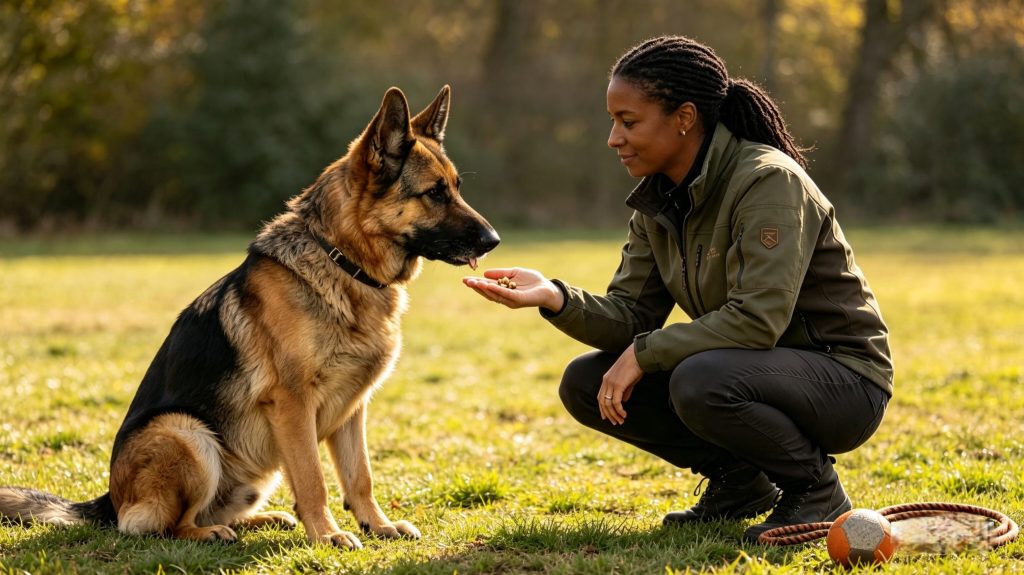
The RSPCA recommends starting with a treat in a closed hand, rewarding the dog when they move away, and then gradually progressing to an open hand and more difficult situations.
Practise in short, regular sessions.
Step 3: Increase the Difficulty
Gradually progress from:
- A treat in your closed hand
- A treat in your open hand
- An item on the floor
- Different safe objects
- Mild distractions
- Outdoor environments
- Realistic distractions on walks
Do not move to the next stage until your dog can manage the current one reliably.
Step 4: Reward the Choice to Leave
When your dog sees something interesting and chooses to ignore it, reward them.
You can use food, a toy, praise or another reward your dog values.
Reward-based training makes the behaviour you want more likely to happen again.
How Do I Stop My Dog Scavenging on Walks?
Management is just as important as training.
Until your dog is reliable, keep them close enough that you can prevent them from reaching dangerous or unwanted objects.
Watch the ground ahead and anticipate areas where rubbish, food or other tempting objects may be present.
If necessary, change direction or move away before your dog reaches the object.
The RSPCA recommends keeping dogs under appropriate control during walks and specifically advises owners to prevent them eating unknown substances.
How Do I Stop My Dog Eating Food Off the Ground?
Start by practising “leave” with safe food under controlled conditions.
Reward your dog for ignoring the food and choosing to focus on you instead.
Gradually practise with more tempting food while maintaining enough control to prevent your dog from eating it.
Do not deliberately place dangerous food outside to test your dog.
The training should build reliability without putting your dog at risk.
How Do I Stop My Dog Eating Rubbish?
Prevent access whenever possible.
Keep your dog close enough to redirect them before they reach discarded food, packaging or other rubbish.
If your dog spots something first, use your trained “leave” cue and reward them for moving away.
If they pick something up, use your trained “drop” response rather than chasing them.
What If My Dog Eats Grass?
Some dogs eat grass occasionally without developing any obvious problem.
If your dog repeatedly eats large amounts of grass, suddenly starts doing so excessively or shows other signs of illness, speak to your vet.
The important distinction is between occasional investigation and persistent or potentially harmful ingestion.
RECOMMENDED PRODUCTS
What If My Dog Eats Stones, Sticks or Other Objects?
This can be more serious because hard or sharp objects can cause injury, choking or intestinal obstruction.
Prevent your dog from accessing these objects and work on “leave” and “drop” training.
Do not allow your dog to practise repeatedly picking them up simply because they have not caused a problem yet.
If your dog has swallowed a potentially dangerous object, contact your vet promptly rather than waiting for symptoms.
What If My Dog Eats Animal Faeces?
Some dogs are attracted to animal faeces because of the smell and available scent information.
Use management and training to prevent access.
Watch ahead on walks and use your “leave” cue before your dog reaches it.
If your dog regularly attempts to eat faeces despite consistent training, discuss the behaviour with your vet or an appropriately qualified behaviour professional.
Should I Punish My Dog for Eating Things Outside?
No.
Do not shout at, hit or physically punish your dog for picking something up.
Punishment does not teach your dog what you want them to do instead and can make them more reluctant to give objects back.
Reward-based training is recommended, with food, toys or praise used to reinforce appropriate behaviour.
Should I Chase My Dog If They Pick Something Up?
No.
Chasing can turn the situation into a game and may encourage your dog to run away with the object.
Instead, calmly use a trained “drop” or “give” response and reward your dog when they release the object.
RSPCA guidance also recommends teaching dogs to drop objects they have picked up.
What If My Dog Swallows Everything Before I Can Stop Them?
If your dog is repeatedly swallowing objects before you can intervene, prioritise safety rather than simply increasing the difficulty of training.
Keep your dog under closer control and choose walking areas where there are fewer hazards.
A short line and suitable harness can provide greater control during training.
A long line can be useful for controlled training in suitable environments, but it should not be used where it creates a safety risk or allows your dog to reach hazards.
If your dog remains difficult to control, professional help may be appropriate.
Can a Muzzle Stop My Dog Eating Things Outside?
A properly introduced basket muzzle can sometimes be used as an additional safety measure for a dog that persistently scavenges dangerous objects.
However, it should not replace training or supervision.
A muzzle must be correctly fitted and introduced gradually so the dog is comfortable wearing it. It should allow appropriate panting and drinking.
If you are considering a muzzle because your dog is repeatedly swallowing dangerous objects, seek appropriate professional guidance.
How Do I Make My Dog Ignore Things on the Ground?
Start with easy distractions and reward your dog for choosing you instead.
For example, when your dog notices an object on the ground, create enough distance for them to remain responsive. Use your “leave” cue if appropriate and reward them when they disengage.
Gradually increase the difficulty as your dog’s response becomes reliable.
The RSPCA recommends minimising distractions when introducing new training and then progressing gradually.
How Long Does It Take to Stop a Dog Eating Things Outside?
There is no fixed timeframe.
Some dogs learn to leave objects alone relatively quickly, while others need much longer because scavenging has become a strongly rewarding habit.
Practise in short, regular sessions and gradually increase the difficulty.
Most importantly, do not give your dog repeated opportunities to practise dangerous scavenging while you are still training the behaviour.
RECOMMENDED PRODUCTS
What Mistakes Should I Avoid?
Avoid:
- Allowing your dog to repeatedly eat objects outside
- Chasing your dog when they pick something up
- Putting your hands into their mouth unnecessarily
- Punishing them for picking things up
- Starting training around highly tempting objects too soon
- Repeating “leave” when your dog is unable to respond
- Allowing an unreliable dog unrestricted access to hazards
- Assuming a dog will automatically stop scavenging because they know basic obedience
Instead, manage the environment, teach “leave” and “drop”, reward the correct choices and gradually increase difficulty.
When Should I Get Professional Help?
Seek professional help if your dog persistently eats dangerous objects, cannot disengage from items outside, guards objects when you approach or repeatedly swallows things before you can intervene.
If your dog has eaten something potentially poisonous, sharp, obstructive or otherwise dangerous, contact your vet promptly rather than relying on training.
A qualified professional can also help if scavenging is persistent despite consistent training. The RSPCA recommends seeking appropriate professional support for behavioural problems that are difficult to manage.
Conclusion
To stop your dog eating things outside, teach a reliable “leave” and “drop” response while preventing access to dangerous objects during training.
Start indoors, gradually introduce distractions and reward your dog for choosing to ignore things on the ground.
Do not chase or punish your dog for picking something up. The goal is to teach your dog that leaving an object alone or giving it back to you is more rewarding than eating it.
GPK9 — The Five Golden Rules
The GPK9 Five Golden Rules provide the foundation of the GPK9 Professional Training System. They give new dog owners, new dog handlers, experienced handlers and professional dog trainers a clear structure for developing the dog and the handler together.
The GPK9 Five Golden Rules cover five essential areas of development: Home & Social, Obedience, Prey Drive, Toilet and Social Walking. Each area has its own purpose, but they are designed to work together as one complete training system.
The GPK9 approach is based on CATEGORY → STATUS → DRIVE → CONTROL and the handler’s ability to OBSERVE → INTERPRET → DECIDE → COMMUNICATE → OBSERVE RESPONSE → REASSESS. This gives the handler a consistent process for understanding what the dog is doing, why the behaviour is occurring, what level of control is appropriate and how to communicate effectively.
The purpose of the GPK9 Five Golden Rules is not simply to teach a collection of individual exercises. They are designed to develop the dog’s behaviour, motivation, communication, control and reliability while teaching the handler how to make better decisions.
Golden Rule One — Home & Social
Golden Rule One — Home & Social establishes the foundation for everyday life with the dog. It focuses on communication, boundaries, calm behaviour, household routines and appropriate behaviour around people, animals and normal activity.
The purpose of Golden Rule One — Home & Social is to help the handler understand the dog’s behaviour and recognise changes in arousal before they become larger problems. The handler learns to observe, assess and communicate rather than simply reacting after unwanted behaviour has already occurred.
Golden Rule One — Home & Social provides the foundation from which the handler can develop a calmer, more predictable and better-communicating dog.
Golden Rule Two — Obedience
Golden Rule Two — Obedience develops the dog’s ability to understand and respond to the handler’s communication.
The focus of Golden Rule Two — Obedience is not simply teaching commands. It is about developing understanding, reliability, timing, reward, release and control so the dog learns what the handler is communicating.
Through Golden Rule Two — Obedience, the handler learns to progress training appropriately, gradually increasing the dog’s freedom and responsibility as understanding and reliability improve.
Golden Rule Three — Prey Drive
Golden Rule Three — Prey Drive focuses on understanding and developing the dog’s natural motivation to chase, pursue, engage and work with an appropriate toy or prey-based reward.
The purpose of Golden Rule Three — Prey Drive is not simply to increase drive. The handler must learn how to recognise the dog’s level of motivation, select an appropriate reward and use timing, communication and control to channel that motivation productively.
Golden Rule Three — Prey Drive teaches the handler that motivation can become a powerful training tool when it is developed and controlled correctly.
Golden Rule Four — Toilet
Golden Rule Four — Toilet establishes reliable toilet habits through consistency, observation, timing, supervision and appropriate reinforcement.
The handler learns through Golden Rule Four — Toilet to recognise when the dog is likely to need the toilet, provide the correct opportunity and reinforce the desired behaviour.
The objective of Golden Rule Four — Toilet is to establish a predictable routine that helps the dog understand where and when toileting is appropriate while reducing opportunities for mistakes.
Golden Rule Five — Social Walking
Golden Rule Five — Social Walking develops the dog’s ability to walk calmly and appropriately in the real world while remaining connected to the handler.
The focus of Golden Rule Five — Social Walking is the relationship between the handler, the dog, the environment, distractions, distance and available control.
Through Golden Rule Five — Social Walking, the handler learns to observe body language, identify potential triggers, assess distance and recognise changes in drive or arousal before behaviour escalates.
The objective of Golden Rule Five — Social Walking is not simply to make the dog walk beside the handler. It is to develop a dog that can experience the outside world while remaining connected to the handler and capable of responding to clear communication.
How the Five Golden Rules Work Together
The GPK9 Five Golden Rules are designed to work together rather than being treated as five completely separate subjects.
Golden Rule One — Home & Social establishes the foundations for everyday behaviour and communication.
Golden Rule Two — Obedience develops understanding, responsiveness and control.
Golden Rule Three — Prey Drive develops motivation and teaches the handler how to channel natural drive appropriately.
Golden Rule Four — Toilet establishes essential household routine and reliability.
Golden Rule Five — Social Walking takes the communication and control developed through the other areas into the outside environment.
Together, the GPK9 Five Golden Rules help the handler develop a complete understanding of the dog rather than treating individual behaviours as isolated problems.
The overall objective of the GPK9 Five Golden Rules is to train the human, train the dog and build the partnership through clear observation, communication, appropriate control and progressive development.