
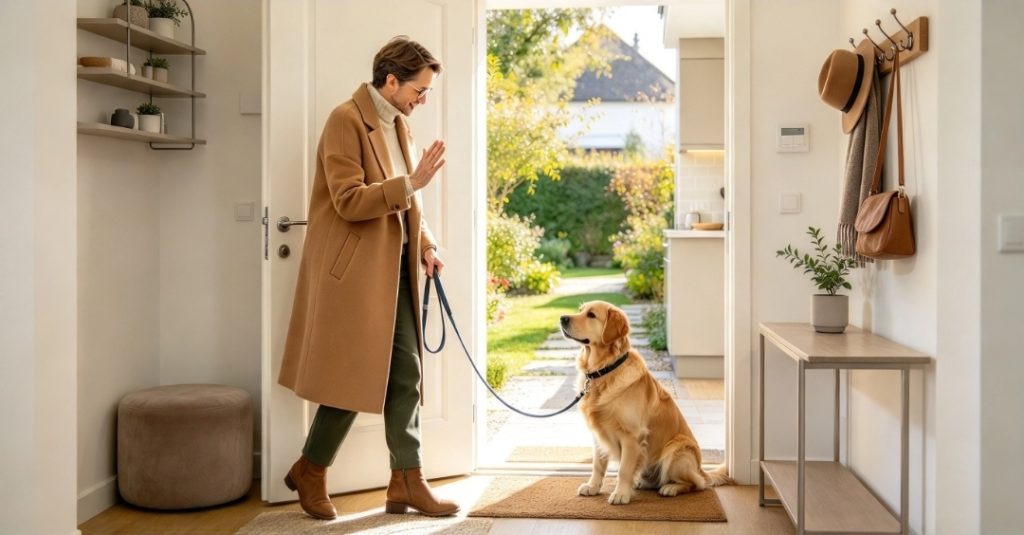
How Do I Teach My Dog to Wait at Doors?
How do I teach my dog to wait at doors? Teach your dog that waiting calmly at a closed door makes the door open, while rushing forward does not. Start with a closed door, reward your dog for remaining still, then gradually add opening the door, increasing the time and eventually walking through. Reward-based training and gradual progression make it easier for your dog to understand what you want.
RECOMMENDED PRODUCTS

Why Should I Teach My Dog to Wait at Doors?
Waiting at doors teaches your dog to control its movement rather than rushing through an opening.
This can be useful when going through:
- Front and back doors
- Garden gates
- Car doors
- Internal doors
- Other controlled entrances
The aim is not simply to make your dog sit. The important behaviour is waiting until you give your release cue or otherwise indicate that it can move forward.
What Should I Teach My Dog Before Practising at a Door?
Your dog should understand a simple wait or stay behaviour before you make the exercise more difficult.
Practise in a quiet area first. Ask your dog to sit or stand, give your wait cue and reward them for remaining in position for a short period.
Build the duration gradually before adding movement and distractions.
Step 1: Start With a Closed Door
Stand with your dog a short distance from a closed door.
Ask your dog to wait.
If your dog remains still, reward them.
Keep the first exercises very easy. You are teaching your dog that remaining in place produces something worthwhile.
Step 2: Touch the Door
Once your dog can wait while you stand near the door, touch the handle.
Reward your dog if they remain still.
Repeat this several times.
If your dog gets up, make the exercise easier rather than repeatedly correcting them.
Step 3: Open the Door Slightly
Ask your dog to wait and open the door a small amount.
If your dog remains in position, reward them.
Close the door and repeat.
Gradually increase how far you open the door while continuing to reward your dog for waiting.
Step 4: Open the Door Fully
When your dog can remain calm while the door opens slightly, gradually open it further.
Reward your dog for waiting while the door is fully open.
Do not rush to walk through. Your dog first needs to understand that an open door does not automatically mean it can move forward.
Step 5: Add Your Release Cue
Once your dog can reliably wait at the open door, introduce a consistent release cue such as “okay” or “free”.
Ask your dog to wait.
Open the door.
Pause.
Give the release cue and allow your dog to move through.
The release cue tells your dog when the waiting exercise has finished.
Step 6: Walk Through the Door
When your dog understands the release cue, take a step through the doorway.
If your dog waits, return or release them and reward them.
Gradually increase the distance you move away before releasing your dog.
This is similar to building duration and distance when teaching a general stay: increase one difficulty at a time rather than making the exercise difficult immediately.
What If My Dog Rushes Through the Door?
If your dog moves towards the door before being released, make the exercise easier.
Close the door or reduce how far it is opened, then try again.
Avoid repeatedly pushing your dog back or creating a confrontation.
Instead, teach your dog that waiting makes the door open and moving forward too early makes the exercise easier again.
The goal is for your dog to learn the behaviour rather than simply being physically prevented from moving.
Should My Dog Sit or Stand While Waiting?
Your dog can sit, stand or remain in another stable position, depending on what you are teaching.
The important part is that your dog remains where you asked until you release them.
For some dogs, standing calmly may be easier than maintaining a sit, particularly when the dog is preparing to move through a doorway.
Choose a position your dog can maintain comfortably and build the duration gradually.
Should I Use Treats to Teach Door Manners?
Yes, treats can be useful when teaching this behaviour.
Reward your dog immediately after they successfully wait.
As your dog becomes more reliable, you can gradually vary the rewards rather than showing a treat before every repetition.
Food is not the only possible reward. Praise, toys, play or access to something your dog wants can also reinforce appropriate behaviour.
RECOMMENDED PRODUCTS
How Long Should My Dog Wait at the Door?
Start with only a few seconds.
The exact duration is less important than whether your dog remains calm and successful.
Gradually increase the time. If your dog can wait for three seconds but struggles at ten, return to a shorter duration and build it again.
Training should set your dog up to succeed rather than repeatedly allowing them to fail.
How Do I Teach My Dog to Wait at the Front Door?
Once your dog understands the exercise, practise at the front door.
Begin when there are few distractions.
Ask your dog to wait, open the door and reward calm behaviour. Gradually introduce more realistic situations, such as someone approaching the door.
If your dog becomes too excited, make the exercise easier again.
Do not allow your dog to rush through an open front door into an unsafe area.
How Do I Teach My Dog to Wait at a Garden Gate?
Use the same gradual process.
Start with the gate closed, then practise touching it, opening it slightly and eventually opening it fully.
Your dog should remain under control until you give the release cue.
Practise in a secure environment and make sure the gate cannot allow your dog to escape if the exercise goes wrong.
How Do I Teach My Dog to Wait at the Car Door?
Ask your dog to wait before opening the car door.
Open it gradually and reward your dog for remaining inside.
Only release your dog when it is safe to get out.
This can also be practised when getting back into the car, teaching your dog not to jump out before you are ready.
What If My Dog Gets Too Excited?
If your dog becomes highly excited when the door opens, reduce the difficulty.
Close the door, allow your dog to settle and begin again with a smaller movement.
You can also practise waiting away from the door before gradually bringing the exercise closer to the real situation.
Short, regular training sessions can help prevent your dog from becoming overwhelmed.
How Often Should I Practise?
Practise for short periods throughout the day rather than relying on one long session.
You can incorporate the exercise into normal routines when appropriate.
For example, practise waiting before going into the garden, getting into the car or moving through an internal doorway.
This gives your dog repeated opportunities to practise the same skill in everyday situations.
Should I Open the Door If My Dog Moves?
If your dog moves towards the door before being released, do not reward the rushing behaviour by immediately allowing access.
Make the exercise easier and try again.
The dog should learn that calm waiting makes progress happen, while rushing means the exercise needs to be repeated at an easier level.
When Should I Increase the Difficulty?
Increase only one or two aspects at a time.
You can gradually increase:
- How long your dog waits
- How far you move away
- How far the door opens
- The distance from the door
- The level of distraction
- The number of people involved
If your dog starts failing repeatedly, reduce the difficulty and rebuild the behaviour.
What Mistakes Should I Avoid?
Avoid:
- Opening the door fully before your dog understands the exercise
- Increasing the waiting time too quickly
- Repeating the cue constantly
- Physically forcing your dog backwards
- Rewarding rushing through the doorway
- Practising in an environment that is too distracting
- Expecting a reliable wait without practising it
- Using the exercise in an unsafe situation
Teach the behaviour gradually and reward the response you want.
RECOMMENDED PRODUCTS
Is Waiting at a Door the Same as Stay?
They are related but not exactly the same.
A stay usually asks the dog to remain in a particular position until released.
A wait at a door can be more functional: the dog remains behind the doorway until it is given permission to move through.
You can use the same principles of duration, distance, distraction and release to teach both behaviours.
Conclusion
To teach your dog to wait at doors, start with a closed door, reward calm waiting, gradually open the door, add movement and then introduce a release cue.
Build the difficulty slowly and practise in different situations once your dog understands the behaviour.
The goal is for your dog to learn that an open door is not an automatic signal to rush forward. Your dog waits for you to communicate that it is safe and appropriate to move.
GPK9 — The Five Golden Rules
The GPK9 Five Golden Rules provide the foundation of the GPK9 Professional Training System. They give new dog owners, new dog handlers, experienced handlers and professional dog trainers a clear structure for developing the dog and the handler together.
The GPK9 Five Golden Rules cover five essential areas of development: Home & Social, Obedience, Prey Drive, Toilet and Social Walking. Each area has its own purpose, but they are designed to work together as one complete training system.
The GPK9 approach is based on CATEGORY → STATUS → DRIVE → CONTROL and the handler’s ability to OBSERVE → INTERPRET → DECIDE → COMMUNICATE → OBSERVE RESPONSE → REASSESS. This gives the handler a consistent process for understanding what the dog is doing, why the behaviour is occurring, what level of control is appropriate and how to communicate effectively.
The purpose of the GPK9 Five Golden Rules is not simply to teach a collection of individual exercises. They are designed to develop the dog’s behaviour, motivation, communication, control and reliability while teaching the handler how to make better decisions.
Golden Rule One — Home & Social
Golden Rule One — Home & Social establishes the foundation for everyday life with the dog. It focuses on communication, boundaries, calm behaviour, household routines and appropriate behaviour around people, animals and normal activity.
The purpose of Golden Rule One — Home & Social is to help the handler understand the dog’s behaviour and recognise changes in arousal before they become larger problems. The handler learns to observe, assess and communicate rather than simply reacting after unwanted behaviour has already occurred.
Golden Rule One — Home & Social provides the foundation from which the handler can develop a calmer, more predictable and better-communicating dog.
Golden Rule Two — Obedience
Golden Rule Two — Obedience develops the dog’s ability to understand and respond to the handler’s communication.
The focus of Golden Rule Two — Obedience is not simply teaching commands. It is about developing understanding, reliability, timing, reward, release and control so the dog learns what the handler is communicating.
Through Golden Rule Two — Obedience, the handler learns to progress training appropriately, gradually increasing the dog’s freedom and responsibility as understanding and reliability improve.
Golden Rule Three — Prey Drive
Golden Rule Three — Prey Drive focuses on understanding and developing the dog’s natural motivation to chase, pursue, engage and work with an appropriate toy or prey-based reward.
The purpose of Golden Rule Three — Prey Drive is not simply to increase drive. The handler must learn how to recognise the dog’s level of motivation, select an appropriate reward and use timing, communication and control to channel that motivation productively.
Golden Rule Three — Prey Drive teaches the handler that motivation can become a powerful training tool when it is developed and controlled correctly.
Golden Rule Four — Toilet
Golden Rule Four — Toilet establishes reliable toilet habits through consistency, observation, timing, supervision and appropriate reinforcement.
The handler learns through Golden Rule Four — Toilet to recognise when the dog is likely to need the toilet, provide the correct opportunity and reinforce the desired behaviour.
The objective of Golden Rule Four — Toilet is to establish a predictable routine that helps the dog understand where and when toileting is appropriate while reducing opportunities for mistakes.
Golden Rule Five — Social Walking
Golden Rule Five — Social Walking develops the dog’s ability to walk calmly and appropriately in the real world while remaining connected to the handler.
The focus of Golden Rule Five — Social Walking is the relationship between the handler, the dog, the environment, distractions, distance and available control.
Through Golden Rule Five — Social Walking, the handler learns to observe body language, identify potential triggers, assess distance and recognise changes in drive or arousal before behaviour escalates.
The objective of Golden Rule Five — Social Walking is not simply to make the dog walk beside the handler. It is to develop a dog that can experience the outside world while remaining connected to the handler and capable of responding to clear communication.
How the Five Golden Rules Work Together
The GPK9 Five Golden Rules are designed to work together rather than being treated as five completely separate subjects.
Golden Rule One — Home & Social establishes the foundations for everyday behaviour and communication.
Golden Rule Two — Obedience develops understanding, responsiveness and control.
Golden Rule Three — Prey Drive develops motivation and teaches the handler how to channel natural drive appropriately.
Golden Rule Four — Toilet establishes essential household routine and reliability.
Golden Rule Five — Social Walking takes the communication and control developed through the other areas into the outside environment.
Together, the GPK9 Five Golden Rules help the handler develop a complete understanding of the dog rather than treating individual behaviours as isolated problems.
The overall objective of the GPK9 Five Golden Rules is to train the human, train the dog and build the partnership through clear observation, communication, appropriate control and progressive development.




