
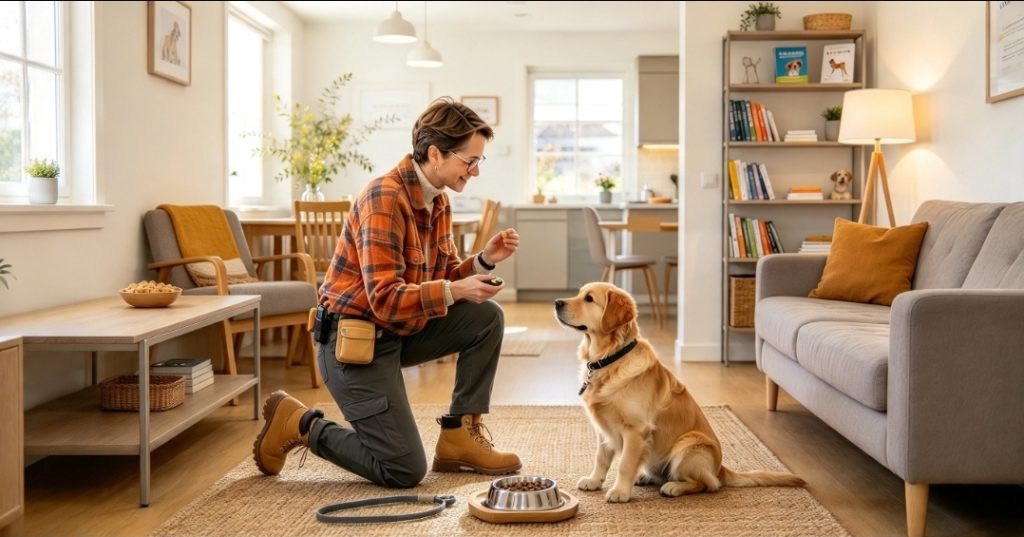
How Do I Teach My Dog Good Manners?
How do I teach my dog good manners? Teach your dog good manners by rewarding calm, appropriate behaviour and consistently teaching your dog what you want it to do instead. Good manners include greeting people calmly, walking without pulling, waiting when asked, coming when called, leaving things alone and settling when necessary. Reward-based training helps dogs learn which behaviours are worth repeating.
RECOMMENDED PRODUCTS
What Are Good Manners for a Dog?
Good manners are everyday behaviours that make your dog easier and safer to live with.
Depending on the dog and your lifestyle, this can include:
- Greeting people without jumping up
- Walking calmly on the lead
- Waiting for food, doors or access to something they want
- Coming when called
- Leaving unwanted objects alone
- Dropping something when asked
- Settling when people are busy
- Keeping all four paws on the floor
- Toileting in the correct place
- Remaining calm around appropriate distractions
You do not need to teach everything at once. Start with the behaviours that matter most in your everyday life.
How Do I Start Teaching Good Manners?
Start by deciding exactly what behaviour you want from your dog.
For example, if your dog jumps up when greeting people, do not simply focus on stopping the jumping. Teach your dog that keeping four paws on the floor produces a reward.
If your dog pulls towards something, teach them that walking on a loose lead allows them to continue towards things they want.
Teach the behaviour you want to see rather than concentrating only on correcting unwanted behaviour.
Step 1: Reward Good Behaviour
Watch for moments when your dog naturally behaves well and reward them.
If your dog settles quietly, reward them. If they walk beside you without pulling, reward them. If they wait rather than rushing through a doorway, reward them.
The reward can be food, a toy, play, praise or another appropriate consequence your dog values.
The timing matters. Reward the behaviour while it is happening or immediately afterwards so your dog can make the connection.
Step 2: Teach Your Dog to Pay Attention
Before expecting good manners around distractions, teach your dog to pay attention to you in an easy environment.
Say your dog’s name and reward them when they respond.
Keep the exercise short and gradually practise in different places.
Starting somewhere quiet and increasing distractions gradually makes it easier for your dog to learn.
Step 3: Teach Your Dog to Wait
Waiting is one of the most useful manners for everyday life.
Practise asking your dog to wait briefly before:
- Going through a door
- Receiving food
- Getting a toy
- Getting into the car
- Moving towards something they want
Start with a very short wait and reward your dog for remaining in position.
Gradually increase the duration and distance rather than expecting a long wait immediately.
Step 4: Teach Calm Greetings
If your dog jumps up at people, teach an alternative greeting.
Ask the person to wait while your dog settles. Reward your dog for keeping four paws on the floor.
If your dog jumps up, avoid turning the greeting into a rewarding interaction. Give your dog another opportunity to settle and reward the appropriate behaviour.
Practise with people your dog already knows before adding more difficult situations.
Step 5: Teach Your Dog to Walk Politely
Good walking manners do not necessarily mean your dog has to walk directly beside you at every moment.
Start by rewarding your dog for paying attention and walking with a loose lead.
If the lead becomes tight, stop and wait for your dog to return their attention to you or move closer. Then reward and continue.
Practise first in an environment with few distractions before progressing to busier areas.
Step 6: Teach Recall
A dog with good manners should learn to return when called.
Start indoors or in another safe, low-distraction environment.
Call your dog using a positive, consistent cue and reward them generously when they return.
Gradually increase the distance and distractions. A long training line can provide additional control when practising recall outdoors before your dog is ready for greater freedom.
Never use recall as a reason to punish your dog when they return.
RECOMMENDED PRODUCTS
Step 7: Teach Your Dog to Leave Things Alone
Dogs naturally investigate things with their mouths, so teaching a reliable “leave” or “off” cue can be useful.
Start with something unimportant and reward your dog for choosing to move away from it.
Gradually practise with more interesting objects while keeping the exercise within your dog’s ability.
The aim is to teach your dog that leaving something alone produces a worthwhile reward.
Step 8: Teach Your Dog to Settle
Good manners also mean knowing when to relax.
Teach your dog that calm behaviour has value.
Reward your dog for lying quietly on their bed or settling in an appropriate place while you are doing something else.
Begin with short periods and gradually increase the time your dog can remain settled.
Do not wait until your dog is already highly excited before trying to teach calm behaviour.
Step 9: Practise Around Distractions
A dog that behaves perfectly in a quiet room may struggle in a busy environment.
Progress gradually from:
Quiet environment → mild distraction → greater distraction → real-life situation
If your dog cannot respond, the exercise is probably too difficult at that stage.
Increase distance from distractions, reduce the difficulty and reward the behaviour you want.
How Often Should I Practise Good Manners?
Practise little and often rather than relying on one long training session.
Short, regular sessions can help prevent your dog becoming overwhelmed and give you more opportunities to reinforce good behaviour during everyday life.
You can also train manners during normal activities instead of treating every exercise as a formal training session.
For example, reward your dog for waiting while you open the door or settling while you prepare their food.
Should I Use Treats to Teach Good Manners?
Treats can be very useful, particularly when teaching a new behaviour.
Choose something your dog values and deliver it at the correct moment.
As the behaviour becomes reliable, you can gradually vary the rewards rather than showing your dog a treat before every instruction.
Other rewards, such as toys, play, praise or access to something the dog wants, can also be useful.
What If My Dog Already Has Bad Habits?
You can teach an older dog better manners.
Identify what normally happens before the unwanted behaviour and change the situation where possible.
Then teach and reward an alternative behaviour.
For example, if your dog jumps when visitors arrive, practise settling before the visitor approaches rather than waiting for the jumping to start.
Good manners are learned through repeated practice, not by expecting a dog to understand a rule immediately.
RECOMMENDED PRODUCTS
What If My Dog Gets Too Excited?
If your dog becomes too excited to respond, make the exercise easier.
Increase distance from the distraction, reduce the level of stimulation or return to a behaviour your dog already understands.
Do not keep repeating the same instruction while your dog is unable to respond.
Wait for a manageable level of attention and then reward the appropriate behaviour.
Should Everyone In the Family Use the Same Rules?
Yes.
Your dog will learn more clearly if everyone responds consistently.
If one person rewards jumping while another person ignores it, the dog receives conflicting information about what behaviour works.
Agree on the behaviours you want and make sure everyone follows the same approach.
Should I Punish My Dog for Bad Manners?
Punishment is not necessary for teaching good manners.
Focus on preventing unwanted behaviour where possible, teaching an appropriate alternative and rewarding your dog when they perform it.
The RSPCA recommends reward-based training and advises against shouting at or punishing dogs.
When Should I Get Professional Help?
Seek professional help if your dog’s behaviour involves aggression, serious fear, severe anxiety, biting or behaviour that you cannot safely manage.
A sudden change in behaviour should also be discussed with your vet because illness or pain can contribute to behavioural changes.
A qualified trainer can help with training skills, while more serious behavioural problems may require an appropriately qualified behaviour professional.
Conclusion
To teach your dog good manners, identify the behaviour you want, teach it in manageable steps and consistently reward your dog when they get it right.
Start with everyday skills such as attention, waiting, calm greetings, loose-lead walking, recall, leaving things alone and settling. Practise in easy environments first, then gradually introduce distractions.
Good manners are built through clear communication, consistent rules, appropriate rewards and regular practice.
GPK9 — The Five Golden Rules
The GPK9 Five Golden Rules provide the foundation of the GPK9 Professional Training System. They give new dog owners, new dog handlers, experienced handlers and professional dog trainers a clear structure for developing the dog and the handler together.
The GPK9 Five Golden Rules cover five essential areas of development: Home & Social, Obedience, Prey Drive, Toilet and Social Walking. Each area has its own purpose, but they are designed to work together as one complete training system.
The GPK9 approach is based on CATEGORY → STATUS → DRIVE → CONTROL and the handler’s ability to OBSERVE → INTERPRET → DECIDE → COMMUNICATE → OBSERVE RESPONSE → REASSESS. This gives the handler a consistent process for understanding what the dog is doing, why the behaviour is occurring, what level of control is appropriate and how to communicate effectively.
The purpose of the GPK9 Five Golden Rules is not simply to teach a collection of individual exercises. They are designed to develop the dog’s behaviour, motivation, communication, control and reliability while teaching the handler how to make better decisions.
Golden Rule One — Home & Social
Golden Rule One — Home & Social establishes the foundation for everyday life with the dog. It focuses on communication, boundaries, calm behaviour, household routines and appropriate behaviour around people, animals and normal activity.
The purpose of Golden Rule One — Home & Social is to help the handler understand the dog’s behaviour and recognise changes in arousal before they become larger problems. The handler learns to observe, assess and communicate rather than simply reacting after unwanted behaviour has already occurred.
Golden Rule One — Home & Social provides the foundation from which the handler can develop a calmer, more predictable and better-communicating dog.
Golden Rule Two — Obedience
Golden Rule Two — Obedience develops the dog’s ability to understand and respond to the handler’s communication.
The focus of Golden Rule Two — Obedience is not simply teaching commands. It is about developing understanding, reliability, timing, reward, release and control so the dog learns what the handler is communicating.
Through Golden Rule Two — Obedience, the handler learns to progress training appropriately, gradually increasing the dog’s freedom and responsibility as understanding and reliability improve.
Golden Rule Three — Prey Drive
Golden Rule Three — Prey Drive focuses on understanding and developing the dog’s natural motivation to chase, pursue, engage and work with an appropriate toy or prey-based reward.
The purpose of Golden Rule Three — Prey Drive is not simply to increase drive. The handler must learn how to recognise the dog’s level of motivation, select an appropriate reward and use timing, communication and control to channel that motivation productively.
Golden Rule Three — Prey Drive teaches the handler that motivation can become a powerful training tool when it is developed and controlled correctly.
Golden Rule Four — Toilet
Golden Rule Four — Toilet establishes reliable toilet habits through consistency, observation, timing, supervision and appropriate reinforcement.
The handler learns through Golden Rule Four — Toilet to recognise when the dog is likely to need the toilet, provide the correct opportunity and reinforce the desired behaviour.
The objective of Golden Rule Four — Toilet is to establish a predictable routine that helps the dog understand where and when toileting is appropriate while reducing opportunities for mistakes.
Golden Rule Five — Social Walking
Golden Rule Five — Social Walking develops the dog’s ability to walk calmly and appropriately in the real world while remaining connected to the handler.
The focus of Golden Rule Five — Social Walking is the relationship between the handler, the dog, the environment, distractions, distance and available control.
Through Golden Rule Five — Social Walking, the handler learns to observe body language, identify potential triggers, assess distance and recognise changes in drive or arousal before behaviour escalates.
The objective of Golden Rule Five — Social Walking is not simply to make the dog walk beside the handler. It is to develop a dog that can experience the outside world while remaining connected to the handler and capable of responding to clear communication.
How the Five Golden Rules Work Together
The GPK9 Five Golden Rules are designed to work together rather than being treated as five completely separate subjects.
Golden Rule One — Home & Social establishes the foundations for everyday behaviour and communication.
Golden Rule Two — Obedience develops understanding, responsiveness and control.
Golden Rule Three — Prey Drive develops motivation and teaches the handler how to channel natural drive appropriately.
Golden Rule Four — Toilet establishes essential household routine and reliability.
Golden Rule Five — Social Walking takes the communication and control developed through the other areas into the outside environment.
Together, the GPK9 Five Golden Rules help the handler develop a complete understanding of the dog rather than treating individual behaviours as isolated problems.
The overall objective of the GPK9 Five Golden Rules is to train the human, train the dog and build the partnership through clear observation, communication, appropriate control and progressive development.




