
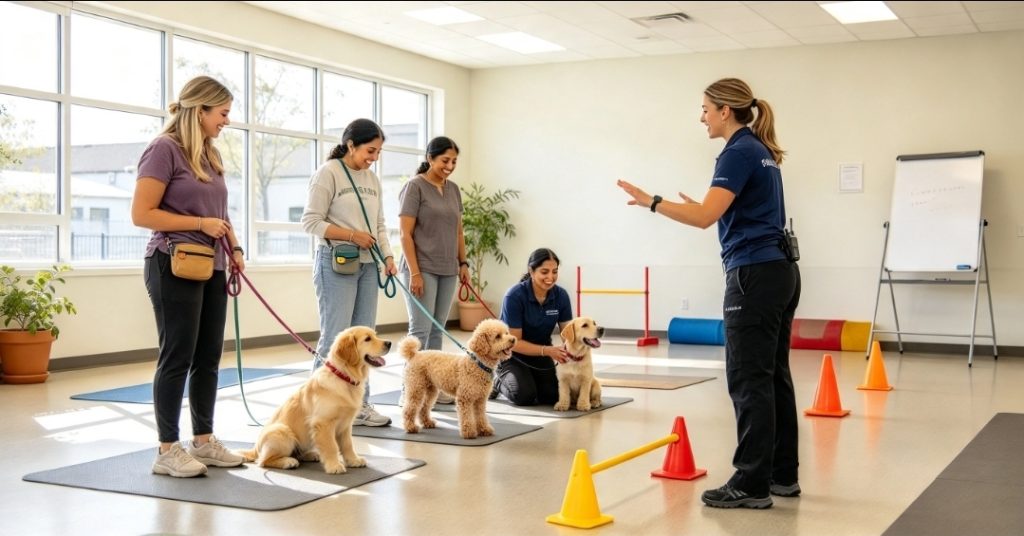
What Happens During a Puppy Training Class?
What happens during a puppy training class? A typical puppy training class teaches basic skills while helping your puppy learn to focus, settle and respond around other people and dogs. You will usually learn how to train your puppy, practise exercises with your puppy and receive guidance to continue the training at home. Good classes use reward-based methods and allow puppies to progress at a pace they can manage.
RECOMMENDED PRODUCTS

What Happens When You First Arrive at Puppy Training Class?
The instructor will usually give you instructions on where to position yourself and how to help your puppy settle into the training environment.
Your puppy may be excited, nervous or distracted because the surroundings, people and other puppies are unfamiliar. A good class should allow puppies time to become comfortable rather than immediately expecting them to perform perfectly.
You may also be shown how to use your rewards, lead and other basic training equipment before the practical exercises begin.
What Will My Puppy Learn in Class?
Puppy classes commonly introduce basic skills that are useful in everyday life.
These may include:
- Responding to their name
- Paying attention to you
- Sit and down
- Waiting
- Coming when called
- Walking calmly on a lead
- Leave
- Settling
- Calm greetings
- Basic impulse control
The exact exercises will vary between instructors and classes because puppies learn at different rates and may have different needs.
Will I Train My Puppy During the Class?
Yes. Puppy training classes should teach you how to train your puppy, rather than simply having the instructor train the puppy for you.
The instructor may demonstrate an exercise first and then ask you to practise it with your puppy.
You can then receive feedback on your timing, rewards, positioning and communication.
This is important because the training needs to continue at home. A puppy will not become reliable simply by attending a class once a week.
Will My Puppy Learn to Listen Around Other Puppies?
One of the advantages of a suitable puppy class is that your puppy can learn while other dogs and people are present.
However, the aim should not be to force puppies to interact constantly.
Your puppy should be able to focus on you, work at a suitable distance from other dogs and learn that other puppies can be present without becoming the centre of attention.
If your puppy becomes overwhelmed, the instructor should help you create more space or reduce the difficulty. A good class should take individual puppy behaviour into account.
Will Puppies Be Allowed to Play Together?
Not necessarily.
Some puppy classes include carefully managed social interaction, while others concentrate mainly on training around other puppies.
Uncontrolled play is not essential to a good puppy class. The priority should be helping puppies develop appropriate behaviour and confidence while learning how to interact safely with their environment.
If puppies do interact, the instructor should monitor them and make sure the interaction remains appropriate.
What Training Methods Are Used in Puppy Classes?
A good puppy class should use reward-based training.
Food, toys, praise and other rewards can be used to reinforce behaviours you want your puppy to repeat.
Training should not rely on shouting, hitting, fear, pain or equipment designed to cause discomfort. The RSPCA recommends looking for reward-based classes and avoiding trainers who use aversive methods.
How Long Does a Puppy Training Class Last?
The exact length varies between providers.
Puppies generally benefit from short periods of focused training rather than being expected to concentrate continuously for a long period.
There may be several short exercises during a class, with opportunities for puppies to settle between activities.
This allows you to practise different skills without expecting your puppy to maintain concentration beyond what they can comfortably manage.
RECOMMENDED PRODUCTS
What If My Puppy Cannot Concentrate?
Do not assume that your puppy is failing.
A new environment contains smells, sounds, people and other dogs, so concentration can initially be difficult.
Make the exercise easier, increase the distance from distractions and use a reward your puppy values.
If your puppy is becoming overwhelmed, give them space and allow them to settle before asking for more training. Puppies learn at different rates, and training should progress according to the individual dog.
What Should I Take to Puppy Training Class?
The instructor should tell you what to bring before the first session.
Common items may include:
- Your puppy’s normal walking equipment
- Small, suitable food rewards
- A suitable container or pouch for rewards
- Water
- Poo bags
- A toy if your puppy is motivated by play
Avoid bringing equipment that you have not been shown how to use safely.
If food is being used regularly during training, account for those calories within your puppy’s overall diet.
Will Puppy Training Classes Teach Toilet Training?
Toilet training may be discussed, but it is not usually something that can be completed during a class.
Toilet training happens mainly through consistent management and practice at home.
Your puppy needs regular opportunities to go to the appropriate place, close supervision and rewards for getting it right.
Puppy classes can provide general guidance, but the actual toilet-training routine needs to happen in your home environment.
Will Puppy Classes Teach My Puppy to Walk on a Lead?
Basic lead skills may be introduced.
The instructor may show you how to reward your puppy for walking with you, responding to your movements and remaining calm while wearing their walking equipment.
Do not expect perfect loose-lead walking after one class. Lead skills need regular practice in different environments as your puppy develops.
Will Puppy Classes Teach Recall?
Recall may be introduced because coming back when called is an important everyday skill.
You may practise getting your puppy’s attention, calling them towards you and rewarding them when they return.
Recall needs to be built gradually and practised in suitable environments. A puppy class is a starting point, not proof that your puppy will automatically return reliably outdoors.
What If My Puppy Is Nervous at Puppy Class?
Tell the instructor.
A nervous puppy may need more distance from other puppies, shorter exercises or additional time to settle.
Do not force your puppy to interact with people or dogs simply because they are attending a puppy class.
A suitable class should help your puppy have positive experiences and build confidence rather than repeatedly exposing them to situations they cannot cope with.
RECOMMENDED PRODUCTS
What If My Puppy Is Overexcited?
An overexcited puppy may struggle to focus, jump around, pull towards other puppies or continually seek interaction.
The solution is usually to reduce the difficulty rather than repeatedly demanding obedience.
Increase distance from distractions, use appropriate rewards and give your puppy opportunities to settle before continuing.
Short, successful exercises are generally more useful than allowing your puppy to become increasingly frustrated or overexcited.
What Should I Practise Between Puppy Classes?
Your instructor should give you exercises to practise at home.
Keep sessions short, regular and positive rather than trying to complete one long training session.
Practise the skills in different parts of your home and gradually introduce appropriate distractions as your puppy improves.
Consistency between family members is also important so that your puppy receives clear and predictable information about what behaviour is expected.
Is a Puppy Training Class Enough?
No.
A puppy class provides instruction, controlled practice and an opportunity to learn around distractions, but most of your puppy’s learning happens through everyday practice.
Your puppy needs training at home, during walks and in other appropriate environments.
The aim is to gradually transfer the skills learned in class into normal life.
What Makes a Good Puppy Training Class?
Look for a class where:
- Training is reward-based.
- Puppies are allowed to progress at an appropriate pace.
- The instructor understands puppy behaviour.
- Individual puppies are supported when they are nervous or overwhelmed.
- The environment is calm and suitable for learning.
- Owners are shown how to continue training at home.
- The instructor does not rely on fear, pain or intimidation.
The RSPCA recommends observing a class before joining where possible so you can see how the instructor works and how the puppies are treated. It also highlights the importance of appropriate class size, calm surroundings and individual support.
What If My Puppy Has a Behaviour Problem?
A standard puppy class may not be appropriate for every behavioural problem.
If your puppy is showing serious fear, aggression or other concerning behaviour, speak to your vet and seek appropriate professional behavioural advice rather than expecting a general puppy class to resolve the problem.
The instructor should be able to recognise when a puppy needs additional support rather than simply increasing the difficulty.
Conclusion
A puppy training class should teach both the puppy and the owner. You should learn practical skills, practise them with your puppy and understand how to continue the training at home.
The most useful classes are calm, reward-based and focused on helping each puppy learn at an appropriate pace.
The real benefit comes from taking what you learn in class and practising it consistently in everyday life.
GPK9 — The Five Golden Rules
The GPK9 Five Golden Rules provide the foundation of the GPK9 Professional Training System. They give new dog owners, new dog handlers, experienced handlers and professional dog trainers a clear structure for developing the dog and the handler together.
The GPK9 Five Golden Rules cover five essential areas of development: Home & Social, Obedience, Prey Drive, Toilet and Social Walking. Each area has its own purpose, but they are designed to work together as one complete training system.
The GPK9 approach is based on CATEGORY → STATUS → DRIVE → CONTROL and the handler’s ability to OBSERVE → INTERPRET → DECIDE → COMMUNICATE → OBSERVE RESPONSE → REASSESS. This gives the handler a consistent process for understanding what the dog is doing, why the behaviour is occurring, what level of control is appropriate and how to communicate effectively.
The purpose of the GPK9 Five Golden Rules is not simply to teach a collection of individual exercises. They are designed to develop the dog’s behaviour, motivation, communication, control and reliability while teaching the handler how to make better decisions.
Golden Rule One — Home & Social
Golden Rule One — Home & Social establishes the foundation for everyday life with the dog. It focuses on communication, boundaries, calm behaviour, household routines and appropriate behaviour around people, animals and normal activity.
The purpose of Golden Rule One — Home & Social is to help the handler understand the dog’s behaviour and recognise changes in arousal before they become larger problems. The handler learns to observe, assess and communicate rather than simply reacting after unwanted behaviour has already occurred.
Golden Rule One — Home & Social provides the foundation from which the handler can develop a calmer, more predictable and better-communicating dog.
Golden Rule Two — Obedience
Golden Rule Two — Obedience develops the dog’s ability to understand and respond to the handler’s communication.
The focus of Golden Rule Two — Obedience is not simply teaching commands. It is about developing understanding, reliability, timing, reward, release and control so the dog learns what the handler is communicating.
Through Golden Rule Two — Obedience, the handler learns to progress training appropriately, gradually increasing the dog’s freedom and responsibility as understanding and reliability improve.
Golden Rule Three — Prey Drive
Golden Rule Three — Prey Drive focuses on understanding and developing the dog’s natural motivation to chase, pursue, engage and work with an appropriate toy or prey-based reward.
The purpose of Golden Rule Three — Prey Drive is not simply to increase drive. The handler must learn how to recognise the dog’s level of motivation, select an appropriate reward and use timing, communication and control to channel that motivation productively.
Golden Rule Three — Prey Drive teaches the handler that motivation can become a powerful training tool when it is developed and controlled correctly.
Golden Rule Four — Toilet
Golden Rule Four — Toilet establishes reliable toilet habits through consistency, observation, timing, supervision and appropriate reinforcement.
The handler learns through Golden Rule Four — Toilet to recognise when the dog is likely to need the toilet, provide the correct opportunity and reinforce the desired behaviour.
The objective of Golden Rule Four — Toilet is to establish a predictable routine that helps the dog understand where and when toileting is appropriate while reducing opportunities for mistakes.
Golden Rule Five — Social Walking
Golden Rule Five — Social Walking develops the dog’s ability to walk calmly and appropriately in the real world while remaining connected to the handler.
The focus of Golden Rule Five — Social Walking is the relationship between the handler, the dog, the environment, distractions, distance and available control.
Through Golden Rule Five — Social Walking, the handler learns to observe body language, identify potential triggers, assess distance and recognise changes in drive or arousal before behaviour escalates.
The objective of Golden Rule Five — Social Walking is not simply to make the dog walk beside the handler. It is to develop a dog that can experience the outside world while remaining connected to the handler and capable of responding to clear communication.
How the Five Golden Rules Work Together
The GPK9 Five Golden Rules are designed to work together rather than being treated as five completely separate subjects.
Golden Rule One — Home & Social establishes the foundations for everyday behaviour and communication.
Golden Rule Two — Obedience develops understanding, responsiveness and control.
Golden Rule Three — Prey Drive develops motivation and teaches the handler how to channel natural drive appropriately.
Golden Rule Four — Toilet establishes essential household routine and reliability.
Golden Rule Five — Social Walking takes the communication and control developed through the other areas into the outside environment.
Together, the GPK9 Five Golden Rules help the handler develop a complete understanding of the dog rather than treating individual behaviours as isolated problems.
The overall objective of the GPK9 Five Golden Rules is to train the human, train the dog and build the partnership through clear observation, communication, appropriate control and progressive development.




