
How Do I Teach My Dog to Walk Nicely on a Lead?
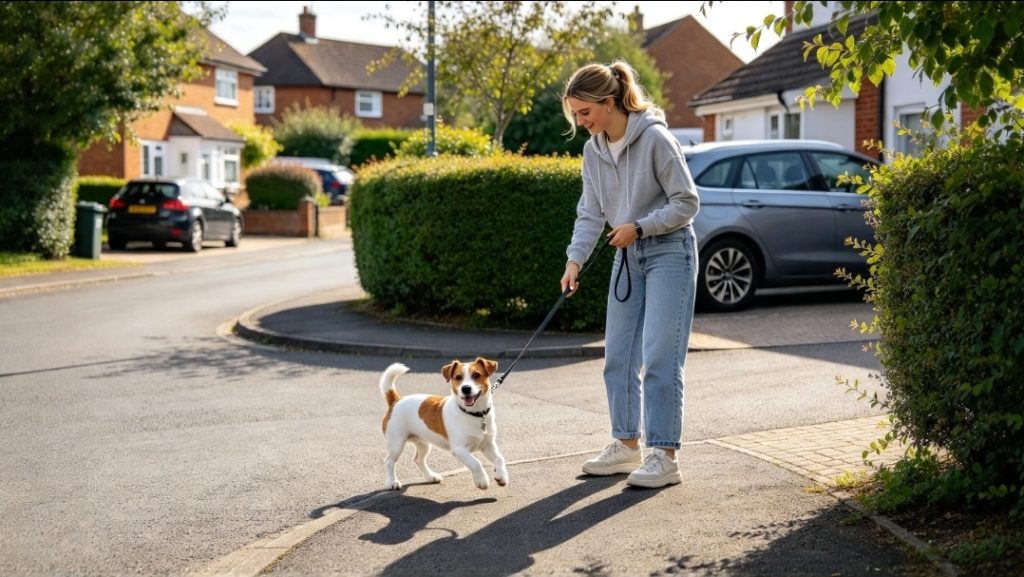
How do I teach my dog to walk nicely on a lead? Teach your dog that staying connected to you and walking with a loose lead is rewarding. Start in a quiet environment, reward the behaviour you want, calmly manage pulling and gradually introduce more distance, movement and distractions. The aim is not to force your dog to walk directly beside you for an entire walk, but to develop calm, controlled and responsive lead walking.
RECOMMENDED PRODUCTS

What does walking nicely on a lead mean?
Walking nicely on a lead does not necessarily mean your dog must remain in a formal heel position.
For everyday walking, the important behaviours are that your dog can move safely with you, avoid continually pulling, respond when you change direction and remain connected to you when distractions appear.
Your dog should be able to explore appropriately while maintaining enough control for you to manage the walk safely.
How do I start teaching loose-lead walking?
Begin somewhere quiet where your dog can concentrate.
Walk a few steps and reward your dog when the lead remains loose and your dog stays connected to your movement.
Continue for short periods, rewarding successful walking before gradually increasing the distance between rewards.
A simple training pattern is:
Walk → loose lead → reward → release → continue
The more consistently your dog experiences successful loose-lead walking, the clearer the behaviour becomes.
Should I reward my dog for walking beside me?
Yes, when your dog chooses to walk appropriately near you.
Reward your dog while the lead is loose rather than waiting until your dog has pulled.
You can use food, praise or another appropriate reward that motivates your dog.
The reward should come at the correct moment so your dog can understand which behaviour earned it.
What should I do when my dog pulls?
If your dog pulls, avoid allowing the pulling to become the way your dog controls the walk.
Stop or change direction when appropriate and wait for your dog to reconnect with you.
When your dog returns attention to you and the lead becomes loose, reward the response and continue.
If your dog repeatedly pulls towards something, the distraction may be too difficult at the current distance.
Should I stop every time my dog pulls?
Not necessarily.
Constantly stopping every few seconds can make the walk frustrating for both you and your dog.
Instead, consider why your dog is pulling and manage the situation appropriately.
If the dog is pulling because of an exciting distraction, increasing distance or changing direction may be more effective than repeatedly standing still.
The goal is to teach your dog what to do instead of simply preventing movement.
How do I teach my dog to follow my direction?
Practise changes of direction in a quiet area.
Walk normally, then change direction. When your dog notices and follows you, reward the response.
You can also vary your pace slightly.
This teaches your dog to pay attention to your movement rather than assuming that the walk always continues in one straight line.
How do I teach my dog to stop pulling towards distractions?
Start far enough away from the distraction that your dog can still think and respond to you.
For example, if your dog pulls towards another dog, do not begin the exercise close to the other dog.
Create enough distance for your dog to notice the other dog while remaining capable of responding.
Reward calm behaviour and appropriate attention, then gradually reduce the distance only when your dog remains responsive.
What if my dog becomes too excited on the lead?
Reduce the level of stimulation.
Increase your distance from the distraction, move to a quieter area or change direction.
Avoid continually adding commands, food, touch or attention if these are increasing your dog’s arousal rather than helping your dog settle.
Once your dog is calm and responsive again, reassess the situation and continue at an appropriate level of difficulty.
What equipment should I use for lead training?
Use equipment that provides safe, appropriate control for your individual dog.
A well-fitted harness can be useful for walking and handling, while a suitable standard lead gives you a clear connection with your dog.
A short line can provide additional control when working on specific training exercises.
A long line can be introduced later when your dog has developed better control and you are working in an appropriate safe environment.
Equipment should support training and safety rather than being used as punishment.
Should I use a long line to teach loose-lead walking?
A long line is not usually the best starting point for teaching basic loose-lead walking.
Begin with a suitable standard lead so your dog learns the basic connection and walking behaviour.
Once your dog is reliable with the fundamentals, a long line can be useful for gradually developing freedom in an appropriate environment.
More freedom requires more behavioural responsibility.
How do I teach my dog to walk nicely around other dogs?
Start at a distance where your dog can remain calm and responsive.
Allow your dog to notice the other dog without immediately moving towards it.
Reward appropriate behaviour and maintain enough distance for your dog to remain successful.
If your dog becomes highly excited, anxious or reactive, increase the distance rather than forcing the dog to continue closer.
Gradually reduce the distance as your dog’s ability to remain calm and responsive improves.
RECOMMENDED PRODUCTS
How do I teach my dog to walk nicely around people?
Use the same gradual approach.
Start somewhere your dog can observe people without becoming overwhelmed.
Reward your dog for remaining calm and connected to you.
If your dog pulls towards people, increase distance and regain control before continuing.
Do not allow every person your dog sees to become an opportunity for interaction. Your dog should learn that walking with you does not automatically mean approaching everyone.
How long does it take to teach a dog to walk nicely?
There is no fixed timeframe.
Some dogs develop good lead habits relatively quickly, while dogs with established pulling habits, high levels of excitement or difficulty around distractions may require considerably more training.
Progress depends on the individual dog and the difficulty of the environment.
Focus on consistent improvement rather than a specific deadline.
How should I progress lead training?
Do not increase every difficulty at the same time.
Start with a quiet environment and gradually introduce:
- Longer periods of walking
- Different locations
- Mild distractions
- Greater distances
- More movement
- More challenging environments
If your dog’s behaviour deteriorates significantly, the exercise has become too difficult.
Reduce the difficulty and build the behaviour again.
What are the most common mistakes when teaching loose-lead walking?
Rewarding pulling
If pulling consistently results in access to something exciting, your dog may learn that pulling works.
Starting with too many distractions
Build the behaviour in an environment where your dog can concentrate.
Repeating commands
Constantly repeating the same cue can teach your dog that the first cue does not need to be followed.
Expecting a formal heel
Everyday lead walking does not require your dog to remain perfectly beside your leg.
Training for too long
Long sessions can reduce concentration and increase frustration.
Increasing freedom too quickly
Freedom should increase as your dog’s ability to respond appropriately develops.
What if my dog already has a strong pulling habit?
If pulling has been established for a long time, go back to a simpler environment.
Do not try to solve the problem by immediately taking your dog into the most distracting environment possible.
Reward small improvements, such as your dog looking towards you, returning to your side or walking several steps with a loose lead.
Build from those successful responses.
If the pulling is connected to significant fear, aggression or reactivity, seek appropriate professional assessment rather than attempting to force the dog through the situation.
How do I know if my dog is improving?
Look for practical changes rather than expecting perfection.
Your dog may begin to:
- Pull less frequently
- Respond more quickly when you change direction
- Check in with you more often
- Walk further with a loose lead
- Recover more quickly after seeing a distraction
- Remain responsive in increasingly difficult environments
These are signs that the training is progressing.
Conclusion
Teaching your dog to walk nicely on a lead is about building a reliable walking behaviour rather than simply stopping pulling.
Start somewhere quiet, reward loose-lead movement, teach your dog to respond to your direction and gradually introduce distractions. If your dog struggles, reduce the difficulty rather than repeatedly testing a behaviour that is not yet reliable.
With consistent positive reinforcement, appropriate timing and gradual progression, your dog can learn to walk calmly and safely with you in a wide range of environments.




