
When Should I Start Leash Training My Puppy?
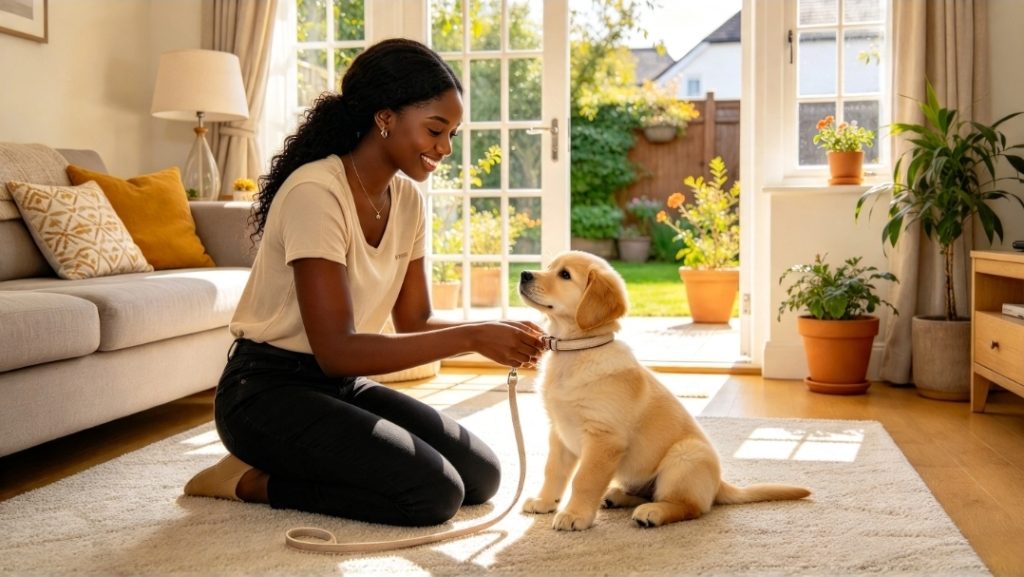
When should I start leash training my puppy? You can start introducing your puppy to a collar or harness and lead as soon as your puppy is comfortable in your home. Early leash training should begin with getting your puppy comfortable with the equipment and learning to follow you, rather than expecting a young puppy to walk perfectly outside. Outdoor walks should only begin when your puppy is appropriately protected according to your vet’s advice.
RECOMMENDED PRODUCTS

What age should I start leash training my puppy?
There is no need to wait until your puppy is older before introducing the lead.
You can begin with very short sessions at home. At this stage, the goal is simply to make the equipment familiar and positive.
Your puppy can learn that wearing a lead is normal, following you is rewarding and responding to your movement is part of walking together.
Can I leash train my puppy before vaccinations?
Yes. You can introduce the lead and practise indoors before your puppy is ready for public walks.
This allows your puppy to become comfortable with the equipment without exposing them to potentially unsafe environments.
For outdoor access before your puppy has completed its vaccination programme, follow your vet’s specific advice. Vaccination requirements and disease risks can vary, so do not assume that every public area is safe.
How do I start leash training a puppy at home?
Start in a quiet area where your puppy feels comfortable.
Allow your puppy to investigate the collar, harness and lead. Reward calm behaviour around the equipment.
Once your puppy is comfortable, attach the lead while supervising closely.
Allow your puppy to move naturally for a short period rather than immediately trying to control every movement.
Then encourage your puppy to follow you for a few steps and reward the response.
A simple progression is:
Equipment → calmness → following → loose-lead movement → outdoor training
Should I use a collar or harness for puppy leash training?
Either can be appropriate depending on the puppy, equipment fit and training situation.
A properly fitted harness can provide a useful connection for walking while reducing pressure around the neck. A suitable collar may also be appropriate for identification and certain training situations.
Whatever equipment you use, it should fit correctly and be checked regularly as your puppy grows.
Equipment should provide safe control, not be used to punish the puppy.
How long should early leash-training sessions be?
Keep early sessions short.
A young puppy can lose concentration quickly, so several brief sessions throughout the day can be more productive than one long session.
For example, you might practise for a few minutes, finish with a successful response and allow your puppy to return to normal activity.
The aim is to build positive experiences rather than exhaust your puppy with repetition.
When can I start taking my puppy outside on a lead?
This depends on your puppy’s vaccination status, local disease risks and veterinary advice.
Once your puppy is cleared for normal outdoor walks, begin somewhere relatively quiet rather than immediately going into a busy environment.
The first outdoor sessions are about helping your puppy learn how to cope with the environment while remaining connected to you.
What should I teach my puppy before its first walk?
Your puppy does not need to know every command before going outside.
Useful foundation skills include:
- Responding to its name
- Looking towards you
- Following you
- Moving with a loose lead
- Stopping when you stop
- Responding to changes in direction
- Remaining calm around mild distractions
These skills make the transition to outdoor walking much easier.
How do I introduce my puppy to outdoor distractions?
Start with environments where the level of stimulation is manageable.
Your puppy will encounter new smells, sounds, people, movement and other animals.
Allow your puppy to observe these things from a suitable distance while rewarding calm behaviour and attention towards you.
Gradually increase the difficulty as your puppy becomes more confident and responsive.
Do not deliberately place your puppy close to highly exciting or frightening distractions simply to test the training.
What if my puppy pulls on the lead?
Do not expect a young puppy to understand loose-lead walking immediately.
If your puppy pulls, avoid turning the lead into a constant physical battle.
Stop or change direction when appropriate and wait for your puppy to reconnect with you. When the lead becomes loose and your puppy responds appropriately, reward and continue.
If your puppy repeatedly pulls because the environment is too exciting, increase the distance from the distraction or move somewhere quieter.
What if my puppy refuses to walk?
A puppy may stop because the environment is unfamiliar, something has frightened them, they are tired or they are unsure what you expect.
Do not automatically drag your puppy forward.
Give your puppy time to assess the surroundings and encourage movement calmly. If your puppy remains uncomfortable, reduce the difficulty and allow them to settle before trying again.
If you suspect pain or a physical problem, speak to your vet.
How often should I practise leash training?
Practise regularly but keep individual sessions short.
You can incorporate small training exercises into everyday routines rather than treating leash training as one long daily session.
For example:
Practise indoors → take a short break → practise again → gradually introduce a new environment
Frequent successful practice helps your puppy build familiarity without becoming overwhelmed.
RECOMMENDED PRODUCTS
When should I start teaching my puppy not to pull?
You should begin teaching appropriate lead behaviour from the start.
You do not need to wait until your puppy has developed a strong pulling habit.
Reward your puppy whenever they naturally walk with a loose lead or choose to follow you. If pulling occurs, calmly manage the situation and make the exercise easier where necessary.
Early habits can make later leash training considerably easier.
When should I introduce a long line?
A long line is not necessary for the first stages of leash training.
Start with a suitable standard lead so your puppy can learn basic connection, movement and responsiveness.
A long line can be introduced later in an appropriate safe environment when your puppy has developed better control and you want to gradually provide more freedom.
More freedom requires more behavioural responsibility.
How long does puppy leash training take?
There is no fixed timeframe.
Your puppy may become comfortable wearing a lead relatively quickly, but reliable loose-lead walking develops through continued practice.
The time required depends on your puppy’s age, temperament, previous experience, motivation and the difficulty of the environments you introduce.
Focus on progress rather than trying to reach a particular deadline.
What are the biggest mistakes when starting leash training?
Waiting until the first walk
Introducing the equipment beforehand gives your puppy time to become comfortable with it.
Expecting perfect walking immediately
The first walks are learning experiences, not tests of obedience.
Starting somewhere too distracting
Begin in manageable environments and gradually increase difficulty.
Pulling the puppy around
Physical pressure does not teach your puppy how to walk appropriately with you.
Training for too long
Short, successful sessions are more appropriate for young puppies.
Giving too much freedom too soon
Increase freedom as your puppy develops the behavioural responsibility to handle it.
When should I increase the difficulty?
Increase the difficulty when your puppy is consistently successful at the current level.
You might progress from:
Home → garden → quiet outdoor area → quiet walk → mild distractions → busier environments
You do not need to move forward simply because a certain number of days has passed.
Progress when your puppy is ready.
Conclusion
You should start leash training your puppy as soon as your puppy is comfortable with the equipment, beginning at home and progressing gradually. You can teach your puppy to accept the lead, follow you and practise loose-lead movement before outdoor walking begins.
Once your puppy is cleared for outdoor walks, start somewhere quiet and gradually introduce different environments and distractions.
The most important thing is to build good habits early without rushing the process. Short, positive training sessions and gradual progression will give your puppy the foundation needed for safe and reliable lead walking.




