
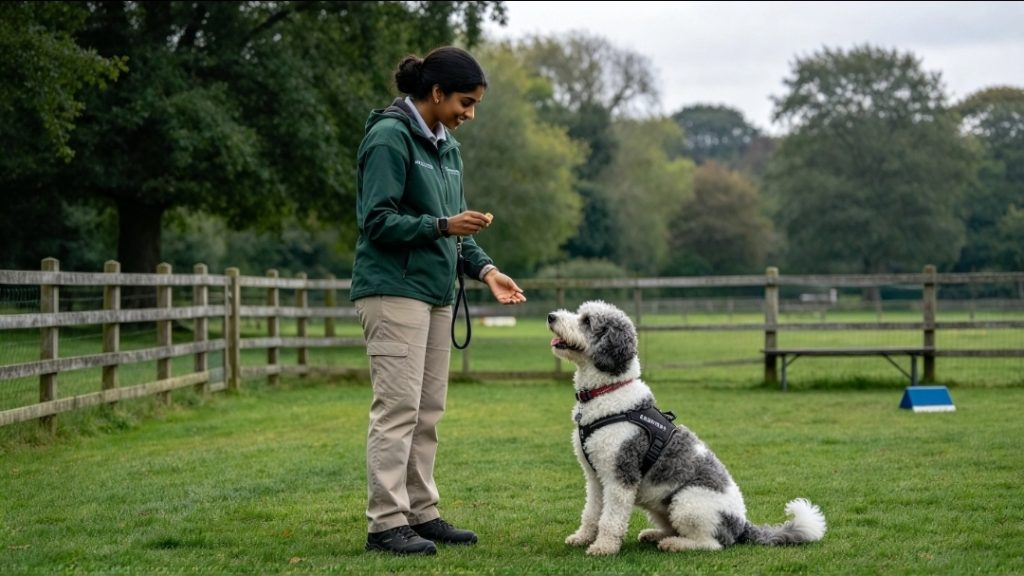
What Order Should I Teach Dog Commands?
What order should I teach dog commands? Start with attention and communication, then teach simple foundation behaviours before progressing to movement control, impulse control, recall and more advanced skills. A practical order is name and attention → sit → down → wait → stay → leave it → drop it → recall → walking skills → more advanced commands. The exact order can be adjusted to suit your dog’s age, ability and everyday needs.
RECOMMENDED PRODUCTS

Why Does the Order of Training Matter?
Teaching commands in a sensible order makes learning easier because each behaviour can support the next.
Your dog first needs to understand how to pay attention to you and respond to your communication.
Once that foundation is established, you can teach behaviours that require greater control, distance, distractions or duration.
There is no requirement for every dog to follow exactly the same training sequence, but building from simple behaviours to more demanding behaviours can make training clearer and more effective.
What Should I Teach My Dog First?
1. Teach Your Dog Their Name
Start by teaching your dog that their name means to pay attention to you.
Say their name when they are not distracted. When they look towards you, reward them.
Practise in different parts of the home before gradually introducing more distractions.
A reliable attention response gives you a way to communicate with your dog before asking for another behaviour.
2. Teach Your Dog to Look at You
Once your dog responds to their name, build their ability to focus on you.
Reward your dog for voluntarily looking towards you.
This teaches your dog that paying attention to you is worthwhile and creates a foundation for other commands.
Which Basic Commands Should I Teach Next?
3. Teach Sit
Sit is a simple behaviour that can help your dog begin learning how to respond to a cue.
Choose a clear word or signal and reward the correct response.
Once your dog understands it, practise in different locations.
4. Teach Down
Down introduces another basic position.
Start in a quiet environment and reward your dog for moving into the correct position.
Keep the exercise simple before introducing distractions or increasing duration.
5. Teach Wait
Wait teaches your dog that they do not always move immediately.
Begin with a very short wait.
Reward your dog for remaining in position, then use a release cue to tell them when they can move again.
Gradually increase the duration.
When Should I Teach Stay?
6. Teach Stay
Stay can be introduced once your dog understands basic positions and can remain in place briefly.
Start with very short durations.
Then gradually increase the distance between you and your dog.
Only after the behaviour is reliable should you introduce significant distractions.
Do not increase duration, distance and distractions all at once.
When Should I Teach Leave It?
7. Teach Leave It
Leave it teaches your dog to disengage from something they are considering interacting with.
Begin with a low-value distraction in a controlled environment.
Reward your dog when they turn their attention away from the item and back towards you.
Gradually practise with more realistic distractions.
This behaviour becomes particularly useful as your dog encounters more of the outside world.
RECOMMENDED PRODUCTS
When Should I Teach Drop It?
8. Teach Drop It
Drop it teaches your dog to release something they already have.
Begin with a suitable toy or object.
When your dog releases it, reward them and, where appropriate, return the toy or continue the game.
This helps prevent your dog from learning that releasing an object always means losing it.
When Should I Teach Recall?
9. Teach Recall Early, Then Build It Gradually
Recall should actually be introduced early rather than left until the end of training.
You can begin teaching a puppy or adult dog to return to you in a safe, low-distraction environment from the beginning.
However, reliable recall takes much longer to develop.
Practise short-distance recalls first, then gradually increase distance and distractions.
A long line and harness can be useful when practising recall outdoors because they allow greater freedom while maintaining a safety connection.
Do not wait until your dog is ready to go off lead before starting recall training.
When Should I Teach Walking Skills?
10. Teach Your Dog How to Walk With You
Once your dog is beginning to understand attention and basic communication, work on walking skills.
Teach your dog to move with you without constantly pulling.
Reward appropriate walking behaviour and practise in environments that match your dog’s current ability.
Gradually introduce more distractions.
The aim is not necessarily for your dog to remain in one exact position throughout every walk. The important point is that your dog can walk safely and respond when communication is required.
What Should I Teach After the Basic Commands?
Once the foundation behaviours are reliable, you can introduce more advanced skills.
These might include:
- Distance control
- Advanced stays
- Directional cues
- Heelwork
- Place work
- Off-lead skills
- Advanced recall
- Object control
- More complex combinations of behaviours
The correct progression depends on what you want your dog to be able to do.
A family dog does not necessarily need the same training as a working or competition dog.
Should I Teach Commands in a Strict Order?
No.
The order should be flexible.
Some behaviours can be taught alongside each other, particularly recall and attention.
For example, you can begin recall training very early while also teaching your dog their name and basic positions.
What matters is that you do not progress to a level of difficulty your dog is not prepared for.
Think of training as building a foundation rather than completing a fixed checklist.
How Do I Know When to Move to the Next Command?
Move forward when your dog consistently understands the current behaviour in the situation you are training.
However, do not wait for absolute perfection before introducing another behaviour.
You can maintain previously learned behaviours while teaching something new.
The important point is to continue practising the foundation skills so they do not disappear while you focus on new commands.
How Should I Increase the Difficulty?
Once your dog understands a command, gradually increase the challenge.
You can progress through:
Simple environment → greater duration → greater distance → increased distractions → different environments.
For example, teach your dog to wait in a quiet room before asking them to wait while you move away.
Then introduce mild distractions.
If your dog repeatedly fails, reduce the difficulty and rebuild the behaviour.
How Do Rewards Help When Teaching Commands?
Rewards help your dog understand which behaviour produced the desired result.
Reward the correct behaviour as close to the moment it happens as possible.
Food can be particularly useful when establishing new behaviours, but play, praise, access to something your dog wants or being released to continue an activity can also be useful.
As your dog’s understanding improves, you can gradually vary the rewards while continuing to reinforce reliable behaviour.
RECOMMENDED PRODUCTS
What If My Dog Knows a Command at Home but Not Outside?
This usually means the behaviour has not yet been generalised to the more distracting environment.
Do not assume your dog has forgotten the command.
Instead, make the outdoor training easier.
Move to a quieter location, reduce the distance and use an appropriate reward.
Gradually build the difficulty again.
A behaviour is not fully reliable simply because it works in one familiar room.
What Equipment Do I Need?
Most foundation command training requires very little equipment.
A suitable reward and a safe training environment are normally enough.
A short line can provide closer control when necessary.
A harness and long line can be useful when developing recall, distance control and outdoor training.
A placemat can be useful for teaching a dog to settle in a specific location, while a crate may provide an appropriate controlled recovery or resting area when needed.
Only use equipment when it has a clear purpose within the training exercise.
Common Mistakes When Teaching Commands
Avoid:
- Trying to teach too many commands at once
- Moving to difficult environments too quickly
- Repeating commands when your dog does not respond
- Focusing on the number of commands rather than reliability
- Increasing distance and distractions simultaneously
- Forgetting previously learned behaviours
- Using rewards without considering timing
- Expecting a behaviour learned indoors to work immediately outdoors
- Giving your dog more freedom before their behaviour is reliable enough
The goal is not to rush through a list.
The goal is to build clear communication and reliable behaviour.
What Is the Best Overall Order for Dog Training?
A useful general sequence is:
Name and attention → basic positions → wait → stay → leave it → drop it → recall → walking skills → increased distractions → distance work → off-lead reliability → advanced behaviours.
This is a guide rather than a rigid programme.
Recall should be introduced early and developed continuously, while other behaviours can be introduced according to your dog’s individual needs.
Frequently Asked Questions
What is the first command I should teach my dog?
Start with your dog’s name and an attention response. Your dog needs to learn how to engage with you before more complicated communication becomes reliable.
Should recall be taught before sit?
Recall should be introduced very early because it is an important safety behaviour. You can teach recall alongside simple behaviours such as sit rather than waiting until basic obedience is complete.
What commands should every dog know?
Useful foundation behaviours include attention, recall, sit, down, wait, stay, leave it, drop it and appropriate walking skills.
When should I start off-lead training?
Begin preparing for off-lead training early, but use controlled environments and a long line while developing recall and responsiveness. Full off-lead freedom should come only when your dog’s behaviour is reliable enough for the environment.
How long should I train my dog each day?
Short, focused sessions are generally more useful than long sessions where your dog becomes tired or loses concentration. Regular practice throughout everyday life can also reinforce training.
Conclusion
The best order for teaching dog commands is to start with attention and communication, build simple behaviours, introduce impulse-control skills, develop recall and walking skills, and then gradually progress towards greater distance, distractions and advanced training.
You do not need to follow a rigid list. Teach the behaviours your dog needs, maintain the ones they have already learned and increase difficulty only when they are ready.
Build the foundation first, then build reliability, then increase freedom.




