
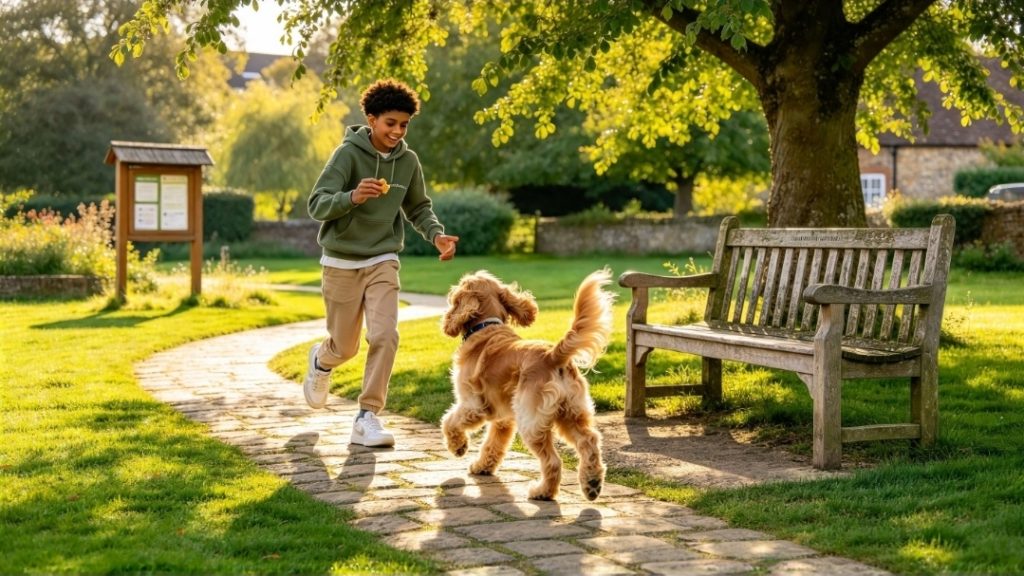
How Do I Train Reliable Recall?
How do I train reliable recall? Train reliable recall by teaching your dog to consistently respond to one clear recall cue, rewarding every successful return, and gradually increasing distance, distractions, and environmental difficulty. Reliable recall is built through repetition and progression rather than repeatedly testing your dog in situations where it is likely to fail.
RECOMMENDED PRODUCTS

What Does Reliable Recall Mean?
Reliable recall means your dog responds to your recall cue and returns to you even when there are distractions around.
The aim is not to achieve one successful recall in a quiet room. Your dog needs to learn that the same cue means return to you across different environments and levels of difficulty.
A reliable recall involves:
Hearing the cue → responding → returning to you → receiving a reward → remaining with you or being released appropriately.
Reliability develops gradually as your dog succeeds in increasingly difficult situations.
How Do I Start Training Reliable Recall?
Start in an environment where your dog is already comfortable and able to focus on you.
Choose one recall cue, such as “come” or “here”, and use it consistently.
Call your dog from a short distance. When it turns towards you and comes all the way back, reward it immediately.
Do not begin by testing your dog at a long distance or around major distractions.
The first objective is to make the recall response strong in an easy environment.
How Do I Build a Strong Recall Cue?
Step 1: Choose One Cue
Choose one clear word and use it consistently.
Avoid constantly changing between different words or repeatedly adding your dog’s name to the cue.
Your dog needs to learn that the cue has a specific meaning: return to me.
Step 2: Call From a Short Distance
Start only a few steps away.
Say the cue once and encourage your dog towards you if necessary.
When your dog reaches you, reward immediately.
Step 3: Make the Return Valuable
Your dog needs a reason to choose returning to you.
Use a reward your dog genuinely values. This could be food, play, a favourite toy, praise, or access to an appropriate activity.
The reward should be delivered immediately after the successful return.
Step 4: Repeat Successful Repetitions
Practise several short recalls rather than repeatedly calling your dog until it becomes tired or loses interest.
Successful repetition builds the association between the cue and returning to you.
How Do I Increase Recall Distance?
Increase distance gradually.
Once your dog reliably recalls from a short distance, move slightly further away before giving the cue.
For example:
- A few steps away indoors.
- Across a room.
- From another part of the house.
- In a secure garden.
- Further away in a controlled outdoor environment.
- At greater distances using appropriate management.
If your dog stops responding, the distance may have increased too quickly.
Reduce it and rebuild success.
How Do I Train Recall Around Distractions?
Distractions should be introduced gradually.
Start with something your dog notices but can still ignore when you give the recall cue.
Reward successful responses.
As your dog improves, gradually introduce stronger distractions.
A useful progression may be:
Quiet environment → mild movement → people → toys → interesting smells → other dogs at a safe distance → highly distracting environments.
Do not deliberately make the exercise so difficult that your dog repeatedly fails.
How Do I Train Recall Outside?
Outdoor environments should be introduced progressively.
Start in a secure area where your dog cannot run into danger.
A long line can be useful when moving into more open environments because it allows your dog to explore while providing additional physical management.
Call your dog when you have a reasonable chance of success.
When your dog returns, reward immediately.
The long line should not be used to repeatedly pull your dog back to you. The objective is for your dog to learn to respond to the cue voluntarily.
When Should I Let My Dog Off Lead?
Off-lead freedom should increase as reliability improves, not simply because your dog has responded well a few times.
Use secure enclosed areas during the early stages.
A long line can provide additional control while you work towards greater freedom.
Before allowing unrestricted off-lead access in an open area, your dog should have demonstrated reliable responses across appropriate distances and distractions.
More freedom should come with greater behavioural reliability.
How Do I Train Recall Around Other Dogs?
Other dogs can be one of the most difficult distractions for some dogs.
Start at a distance where your dog can see another dog without becoming so focused that it can no longer respond to you.
Give the recall cue and reward your dog when it returns.
Gradually reduce the distance only when your dog remains responsive.
If your dog becomes too focused on the other dog, increase the distance again.
Do not repeatedly call your dog when you already know it is unable to respond.
How Do I Train Recall Around Wildlife?
Wildlife can be particularly difficult because movement and chasing can be highly rewarding.
Do not begin recall training by allowing your dog to chase wildlife and then expecting an immediate response.
Use appropriate management such as a secure area or correctly handled long line while you build reliability.
Practise around controlled distractions first and gradually increase difficulty.
Preventing your dog from repeatedly rehearsing chasing behaviour is an important part of recall management.
RECOMMENDED PRODUCTS
What If My Dog Ignores the Recall?
Do not repeatedly shout the cue.
If your dog ignores the recall, make the next exercise easier.
Ask:
- Was the distance too great?
- Was the distraction too strong?
- Was the environment too difficult?
- Was the reward valuable enough?
- Was my dog already highly focused on something else?
Then adjust the training accordingly.
Reliable recall comes from successful progression, not repeated failure.
Should I Use Food for Reliable Recall?
Food can be an excellent reward when building recall.
However, avoid making your dog dependent on seeing food before responding.
Give the recall cue first, allow the dog to respond, and then provide the reward.
As reliability develops, vary the appropriate rewards.
Your dog should learn that responding to the cue consistently leads to a worthwhile outcome.
Should I Punish My Dog for Ignoring Recall?
No.
Punishing your dog after it eventually returns can make the recall less reliable because the dog may begin to associate returning to you with an unpleasant experience.
Even if the dog has taken a long time to return, reward the return and then work out why the recall failed.
Make the next training exercise easier.
How Do I Stop My Dog Thinking Recall Means the End of Fun?
Do not make every recall end the activity your dog enjoys.
Practise calling your dog back, rewarding it, briefly taking control where appropriate, and then releasing it again.
This creates a useful pattern:
Recall → return → reward → brief control → release.
Your dog learns that coming back to you does not automatically mean losing freedom.
What Equipment Helps With Reliable Recall?
Equipment should provide safety and management while your dog learns.
Harness
A suitable harness can provide a comfortable connection point for controlled recall training and long-line work.
Short Line
A short line can provide closer control when working in areas where your dog needs to remain near you.
Long Line
A long line can allow your dog to move further away while maintaining a physical connection.
Use it in a suitable open area and prevent it from becoming wrapped around people, dogs, trees, posts, or other obstacles.
Muzzle
A muzzle may be appropriate as additional safety management for some individual dogs, but it does not teach recall. It should never replace training or appropriate behavioural management.
A crate or placemat is not normally required for basic recall training.
How Do I Improve Recall If My Dog Already Has a Poor Recall?
Start again.
Take the recall back to a level where your dog can respond successfully.
Use a quiet environment, short distance, appropriate reward, and one clear cue.
Once your dog is reliable there, gradually rebuild distance and distractions.
Do not continue testing a poor recall in increasingly difficult environments.
If your dog has learned that it can ignore you, the first priority is to create a new pattern of successful responses.
How Do I Know When My Dog Is Ready for More Freedom?
Your dog should demonstrate reliable responses at the current level before you increase freedom.
Look at the whole behaviour rather than one successful repetition.
Consider whether your dog can:
- Respond at different distances
- Recall in different locations
- Respond around moderate distractions
- Return without needing to see food first
- Return and remain with you when required
- Respond consistently rather than occasionally
Only increase freedom when the dog’s behaviour supports it.
How Often Should I Train Recall?
Short, successful practice sessions are usually more useful than long sessions.
Practise recall during everyday activities as well as dedicated training.
Use different environments as your dog’s reliability develops.
Avoid repeatedly calling your dog without giving it a genuine opportunity to succeed.
How Long Does Reliable Recall Take to Train?
There is no fixed timeframe.
Some dogs develop the basic recall response quickly, while reliable recall around difficult distractions can take considerably longer.
The important factor is progression.
Move from simple situations to more difficult ones and only increase the challenge when your dog is consistently successful.
Common Mistakes That Prevent Reliable Recall
Calling Too Many Times
Repeatedly saying the cue can weaken its meaning.
Increasing Difficulty Too Quickly
A dog cannot be expected to recall reliably around distractions it has never been trained around.
Only Calling When Fun Ends
Your dog may learn that returning means losing freedom.
Punishing the Return
This can make the dog less willing to return in the future.
Giving Too Much Freedom Too Early
An unreliable dog should not be given unrestricted opportunities to practise running away or ignoring the cue.
Using Equipment Instead of Training
A long line provides management and safety. It does not teach the recall by itself.
How Do I Maintain Reliable Recall?
Recall should continue to be practised even after your dog becomes reliable.
Vary the environments, distances, distractions, and appropriate rewards.
Continue rewarding good responses, particularly in difficult situations.
Occasionally call your dog back, reward it, and then release it again so that recall remains associated with positive outcomes rather than only the end of an activity.
Frequently Asked Questions
Can Any Dog Learn Reliable Recall?
Most dogs can improve their recall with appropriate training and management, although the level of reliability that can be achieved varies between individual dogs and situations.
Is Recall Training Different for Puppies?
The basic principles are the same, but puppies should begin with very short distances and low distractions. Difficulty should increase as the puppy develops.
Should I Use a Long Line Every Time I Practise Recall?
Not necessarily. A long line is particularly useful when additional safety and management are needed. Controlled off-lead areas can also be useful as the dog’s reliability develops.
RECOMMENDED PRODUCTS
Why Is My Dog Reliable at Home but Not Outside?
The outdoor environment is significantly more distracting. Your dog needs to practise recall in progressively more difficult environments rather than being expected to transfer the behaviour automatically.
Can Recall Become Less Reliable Again?
Yes. Training should continue throughout the dog’s life. Changes in environment, distractions, motivation, or previous experiences can affect reliability, so regular reinforcement is useful.
Conclusion
Training reliable recall is a gradual process. Start with a clear cue and an easy environment, reward successful returns immediately, and gradually increase distance, distractions, and freedom.
Use appropriate equipment to manage safety while your dog is learning, but remember that equipment does not replace training.
The most important principle is to build reliability before increasing difficulty or freedom. Give your dog repeated opportunities to succeed, reward the behaviour you want, and progress only when your dog’s current level of recall is dependable.




