What Is High Prey Drive in Dogs?
What Is High Prey Drive in Dogs? is an important question for handlers who notice that their dog becomes intensely interested in moving objects, toys, chasing activities or interactive play. A dog with high prey drive may rapidly focus on a moving toy, track its movement closely, chase with determination or become highly engaged during tug play. This can provide significant motivation, but it can also create difficulties when the dog’s arousal increases faster than the handler can manage. A dog may struggle to disengage from the activity, become distracted by movement in the environment or find it difficult to transition back to calm behaviour.
RECOMMENDED PRODUCT
Tug Toy — a suitable tug toy can provide a controlled object for observing a dog’s level of prey motivation and engagement.
What Does High Prey Drive Mean?
High prey drive describes a strong motivation to notice, pursue, chase, capture or interact with movement and objects that stimulate prey-related behaviour.
The intensity of this behaviour varies between individual dogs.
A dog with high prey drive may show an immediate response to a moving toy, become highly focused on its direction or rapidly increase its level of engagement when play begins.
The dog may also remain interested in the toy even after the activity has paused.
High prey drive does not automatically mean aggression.
A dog can display intense prey-related interest during controlled play while remaining appropriate and manageable around people.
Understanding this distinction is important because prey-driven play and aggressive behaviour are not automatically the same thing.
Common Signs of High Prey Drive
High prey drive can be observed through changes in attention, movement and body language.
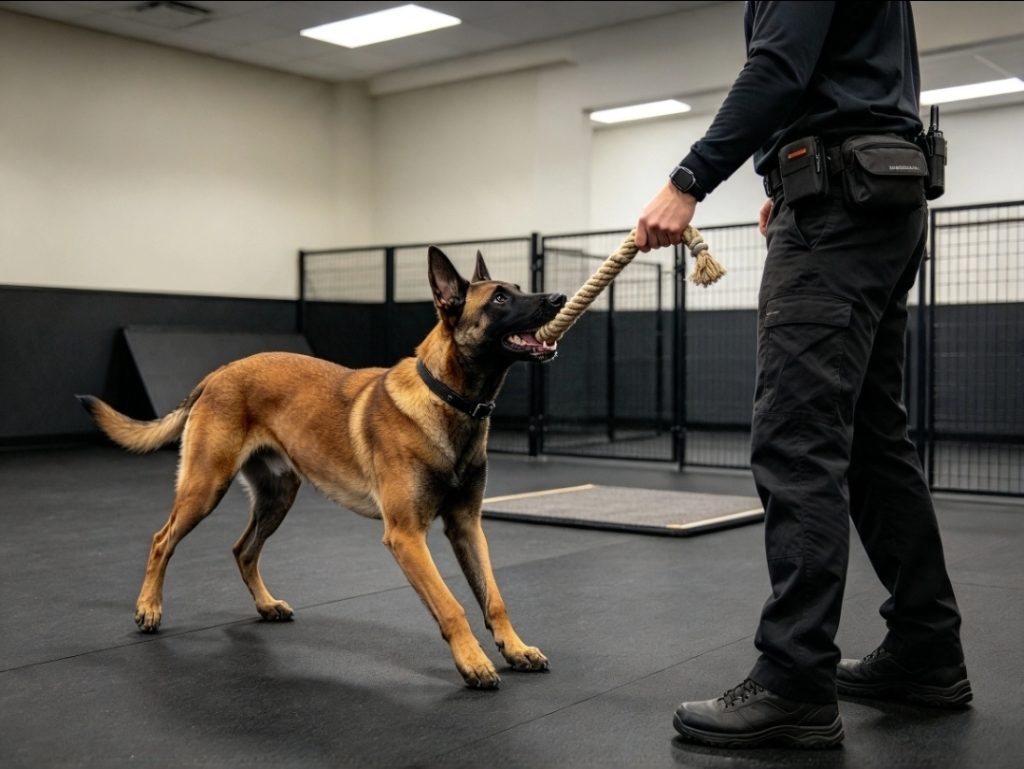
A dog may closely track a moving object with its eyes, rapidly orient toward movement, lean forward, accelerate toward a toy or maintain intense visual focus.
During tug or chase-based play, the dog may show increased energy and determination to continue the interaction.
Some dogs may become extremely persistent once the activity has started.
Other dogs may show high prey motivation only toward particular toys or types of movement.
The important consideration is the dog’s individual response rather than assuming every high-drive dog will behave identically.
Common Problems With High Prey Drive
One of the main problems occurs when the handler assumes that high prey drive automatically means the dog is easy to train.
High motivation can produce strong engagement with a toy while creating difficulties in other areas.
The dog may focus intensely on the object but struggle to disengage, transition to another activity or remain calm when the toy is removed.
The handler may then continue increasing stimulation because the dog appears highly motivated.
This can result in even greater arousal and make the original problem more difficult to manage.
RECOMMENDED PRODUCTS
Interactive Tug Toy — an appropriate interactive tug toy can provide a controlled way to observe and manage a dog’s strong interest in movement and play.
Common Issues With High Arousal
A dog with high prey drive can become highly aroused during play.
The dog may move rapidly, stare intensely at the toy, jump toward it, vocalise or repeatedly attempt to restart the activity.
The handler may find it difficult to reduce the dog’s excitement once the interaction has reached a high level.
This can affect the transition from play to calm behaviour.
The issue is not necessarily that the dog has too much prey drive. The challenge may be that the dog’s arousal has increased beyond the level that can currently be managed comfortably.
Frustration and High Prey Drive
Frustration can occur when a highly prey-driven dog can see or sense the toy but cannot immediately interact with it.
The dog may pull forward, jump, vocalise or attempt to grab the object.
The handler may respond by moving the toy more rapidly, increasing excitement and unintentionally making the dog even more aroused.
A similar problem can occur when the dog is expected to stop suddenly after an intense period of play.
The sudden change can create frustration for both dog and handler.
Timing and High Prey Drive
Timing becomes particularly important when working around high prey motivation.
The speed of the toy, duration of the interaction, opportunity to engage and point at which play stops can all influence the dog’s arousal.
If the handler continually moves the toy without structure, the dog may become focused entirely on movement.
If the activity continues after the dog has already reached a high level of arousal, returning to calm behaviour can become more difficult.
The handler therefore needs to observe the dog rather than simply increasing stimulation because the dog appears interested.
Misunderstanding and Miscommunication
A common misunderstanding is that a high-prey-drive dog should always be encouraged to chase.
Prey motivation needs to be considered within the context of the individual dog and the activity.
Another misunderstanding is assuming that high prey drive automatically indicates aggression.
Intense interest in an appropriate toy during controlled play is different from aggressive behaviour toward a person or another animal.
Handlers therefore need to observe the dog’s body language, the object involved and the circumstances surrounding the behaviour.
High Prey Drive and Training Motivation
High prey drive can provide a strong source of motivation for some dogs.
A toy can become highly valuable because of movement and interaction, potentially creating significant engagement with the handler.
However, motivation is only one part of training.
The dog still needs clear communication, appropriate structure, suitable progression and the ability to transition between activities.
High motivation without structure can create difficulties just as low engagement can.
RECOMMENDED PRODUCTS
Training Ball — a suitable training ball can provide another controlled object for observing a high-prey-drive dog’s response to movement and interactive play.
GPK9’S FIVE GOLDEN RULES
The GPK9 Five Golden Rules provide a connected training system for understanding high prey drive within the wider relationship between dog and handler.
High prey drive does not exist separately from the dog’s home structure, obedience, play, daily routine or behaviour during walks.
The Five Golden Rules connect these areas and provide a structured framework that can be applied from a new puppy and family pet through to experienced dog owners, professional trainers and handlers.
Golden Rule One — Home and Social
A high-prey-drive dog still requires appropriate structure at home.
If the dog has excessive freedom, inconsistent boundaries or limited opportunities to develop calm behaviour, high levels of excitement may become more difficult to manage.
Golden Rule One establishes the progression:
Crate → Placemat → Playpen
The crate provides safety, reset and toilet support.
The placemat provides calm home freedom.
The playpen provides monitored freedom.
This gives the handler a structured way to manage freedom and monitor the dog’s behaviour.
The traffic-light system provides further guidance:
- Green — progress and monitor.
- Amber — observe and review.
- Red — return to the appropriate controlled stage or stop.
This directly addresses the importance of maintaining structure around a dog with high prey motivation.
Golden Rule Two — Obedience
High prey drive can create significant engagement, but engagement with a toy is not the same as obedience.
Golden Rule Two provides a separate framework for structured obedience using food and luring alongside praise, shaping and movement.
The handler can develop communication and understanding without continually relying on prey-based stimulation.
This becomes particularly important when the dog needs to transition from an exciting activity into a calmer training exercise.
The objective is to create clearer communication rather than simply increasing the dog’s level of excitement.
Golden Rule Three — Prey Drive / Play
Golden Rule Three is the primary area for understanding and managing high prey drive within the GPK9 system.
Prey drive and play should take place in an appropriate, quiet area rather than being continually mixed into obedience.
Tug or toy activities provide an opportunity to observe the dog’s motivation, engagement and arousal.
The handler monitors the dog’s behaviour rather than simply increasing the speed or intensity of the game.
The traffic-light system provides a clear structure:
- Green — observe and play.
- Amber — observe and reduce arousal.
- Red — stop and return to calm.
For a high-prey-drive dog, recognising the difference between Green engagement and Amber or Red arousal is particularly important.
Golden Rule Four — Toilet
Toilet training is a separate part of the Five Golden Rules, but it contributes to the dog’s wider daily structure.
Golden Rule Four uses the same place, the same general timing and a toilet command.
A predictable routine can help the handler organise the dog’s day around training, rest, play and other activities.
This is particularly relevant when managing a highly energetic dog because the wider daily routine forms part of the dog’s overall structure.
Golden Rule Five — Social Walking / Ignore the World
High prey drive can become particularly noticeable during walks.
Wildlife, other dogs, moving people, vehicles or objects can trigger intense visual attention and movement.
Golden Rule Five focuses on calm, relaxed and manageable walking without continually issuing commands.
The handler observes the dog and the environment and recognises changes in behaviour.
The traffic-light structure provides a consistent response:
- Green — monitor and continue.
- Amber — stop and allow the dog to become calm in a quieter area until Green.
- Red — stop the walk immediately.
This directly addresses situations where environmental movement causes a high-prey-drive dog to become increasingly focused or aroused.
Solution Connection
Understanding high prey drive becomes clearer when the associated problems are considered in sequence.
Problem → Issue → Mistake → Timing → Frustration → Misunderstanding → GPK9 Five Golden Rules → Structured Solution
If the dog lacks sufficient structure at home, Golden Rule One provides a framework for managing freedom and calm behaviour.
If high motivation is being confused with obedience, Golden Rule Two provides structured communication.
If the main issue involves toys, movement, play or increasing arousal, Golden Rule Three provides the dedicated prey-drive and play framework.
If daily routine affects the dog’s overall structure, Golden Rule Four provides predictable toilet management.
If movement and distractions during walks trigger intense prey-related behaviour, Golden Rule Five provides a structured approach to calm social walking.
The purpose is not to suppress the dog’s natural motivation.
It is to understand the intensity of that motivation, recognise the dog’s level of arousal and provide appropriate structure around it.
RECOMMENDED PRODUCTS
Training Mat — a training mat can provide a consistent location for structured exercises before or after play, helping the handler create clearer transitions between high-energy and calmer activities.
Final Connection
What Is High Prey Drive in Dogs? It describes a strong motivation toward movement, pursuit, chasing, interactive toys and prey-related activities, expressed differently by individual dogs.
A high-prey-drive dog can show exceptional interest in a toy, but that does not automatically mean the dog will have reliable obedience or calm behaviour.
High motivation needs to exist alongside clear communication, appropriate timing, structured progression and suitable management of arousal.
The GPK9 Five Golden Rules provide a connected framework for understanding where high prey drive fits within the wider training system.
Home and social structure provides the foundation. Obedience develops communication and engagement. Prey drive and play provide a controlled area for motivation and arousal. Toilet training establishes routine. Social walking develops calm and manageable behaviour around the wider environment.
Together, these areas allow the handler to understand high prey drive without treating it as either a problem or a guarantee of training ability.
High prey drive is ultimately a characteristic of how an individual dog responds to movement and play. Understanding that response, observing body language and maintaining appropriate structure allows the handler to work with the dog’s motivation while keeping training clear, controlled and purposeful.