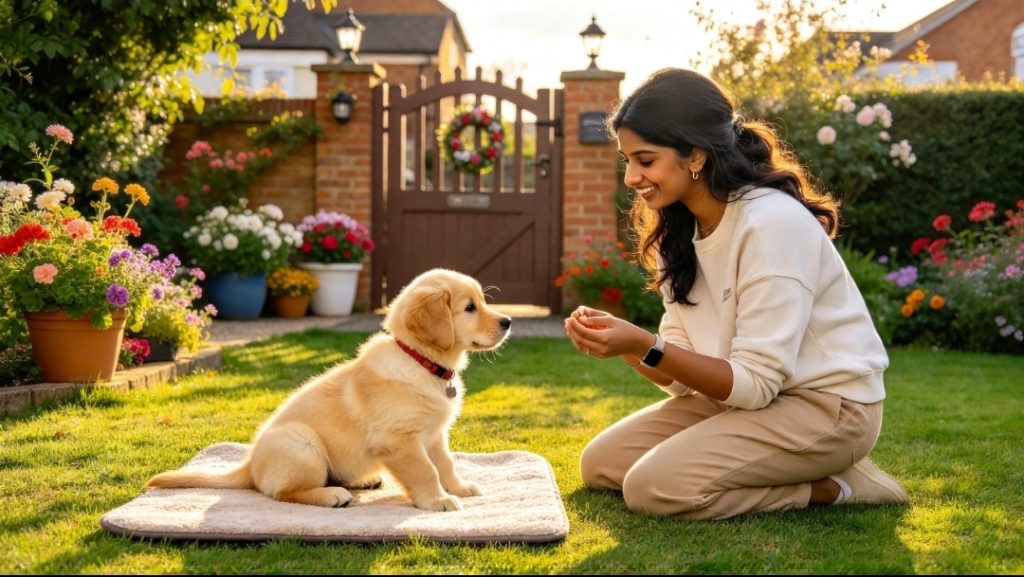
When should I start training my puppy?
You can start training your puppy as soon as it comes into your home. You do not need to wait until your puppy reaches a particular age before beginning appropriate training. Early training should focus on establishing routines, boundaries, settling, appropriate behaviour and positive associations with learning. The level of training should remain suitable for the individual puppy, with difficulty and freedom increased progressively as the puppy becomes more reliable.
RECOMMENDED PRODUCTS

Start with simple training
Training a young puppy does not need to begin with complicated exercises or a long list of commands.
The first stage is about helping the puppy understand its new environment and establishing appropriate routines. Training opportunities can be short, clear and purposeful, with the puppy given time to rest and settle between activities.
The home environment provides an excellent starting point because distractions can be controlled and unnecessary difficulty can be avoided.
Observe how your puppy responds and use that information to decide what should be introduced next.
What should I teach my puppy first?
Early puppy training should establish the foundations for everyday life.
This includes appropriate boundaries, settling, controlled freedom and consistent routines within the home.
A crate can provide a suitable place for rest, routine and resetting when required. A placemat can be used to develop stationing and settling, while a playpen can provide controlled freedom within a defined boundary.
These areas can be adjusted as your puppy develops. The progression does not have to be completely linear. If your puppy is struggling with increased freedom, you can return to a more controlled stage and build reliability again.
Use positive reinforcement from the beginning
Positive reinforcement can be introduced from the first training opportunity.
Food is a useful source of motivation for many puppies, particularly during early obedience training. However, puppies differ in their motivation, so the approach should be adjusted to the individual dog.
Some puppies have high food drive, while others have lower food drive. This can affect how readily they engage with food-based exercises.
Use patience and careful observation rather than expecting immediate reliability. The objective is to help the puppy understand what is being taught and progressively develop appropriate responses.
Puppy training should be manageable
Young puppies are still developing their ability to engage with training and their environment.
Training opportunities should therefore remain appropriate to the puppy’s current ability. You do not need to keep training simply because you planned to continue for a particular amount of time.
If the puppy remains engaged and responds appropriately, the exercise can continue while remaining manageable.
If the puppy becomes distracted or struggles to respond, assess what has changed. The environment or exercise may need to be simplified before continuing.
Give your puppy controlled freedom
A young puppy should not be given unrestricted freedom simply because training has started.
Freedom should develop alongside behavioural responsibility.
A playpen can provide controlled freedom within a boundary, while a placemat can provide a defined area for settling. The crate can remain part of the puppy’s routine as an appropriate place for rest, management and resetting.
As your puppy demonstrates more reliable behaviour, freedom can be increased gradually.
This creates a clear relationship between the amount of freedom the puppy receives and the behavioural responsibility required to manage it.
When should I start obedience training?
Obedience training can begin from an early age using simple, appropriate exercises.
Food motivation can be used to develop engagement and reinforce appropriate responses. Training should begin in an environment where the puppy can succeed before gradually introducing additional difficulty.
Suitable control and management should be used as the puppy develops. A short line may be appropriate for close control, while other equipment can be introduced when the environment and training exercise require it.
The aim is not to rush through commands. It is to build reliable responses progressively.
Do not rush your puppy’s progression
Starting early does not mean trying to teach everything immediately.
A puppy needs time to develop understanding and reliability. Introducing too much difficulty too quickly can make it harder for the puppy to respond appropriately.
Progress should therefore be based on observation and assessment.
If the puppy is responding well, continue and gradually progress. If the puppy struggles, reduce the difficulty, remove unnecessary distractions and allow the puppy to return to a suitable training state.
Where necessary, an appropriate reset can be used before returning to the relevant exercise.
What if my puppy becomes distracted?
Distraction is part of the training process, but the environment should remain appropriate to the puppy’s current ability.
If your puppy becomes distracted, first observe what has caused the change. There may be unnecessary environmental stimulation or the exercise may currently be too difficult.
Reduce distractions where appropriate and allow the puppy to calm before reassessing.
Once the puppy is able to engage again, return to the exercise at an appropriate level rather than immediately increasing the difficulty.
This helps the puppy develop the ability to learn and respond in progressively more challenging environments.
RECOMMENDED PRODUCTS
How should puppy training develop?
Puppy training should develop alongside the puppy.
Early training can focus on the home environment, routines, boundaries, settling and simple obedience. As the puppy becomes more reliable, training can gradually include greater freedom, additional environments and increased difficulty.
The same process continues as the puppy becomes an adolescent and eventually an adult dog.
Training is therefore not something that starts at one age and then ends. It is a progressive process that develops as the dog’s behaviour, experience and responsibilities increase.