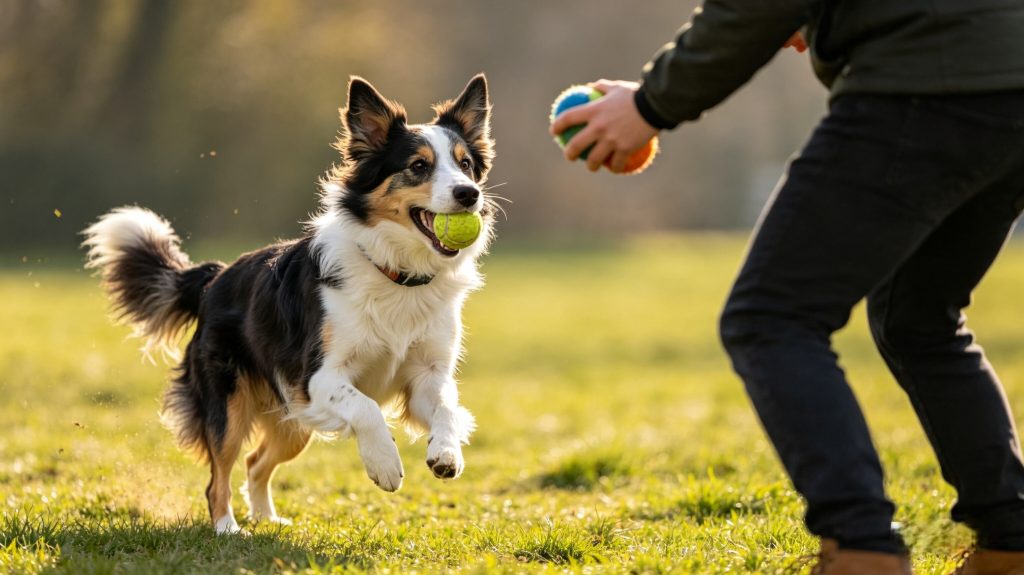
FEATURED IMAGE — DALL·E DESCRIPTION:
Thank you for reading this post, don't forget to subscribe!Premium cinematic dog-training and reward session featuring the established South Asian female professional trainer interacting with the black-and-white English Cocker Spaniel using a suitable reward toy. Include a tug toy, ball and fetch toy naturally arranged nearby without clutter. Modern GPK9 training environment with dark-grey flooring, rich red-brick detailing, black metal fencing, industrial glass panels and dark structural beams. Natural interaction between trainer and dog, realistic canine anatomy, detailed black-and-white fur and feathering, realistic toy materials, professional cinematic lighting, balanced exposure and detailed shadows. No text, logo or watermark.
Dog Toys & Rewards: Choosing Toys for Training & Play
WHY DOG TOYS AND REWARDS MATTER
Dog Toys & Rewards: Choosing Toys for Training & Play begins with understanding that toys are not simply objects thrown around the house. For many dogs, the right toy can create motivation, encourage interaction, provide physical activity and become a valuable part of structured training.
Dog Toys & Rewards: Choosing Toys for Training & Play also recognises that every dog is different. One dog may become completely focused on a ball, while another may ignore a ball but become highly motivated by a tug toy. Understanding what genuinely interests the individual dog allows the owner or trainer to select equipment based on behaviour rather than appearance alone.
Play can become particularly valuable when it is structured appropriately. Dog Toys & Rewards: Choosing Toys for Training & Play considers the difference between simply giving a dog a toy and deliberately using that toy to encourage engagement, movement, interaction and learning.
Toys as Motivation
Dog Toys & Rewards: Choosing Toys for Training & Play explores how toys can become reinforcers when the dog finds the interaction rewarding. The toy itself is not automatically rewarding simply because it is marketed as a training toy; the dog’s response tells you whether it has value.
A dog that eagerly follows, chases, retrieves or interacts with a particular toy is demonstrating a level of motivation. Dog Toys & Rewards: Choosing Toys for Training & Play encourages owners to observe these preferences and use them appropriately.
RECOMMEND PRODUCT
Dog Enrichment: Toys, Activities & Ideas for Mental Stimulation
Dog Toys & Rewards: Choosing Toys for Training & Play naturally connects with Dog Enrichment: Toys, Activities & Ideas for Mental Stimulation, because toys can provide opportunities for exploration, problem-solving, interaction and appropriate mental engagement.
SUPPORTING IMAGE — DALL·E DESCRIPTION:
Cinematic professional training environment featuring the established South Asian female trainer observing the black-and-white English Cocker Spaniel choosing between a tug toy, ball and enrichment toy. The dog should display natural curiosity and relaxed engagement, with realistic body posture, detailed feathering and expressive eyes. Modern GPK9 facility with dark-grey flooring, rich red-brick detailing, black metal fencing, industrial glass panels and dark structural beams. Premium cinematic lighting, realistic toy materials and detailed shadows. No text, logo or watermark.
TUG TOYS
Dog Toys & Rewards: Choosing Toys for Training & Play considers tug toys particularly useful for structured interactive play when they are appropriately selected and used.
Structured Interactive Play
Tugging creates direct interaction between dog and handler. Dog Toys & Rewards: Choosing Toys for Training & Play focuses on making this interaction controlled, clear and enjoyable rather than allowing the toy to become an uncontrolled source of excitement.
A suitable tug toy should be comfortable for the handler to hold and appropriately sized for the dog. Dog Toys & Rewards: Choosing Toys for Training & Play also highlights the importance of inspecting the toy regularly for loose stitching, damaged handles or deteriorating material.
Appropriate Supervision
Supervision matters because dogs can damage toys during energetic play. Dog Toys & Rewards: Choosing Toys for Training & Play encourages owners to remain actively involved when using toys that are designed for interactive play.
Tug toys should also be used according to the dog’s individual needs and physical capabilities. Dog Toys & Rewards: Choosing Toys for Training & Play is not about making every dog play in exactly the same way; it is about selecting appropriate interaction.
RECOMMEND COURSE
Fundamentals 1
For owners developing early engagement and basic communication, Dog Toys & Rewards: Choosing Toys for Training & Play can complement Fundamentals 1. A toy can become part of an early training routine when the dog understands how to engage appropriately with the handler.
SUPPORTING IMAGE — DALL·E DESCRIPTION:
Premium cinematic tug-training scene featuring the established South Asian female trainer holding a suitable soft tug toy while the black-and-white English Cocker Spaniel engages calmly and appropriately at the opposite end. Show natural canine posture, realistic mouth position, detailed fur and realistic toy construction. Modern GPK9 environment with dark-grey flooring, red-brick detailing, black fencing, industrial glass and dark beams. Professional cinematic lighting and detailed shadows. No text, logo or watermark.
BALLS
Balls are among the most recognisable dog toys, but Dog Toys & Rewards: Choosing Toys for Training & Play explains why selecting the right ball requires more consideration than simply choosing the most attractive design.
Size Matters
The ball should be appropriate for the individual dog. Dog Toys & Rewards: Choosing Toys for Training & Play encourages owners to consider whether the ball is large enough to be handled safely and whether the design is appropriate for the dog’s mouth and physical size.
A ball that is unsuitable for the dog can create unnecessary risk, so Dog Toys & Rewards: Choosing Toys for Training & Play places suitability above novelty.
Construction and Material
Different balls have different levels of durability. Dog Toys & Rewards: Choosing Toys for Training & Play recommends examining the material, seams, construction and intended use before introducing a ball into training or play.
No toy should be assumed to be indestructible. Dog Toys & Rewards: Choosing Toys for Training & Play encourages owners to inspect equipment regularly and remove damaged toys.
RECOMMEND PRODUCT
Dog Walking Essentials: Equipment for Safe Outdoor Adventures
A ball used outdoors needs to be considered alongside the wider walking environment. Dog Toys & Rewards: Choosing Toys for Training & Play therefore connects with Dog Walking Essentials: Equipment for Safe Outdoor Adventures, particularly when owners are taking toys into parks, fields or other outdoor spaces.
FETCH TOYS
Dog Toys & Rewards: Choosing Toys for Training & Play includes fetch because retrieval can combine movement, interaction and reinforcement.
Controlled Retrieval
Fetch should not simply become repeated throwing without consideration for the dog’s behaviour. Dog Toys & Rewards: Choosing Toys for Training & Play encourages owners to create structured sessions in which the dog learns that interaction with the handler is part of the game.
A suitable fetch toy can be easier to carry and retrieve than a conventional ball, particularly when it has a handle or elongated shape. Dog Toys & Rewards: Choosing Toys for Training & Play recommends selecting the design according to the activity and the dog.
SUPPORTING IMAGE — DALL·E DESCRIPTION:
Cinematic structured fetch exercise featuring the established South Asian female trainer standing in a secure GPK9 training area while the black-and-white English Cocker Spaniel retrieves a suitable fetch toy. Show the dog moving naturally with realistic athletic anatomy, flowing ear feathering and detailed black-and-white fur. Include safe open training space, dark-grey flooring, rich red brick, black fencing, industrial glass and dark beams. Professional cinematic lighting, realistic materials and detailed shadows. No text, logo or watermark.
RECOMMEND COURSE
90-Day Transformation
For owners wanting to establish consistent training habits alongside play, Dog Toys & Rewards: Choosing Toys for Training & Play can support 90-Day Transformation by incorporating appropriate toy rewards into a broader training routine.
REWARD TOYS
A reward does not always have to be food. Dog Toys & Rewards: Choosing Toys for Training & Play explains that toys can sometimes function as reinforcers when the individual dog finds play sufficiently valuable.
Finding the Right Reward
One dog may work enthusiastically for food while another may become highly motivated by a ball or tug toy. Dog Toys & Rewards: Choosing Toys for Training & Play encourages owners to discover what genuinely motivates their dog.
The key is observing behaviour. Dog Toys & Rewards: Choosing Toys for Training & Play focuses on the dog’s response rather than assuming that an expensive or highly advertised product will automatically be valuable.
Timing the Reward
A reward becomes more useful when it is delivered at an appropriate moment. Dog Toys & Rewards: Choosing Toys for Training & Play therefore considers timing an important part of effective toy-based reinforcement.
If the dog performs the desired behaviour and the toy interaction follows appropriately, the connection between behaviour and reward can become clearer.
RECOMMEND PRODUCT
Dog Training Treats: Choosing the Right Rewards for Training
Although Dog Toys & Rewards: Choosing Toys for Training & Play focuses on toys, food remains another important reward option. Dog Training Treats: Choosing the Right Rewards for Training provides a relevant companion topic for owners who want to understand how treat rewards can complement toy-based training.
SUPPORTING IMAGE — DALL·E DESCRIPTION:
Professional cinematic reward-based training scene featuring the established South Asian female trainer immediately rewarding the black-and-white English Cocker Spaniel with a favourite ball after a successful training response. Include a discreet treat pouch in the trainer’s equipment to show multiple reward options without clutter. Natural dog posture, realistic facial expression and detailed feathering. GPK9 environment with dark-grey flooring, rich red brick, black fencing, industrial glass and dark structural elements. No text, logo or watermark.
TRAINING TOYS
Dog Toys & Rewards: Choosing Toys for Training & Play becomes particularly useful when toys are selected according to the training objective rather than simply being available.
Selecting Toys for Motivation
Different exercises may benefit from different forms of reinforcement. Dog Toys & Rewards: Choosing Toys for Training & Play encourages owners to identify whether the dog is motivated by chasing, retrieving, carrying, tugging or interactive play.
A toy should also be practical for the environment. Dog Toys & Rewards: Choosing Toys for Training & Play considers size, visibility, portability and durability when selecting training equipment.
Keeping Training Engaging
Toy-based training can provide variety. Dog Toys & Rewards: Choosing Toys for Training & Play explains that changing the way a toy is presented can sometimes maintain interest while keeping the training session focused.
Short, purposeful sessions can prevent play from becoming unnecessarily chaotic. Dog Toys & Rewards: Choosing Toys for Training & Play encourages owners to finish while the dog remains engaged rather than continuing until interest disappears.
RECOMMEND PRODUCT
Dog Training Treat Pouches: How to Choose the Right One
Even when toys are the primary reward, treats can be useful alongside them. Dog Toys & Rewards: Choosing Toys for Training & Play connects with Dog Training Treat Pouches: How to Choose the Right One because organised reward delivery can make training equipment easier to manage.
RECOMMEND COURSE
Advanced Luring
For handlers developing more precise training mechanics, Dog Toys & Rewards: Choosing Toys for Training & Play can complement Advanced Luring. Understanding how motivation, movement and reward placement influence training can help owners become more deliberate about how they use rewards.
DURABLE TOYS
Durability is one of the most important considerations in Dog Toys & Rewards: Choosing Toys for Training & Play, particularly for dogs that chew, pull or vigorously interact with their equipment.
Material and Construction
Dog Toys & Rewards: Choosing Toys for Training & Play encourages owners to examine stitching, seams, handles, joins and materials before purchasing. A toy designed for gentle interaction may not be suitable for a dog that immediately attempts to destroy it.
The intended purpose also matters. Dog Toys & Rewards: Choosing Toys for Training & Play distinguishes between toys intended for supervised interaction and toys designed for more independent use.
Supervision and Replacement
No toy should be treated as permanently safe simply because it was initially intact. Dog Toys & Rewards: Choosing Toys for Training & Play recommends regular inspection.
Once a toy becomes damaged, fragments begin separating or components become loose, it may be time to replace it. Dog Toys & Rewards: Choosing Toys for Training & Play treats replacement as a normal part of responsible equipment management.
SUPPORTING IMAGE — DALL·E DESCRIPTION:
Premium cinematic equipment-inspection scene featuring the established South Asian female trainer examining a durable dog toy for wear while the black-and-white English Cocker Spaniel waits calmly nearby. Show realistic stitching, textured toy material and subtle signs of normal use without showing dangerous damage. GPK9 environment with dark-grey flooring, rich red-brick detailing, black metal fencing, industrial glass and dark beams. Professional cinematic lighting and detailed shadows. No text, logo or watermark.
TOYS AND ENRICHMENT
Dog Toys & Rewards: Choosing Toys for Training & Play also connects directly with enrichment because appropriate toys can encourage dogs to explore, manipulate, chase, retrieve, carry or interact with their environment.
Mental Stimulation
Not every toy needs to involve high-energy physical activity. Dog Toys & Rewards: Choosing Toys for Training & Play recognises that quieter activities can also provide mental engagement.
Interactive toys, food-based toys and puzzle-style equipment can encourage a dog to investigate and work through an activity. Dog Toys & Rewards: Choosing Toys for Training & Play therefore works alongside Dog Enrichment: Toys, Activities & Ideas for Mental Stimulation when owners are developing a varied enrichment routine.
Puppy Play
For puppies, Dog Toys & Rewards: Choosing Toys for Training & Play should be adapted to the puppy’s age, size, physical development and individual behaviour.
Puppies can benefit from appropriate opportunities to explore toys and interact with their owners. Dog Toys & Rewards: Choosing Toys for Training & Play encourages owners to supervise play and select equipment that is appropriate for the puppy rather than simply buying adult-sized toys.
RECOMMEND PRODUCT
Puppy Training: Essential Skills, Equipment & Techniques
Play can support early learning when used appropriately, making Puppy Training: Essential Skills, Equipment & Techniques a relevant companion to Dog Toys & Rewards: Choosing Toys for Training & Play. The two subjects can work together by combining training exercises with suitable rewards and structured interaction.
RECOMMEND COURSE
Fundamentals 2
As a dog’s training develops, Dog Toys & Rewards: Choosing Toys for Training & Play can complement Fundamentals 2, particularly where the handler is building greater consistency and engagement through structured reward-based exercises.
FAQ
How do I choose the right toy for my dog?
Dog Toys & Rewards: Choosing Toys for Training & Play recommends considering the dog’s size, age, physical abilities, chewing behaviour, motivation and intended activity. The best toy is one that is appropriate and genuinely useful for that individual dog.
Are tug toys good for training?
Yes, Dog Toys & Rewards: Choosing Toys for Training & Play explains that tug toys can be useful for structured interactive play and, where appropriate, can become a valuable reinforcer. They should be appropriately sized and used with suitable supervision.
What size ball should I buy?
Dog Toys & Rewards: Choosing Toys for Training & Play recommends selecting a ball appropriate for the individual dog’s size and ability to interact with it safely. The manufacturer’s guidance should also be considered.
Can a ball be used as a reward?
Yes. Dog Toys & Rewards: Choosing Toys for Training & Play explains that a ball can function as a reward when the individual dog finds playing with it motivating.
Are fetch toys different from normal balls?
They can be. Dog Toys & Rewards: Choosing Toys for Training & Play explains that fetch toys come in different shapes and designs intended to make carrying and retrieving easier, depending on the activity and dog.
Are durable toys indestructible?
No. Dog Toys & Rewards: Choosing Toys for Training & Play emphasises that even durable toys can eventually become damaged. Regular inspection and replacement remain important.
Can toys provide mental stimulation?
Yes. Dog Toys & Rewards: Choosing Toys for Training & Play shows how appropriate toys can encourage exploration, problem-solving, interaction and activity. For a broader discussion, Dog Enrichment: Toys, Activities & Ideas for Mental Stimulation is particularly relevant.
CONCLUSION
Dog Toys & Rewards: Choosing Toys for Training & Play demonstrates that choosing dog toys is about much more than buying something colourful or entertaining. The most useful equipment is selected according to the individual dog’s size, motivation, behaviour, training needs and intended activity.
From tug toys and balls to fetch toys, reward toys and enrichment equipment, Dog Toys & Rewards: Choosing Toys for Training & Play encourages owners to think about why a toy is being used and what role it plays in the dog’s daily routine.
For puppies, Puppy Training: Essential Skills, Equipment & Techniques provides a natural next step for developing foundational behaviours while using appropriate rewards. Obedience Dog Training: Equipment, Commands & Techniques is also relevant when owners progress from simple play into more structured obedience work.
For owners interested in food-based reinforcement, Dog Training Treats: Choosing the Right Rewards for Training provides another useful resource, while Dog Enrichment: Toys, Activities & Ideas for Mental Stimulation expands the discussion into wider mental stimulation and enrichment activities.
Ultimately, Dog Toys & Rewards: Choosing Toys for Training & Play is about creating purposeful interaction. A toy can be a source of play, movement, motivation, enrichment or reinforcement, but its value comes from how appropriately it is selected and used.
When equipment is suitable, supervision is consistent and the reward genuinely matters to the dog, Dog Toys & Rewards: Choosing Toys for Training & Play becomes more than a guide to buying toys. It becomes part of a broader approach to building engagement, communication and a positive training relationship between dog and handler.