
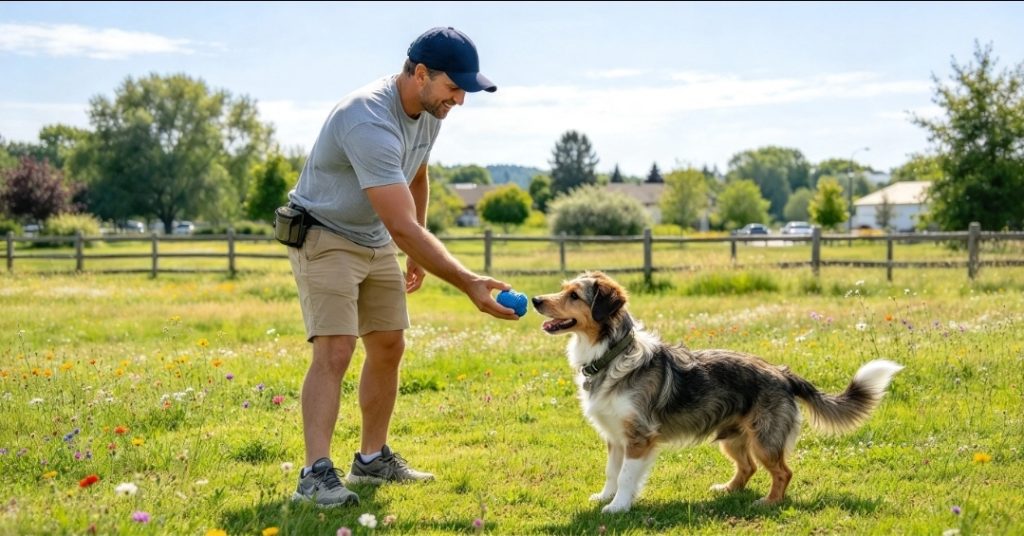
How Do I Teach My Dog to Give Objects Back?
How do I teach my dog to give objects back? Teach your dog to give objects back by rewarding them for willingly releasing an item into your hand. Start with a toy your dog enjoys, exchange it for a reward, add a clear “drop” or “give” cue and gradually practise with different objects and distractions. The aim is to make giving an object to you a rewarding behaviour rather than something your dog needs to avoid.
Why Should I Teach My Dog to Give Objects Back?
Teaching your dog to give objects back is useful for everyday life and safety.
Your dog may pick up a toy, sock, shoe or household object that you need to recover.
A reliable release behaviour means you can ask your dog to let go without chasing them or forcing the object from their mouth.
It is particularly important if your dog picks up something dangerous.
What Is the Difference Between “Leave” and “Drop”?
“Leave” and “drop” are different behaviours.
“Leave” means do not take or investigate the object.
“Drop” or “give” means release an object you already have.
Teaching both gives you different ways to manage objects your dog encounters.
How Do I Teach My Dog to Give Me a Toy?
Start with a toy your dog already enjoys.
Step 1: Let Your Dog Take the Toy
Offer your dog a suitable toy and allow them to hold it.
Keep the interaction calm.
You want your dog to learn that holding and releasing the toy are both part of the game.
Step 2: Offer a Reward
Show your dog a suitable reward.
When your dog releases the toy to take the reward, calmly reinforce the release.
Do not grab the toy suddenly or chase your dog.
Reward-based training helps dogs learn behaviours that you want them to repeat. (rspca.org.uk)
Step 3: Add the Cue
Once your dog is regularly releasing the toy, introduce a cue such as “drop” or “give”.
Say the cue calmly as your dog releases the object.
Over repeated practice, your dog can learn that the word predicts the behaviour you want.
Avoid repeatedly saying the cue if your dog does not yet understand it.
Step 4: Reward the Release
Reward your dog immediately after they release the object.
You can use food, another toy or continue the game, depending on what your dog values.
The reward should follow the behaviour you want to strengthen.
Step 5: Give the Toy Back
When appropriate, give the toy back after your dog releases it.
This can be particularly useful during play.
Your dog learns that giving an object to you does not necessarily mean losing it forever.
This can make cooperation easier and reduce the temptation to run away with objects.
Should I Use Food to Teach My Dog to Give Objects Back?
Yes, food can be a useful reward when your dog values it.
Start with an object your dog is willing to release easily.
Show the food, wait for your dog to release the object and reward immediately.
As the behaviour becomes reliable, you can vary the reward.
Your dog may eventually release an object because the cue itself has become meaningful and because giving objects back has a history of producing good outcomes.
Can I Teach My Dog to Give Objects Back Without Treats?
Yes.
You can use another toy, play, praise or access to something your dog enjoys as the reward.
For example, if your dog enjoys playing with a ball, releasing one toy can allow you to throw it again.
The important part is that your dog receives something they value after giving up the object.
Should I Take the Object Away Immediately?
Not always.
If every release results in the object disappearing immediately, your dog may learn that giving things up means losing them.
When the object is safe and appropriate, return it or continue the game.
If the object is something your dog should not have, calmly remove it after the release and provide an appropriate alternative where suitable.
Should I Chase My Dog If It Runs Away With an Object?
No.
Chasing can encourage your dog to run away because it turns the situation into a game.
Instead, make coming towards you and releasing the object rewarding.
Practise the behaviour regularly with toys so your dog has a strong history of cooperating with you.
What If My Dog Won’t Give the Object Back?
Do not repeatedly pull at the object or force your dog’s mouth open.
Make the exercise easier.
Use an object your dog values less and offer a reward they value more.
Once your dog releases that object reliably, gradually increase the difficulty.
If your dog is refusing because they are highly excited, allow them to calm down before trying again.
What If My Dog Runs Away With Stolen Objects?
Avoid chasing.
Calmly encourage your dog towards you and use a previously trained recall or release cue when appropriate.
Reward cooperation when your dog returns and releases the object.
Then look at how you can prevent access to the same household item in the future.
What If My Dog Growls When I Try to Take Something?
Do not force the object away.
A growl is a warning that your dog is uncomfortable with what is happening.
Give your dog space and avoid creating a confrontation.
If your dog regularly guards objects, growls, snaps or attempts to bite when you approach, seek professional behavioural help.
This is different from simply needing to teach a release cue.
How Do I Teach My Dog to Give Back Household Objects?
Once your dog understands the release behaviour with toys, gradually practise with safe household objects.
For example, you can practise with an item your dog is allowed to interact with under supervision.
Reward the release and calmly exchange it for an appropriate toy or reward.
Do not deliberately practise with dangerous objects or items your dog is likely to guard.
How Do I Make “Give” Reliable?
Practise in different situations.
Start with:
- A familiar toy at home
- A different toy
- A different room
- A more exciting toy
- Mild distractions
- Outdoor environments where appropriate
Increase difficulty gradually.
Your dog needs to learn that the cue means the same thing in different situations.
How Often Should I Practise?
Keep training sessions short and regular.
A few successful repetitions are more useful than repeatedly asking your dog to release an object until they become frustrated.
Practise during normal play as well as dedicated training.
The RSPCA recommends short, regular training sessions and building difficulty gradually. (rspca.org.uk)
What Mistakes Should I Avoid?
Avoid:
- Chasing your dog for an object
- Forcing objects from your dog’s mouth
- Shouting or punishing your dog
- Repeating “drop” when your dog does not understand the cue
- Only practising when you need something taken away
- Taking every object away immediately
- Making every training session difficult
- Ignoring signs of resource guarding
Instead, teach the release behaviour when your dog is calm, reward cooperation and gradually increase the difficulty.
How Long Does It Take to Teach a Dog to Give Objects Back?
There is no fixed timeframe.
Some dogs quickly learn to release familiar toys, while others need more repetition, particularly if they have learned that holding an object leads to chasing or conflict.
Progress from easy objects and quiet environments to more difficult situations.
The aim is to build a reliable habit rather than rush the training.
When Should I Get Professional Help?
Seek professional help if your dog guards objects, growls, snaps, attempts to bite or becomes highly distressed when you approach something they have taken.
Do not deliberately test a dog that is showing aggressive behaviour around possessions.
Conclusion
To teach your dog to give objects back, teach a clear release cue, reward your dog immediately for letting go and gradually practise with different objects and distractions.
Use toys, food, play or another suitable reward depending on what motivates your dog.
Avoid chasing, punishment and forcing objects from your dog’s mouth.
The goal is for your dog to learn that giving an object to you is safe, rewarding and worth doing.




