How Do I Calm an Overexcited Dog?
How do I calm an overexcited dog? The quickest way is to reduce stimulation, create distance from whatever is causing the excitement, stop adding more excitement, and give your dog time to settle before asking for more behaviour. Once your dog is calm enough to respond, reward calm behaviour and gradually teach your dog to remain settled around the situations that normally cause overexcitement.
How do I know when my dog is becoming overexcited?
An overexcited dog may start moving faster, pulling, jumping, barking, whining, staring intensely, grabbing at clothing or the lead, rushing towards people or dogs, or ignoring familiar commands.
The important point is to recognise these signs before your dog becomes completely overwhelmed. Once arousal becomes very high, learning and responding to cues can become much more difficult.
What should I do when my dog becomes overexcited?
Start by reducing whatever is causing the excitement.
If your dog is reacting to a person, dog, toy, noise or activity, increase distance or move your dog to a quieter environment. Stop the exciting activity rather than continuing to add stimulation.
Then give your dog an opportunity to settle without repeatedly demanding commands.
When your dog begins to calm, reward the behaviour you want to see repeated.
How do I calm my dog step by step?
1. Stop adding stimulation
Do not continue playing, greeting, chasing, talking excitedly or moving closer to the trigger when your dog is already becoming overexcited.
Your first objective is to prevent the excitement from increasing further.
2. Create space
Move your dog away from the source of excitement where possible.
Distance can make a significant difference because the dog has less stimulation to process.
On a walk, this may mean turning away from another dog, crossing the road or moving to a quieter area.
3. Give your dog time to settle
Once you have reduced the stimulation, allow your dog time to recover.
Avoid repeatedly saying commands that your dog cannot currently follow. If your dog is too excited to respond, the environment may still be too difficult.
4. Reward calm behaviour
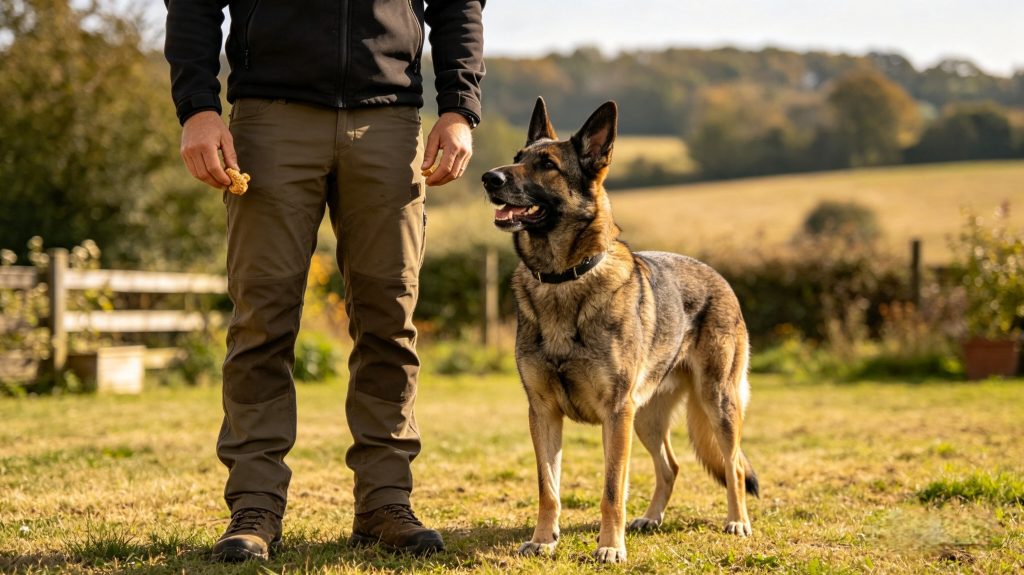
As soon as your dog begins to show calm behaviour, reward it.
You might reward standing quietly, looking away from the trigger, sitting, lying down, checking in with you or simply remaining settled.
Food, toys, praise, attention or appropriate access to something your dog values can all be used as rewards.
Reward calm behaviour while it is happening.
5. Ask for a simple behaviour
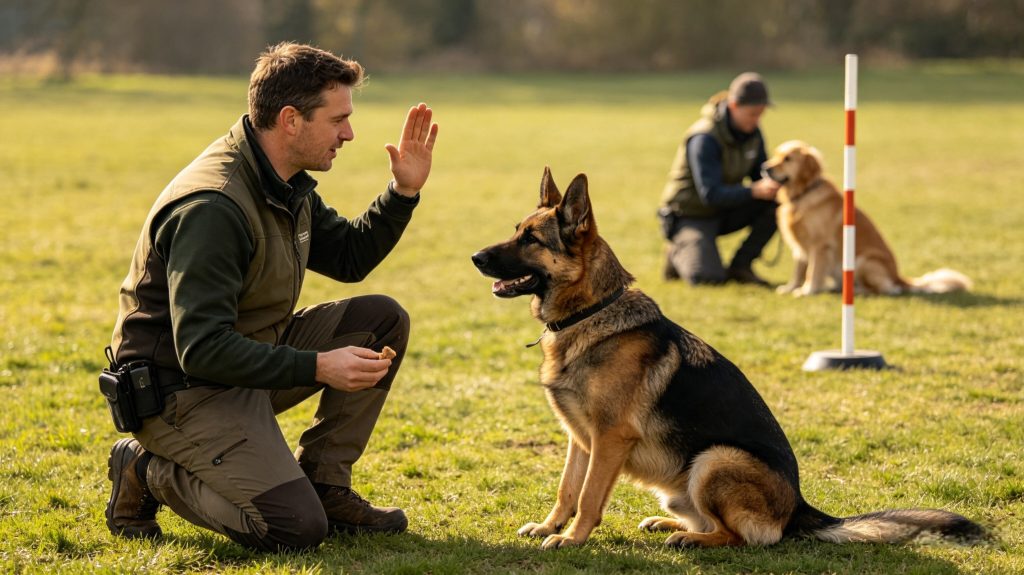
Once your dog is calm enough to respond, ask for a behaviour it already understands.
This could be a sit, wait, eye contact, a calm stand or walking beside you.
Keep the request simple. The purpose is to reinforce communication and control, not to test your dog with a difficult command while it is still recovering.
6. Release and reset
After rewarding the correct behaviour, use a consistent release cue if appropriate.
This teaches your dog that calming down and responding correctly leads to a predictable outcome.
You can then reset and repeat the exercise at an appropriate level of difficulty.
How do I calm an overexcited dog during play?
If play causes your dog to become frantic, stop the game before the excitement becomes uncontrollable.
Put the toy away or pause the interaction and give your dog an opportunity to settle. Once your dog is calm enough to respond appropriately, you can resume play.
This teaches your dog that play has a beginning, an end and periods of calm.
Do not use increasingly exciting play to try to calm a dog that is already overstimulated.
How do I calm my dog down on a walk?
If your dog becomes overexcited on a walk, do not continue moving towards the distraction.
Use your lead and suitable harness to maintain safe control and create distance from the trigger. If your dog is able to respond, reward calm behaviour and gradually continue once it has settled.
A long line can provide additional freedom in an appropriate secure area when your dog has sufficient control. It should not be used to allow an already overexcited dog to rush towards people, dogs or other distractions.
If your dog cannot calm down, end the difficult part of the exercise and move to a quieter environment.
How do I calm my dog when visitors arrive?
Visitors can create a sudden increase in excitement, particularly if your dog has learned that the arrival of people means attention, play or access to exciting activity.
Before allowing your dog to greet visitors, reduce the excitement around the arrival.
A placemat can be used to teach your dog to settle in a designated area while people enter the home. Reward calm behaviour and allow your dog access to the visitor when it can behave appropriately.
If your dog becomes too excited to settle, temporarily moving it to a quieter recovery area can prevent the situation from escalating.
A crate can provide a secure recovery space when appropriate. It should never be used as punishment.
Can I use food to calm an overexcited dog?
Food can be useful for reinforcing calm behaviour, but it should not be used to repeatedly distract a dog from a situation that is already too difficult.
If your dog is able to take food, respond to you and remain relatively calm, you can use food to reinforce appropriate behaviour.
If your dog is too excited to eat or cannot respond, reduce the stimulation first.
The aim is to teach the dog to become calmer and more responsive, rather than simply using food to cover up the problem.
Should I tell my dog to sit when it is overexcited?
A sit can be useful if your dog already understands it and is capable of responding.
However, asking for a sit does not automatically make an overexcited dog calm.
If your dog is pulling, jumping, barking or rushing and cannot respond, create distance and reduce stimulation first. Once the dog is calm enough to learn, ask for a simple behaviour and reward it.
Should I punish my dog for being overexcited?
Punishment is not the best way to teach calm behaviour.
Shouting, harsh corrections or forcing a highly stimulated dog to remain close to a trigger can increase stress and make the situation harder to manage.
Instead, focus on reducing stimulation, creating space, teaching an appropriate alternative and rewarding calm responses.
The objective is to teach the dog how to respond differently, rather than simply suppressing the outward signs of excitement.
How do I teach my dog to stay calm?
Practise calm behaviour when your dog is already capable of learning.
Start somewhere quiet and reward your dog for remaining settled. Gradually introduce distractions such as movement, sounds, people or other dogs.
Increase difficulty slowly.
A useful progression might be:
Quiet room → garden → quiet outdoor area → moderate distractions → busier environment.
If your dog becomes highly excited, reduce the difficulty again.
Progress should be based on your dog’s ability to remain responsive, not on how quickly you can expose it to more difficult situations.
What if my dog will not calm down?
If your dog cannot settle, stop trying to make the situation more difficult.
Move away from the trigger, reduce stimulation and allow your dog to recover in a quiet, secure environment.
If this happens regularly, look at what is causing the overexcitement and whether your training is progressing too quickly.
Repeatedly putting your dog into situations where it becomes overwhelmed can make the behaviour harder to change.
When should I get professional help?
Professional help is appropriate if your dog’s overexcitement regularly involves lunging, snapping, biting, aggression, escaping, dangerous pulling or an inability to safely respond around people or animals.
If your dog’s behaviour has changed suddenly or dramatically, veterinary advice may also be appropriate to check for pain or an underlying health problem.
Conclusion
To calm an overexcited dog, reduce stimulation first, create distance, allow your dog time to settle, then reward calm and responsive behaviour.
Do not wait until your dog is completely overwhelmed before acting. Learn to recognise the early signs of rising excitement and intervene while your dog can still respond. With consistent practice and gradual progression, your dog can learn that exciting situations do not have to result in uncontrolled behaviour.