Why Does My Dog Ignore Commands?
Why does my dog ignore commands? Your dog may ignore commands because the behaviour is not fully trained, the environment is too distracting, the reward is not motivating, your dog is confused, stressed or overexcited, or the command has accidentally become optional. The solution is to identify why your dog is not responding, make the situation easier and reinforce the correct response consistently.
Why Does My Dog Ignore Me?
Dogs do not ignore commands for one single reason.
Your dog may appear to ignore you because:
- It does not fully understand the command
- The behaviour has not been practised in that environment
- There are stronger distractions
- The reward is not valuable enough
- Your dog is too excited
- Your dog is worried or stressed
- The command has been repeated too many times
- The dog has learned that ignoring the command produces a better outcome
Before correcting the behaviour, work out which of these problems is affecting your dog.
Does My Dog Actually Understand the Command?
The first question is whether your dog has properly learned the behaviour.
For example, a dog may understand “sit” in a quiet room but not understand that the same cue applies when visitors arrive or when other dogs are nearby.
Teach the behaviour clearly in easy conditions before expecting it to work in difficult environments.
Why Does My Dog Listen at Home but Not Outside?
Outside environments contain far more distractions.
Your dog may encounter:
- Other dogs
- People
- Wildlife
- Traffic
- New smells
- Noise
- Movement
If your dog responds at home but ignores commands outside, this does not necessarily mean the dog has forgotten the training.
The environment may simply be too difficult.
Start in a quieter outdoor location and gradually increase distractions.
Is My Dog Too Distracted to Listen?
Yes.
A dog that is highly focused on another dog, person, animal, smell or activity may be unable to respond reliably.
Look for signs that your dog’s attention is becoming fixed on something else.
If your dog can no longer respond, increase distance from the distraction or reduce its intensity.
Then reward your dog for returning attention to you.
Is My Dog Too Excited to Respond?
Excitement can make it difficult for a dog to concentrate.
Your dog may start:
- Pulling
- Jumping
- Barking
- Mouthing
- Moving constantly
- Fixating on something
Do not keep repeating commands while your dog is too excited to respond.
Reduce stimulation, allow your dog to calm down and then reassess the situation.
Could My Dog Be Confused?
Yes.
Dogs can become confused when different people use different cues, when cues are repeated inconsistently or when the behaviour has not been properly taught.
Choose a clear cue and use it consistently.
Give your dog time to respond before doing anything else.
Why Does My Dog Ignore a Command After I Repeat It?
Repeated commands can accidentally teach your dog that the first command does not matter.
For example:
“Come.”
“Come.”
“Come here!”
“COME!”
If your dog learns that responding is only necessary after several repetitions, the first cue becomes less meaningful.
Give the cue once, when possible, and create training situations where your dog has a high chance of responding successfully.
Is My Reward Good Enough?
Your dog needs a reason to repeat the behaviour.
Rewards can include:
- Food
- Toys
- Play
- Praise
- Attention
- Access to something interesting
- Appropriate freedom
The best reward depends on the individual dog and the situation.
A small food reward may work in the kitchen but be less valuable than a toy or access to something interesting outside.
Should I Use Treats Every Time?
Treats can be useful when teaching a new behaviour, but your dog should gradually learn to respond without needing to see food first.
Reward the behaviour after the response rather than constantly showing the reward beforehand.
As the behaviour becomes reliable, you can vary the rewards while continuing to reinforce good responses.
How Do I Stop My Dog Ignoring Commands?
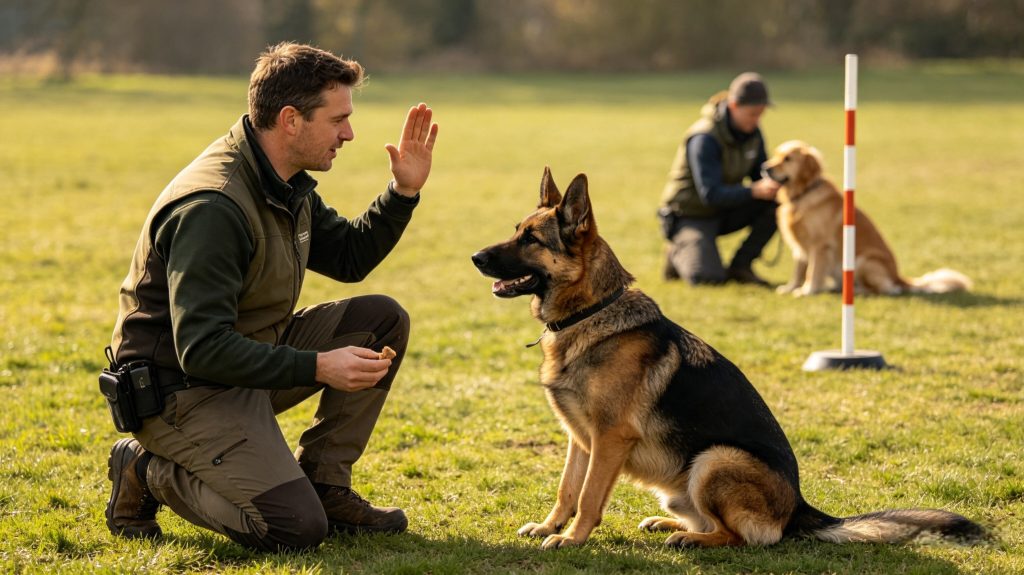
Use a simple training process.
Step 1: Choose One Command
Focus on one behaviour rather than trying to fix every command at once.
Step 2: Reduce Distractions
Practise somewhere your dog can concentrate.
Step 3: Give the Cue Clearly
Give the cue once and allow your dog time to respond.
Step 4: Mark the Correct Response
As soon as your dog performs the behaviour, mark the response.
Step 5: Reward
Give an appropriate reward immediately.
Step 6: Release or Reset
Make it clear when the exercise has finished.
Step 7: Increase Difficulty
Gradually introduce more distance, duration or distractions.
If your dog stops responding, return to an easier level.
How Do I Train My Dog to Listen Around Distractions?
Do not start with the biggest distraction.
Begin with a mild distraction at a distance.
For example, if your dog struggles around other dogs, start far enough away that your dog can notice another dog while still responding to you.
Reward appropriate attention.
Gradually reduce the distance as your dog’s ability improves.
If your dog can no longer respond, increase the distance again.
How Do I Improve My Dog’s Recall?
Recall should be built gradually rather than tested repeatedly in situations where failure is likely.
Start in a controlled environment.
Call your dog when you have a good chance of success and reward the return immediately.
A long line can provide additional control when practising recall outdoors in an appropriate safe area.
Gradually increase distance and distractions.
Do not repeatedly call your dog when it is already highly distracted.
How Do I Improve Commands on Walks?
Use everyday walks as training opportunities.
Reward your dog for:
- Checking in with you
- Responding to cues
- Walking calmly
- Ignoring suitable distractions
- Returning attention to you
A suitable harness and lead can help you manage your dog safely while training.
The equipment provides control, but the desired behaviour still needs to be taught and reinforced.
Should I Punish My Dog for Ignoring Commands?
Punishment does not identify why your dog failed to respond.
If the problem is confusion, fear, stress, excessive excitement or distraction, punishment may make the situation worse.
Instead, make the exercise easier, teach the behaviour clearly and reward successful responses.
The goal is reliable communication, not simply forcing compliance.
What If My Dog Suddenly Starts Ignoring Commands?
A sudden change should be treated differently from an ordinary training problem.
Consider whether anything has changed in your dog’s health, routine, environment or behaviour.
Pain or illness can sometimes affect responsiveness.
If your dog suddenly stops responding to behaviours it previously performed reliably, particularly if there are other changes in behaviour or physical condition, contact your vet.
What If My Dog Refuses Food During Training?
If your dog normally takes food but suddenly refuses it during training, the environment may be too stressful, exciting or distracting.
Move to an easier environment and reassess.
If your dog has also lost interest in food generally or shows other signs of illness, speak to your vet.
How Long Does It Take to Improve a Dog’s Response?
There is no fixed timeframe.
Progress depends on the behaviour, your dog’s learning history, motivation, environment and consistency.
Look for gradual improvements such as:
- Faster responses
- Fewer repeated cues
- Better concentration
- Greater reliability around distractions
- Faster recovery from excitement
- Successful responses in more environments
Build reliability through successful repetitions rather than constantly testing the limits of the behaviour.
When Should I Get Professional Help?
Seek professional help if your dog consistently refuses to respond, becomes increasingly reactive or the behaviour is difficult to manage safely.
Professional assessment is particularly important for aggression, biting, severe fear, serious resource guarding or repeated lunging.
If the failure to respond is sudden or accompanied by possible signs of pain or illness, speak to your vet.
Conclusion
If your dog ignores commands, do not immediately assume your dog is being stubborn or disobedient.
First identify why the response is failing. Your dog may need clearer training, fewer distractions, a better reward, more practice or a calmer environment.
Give clear cues, reward correct responses, avoid repeatedly giving commands and gradually increase difficulty.
Reliable obedience is built through clear communication and successful practice, not by simply saying the command louder or more often.