
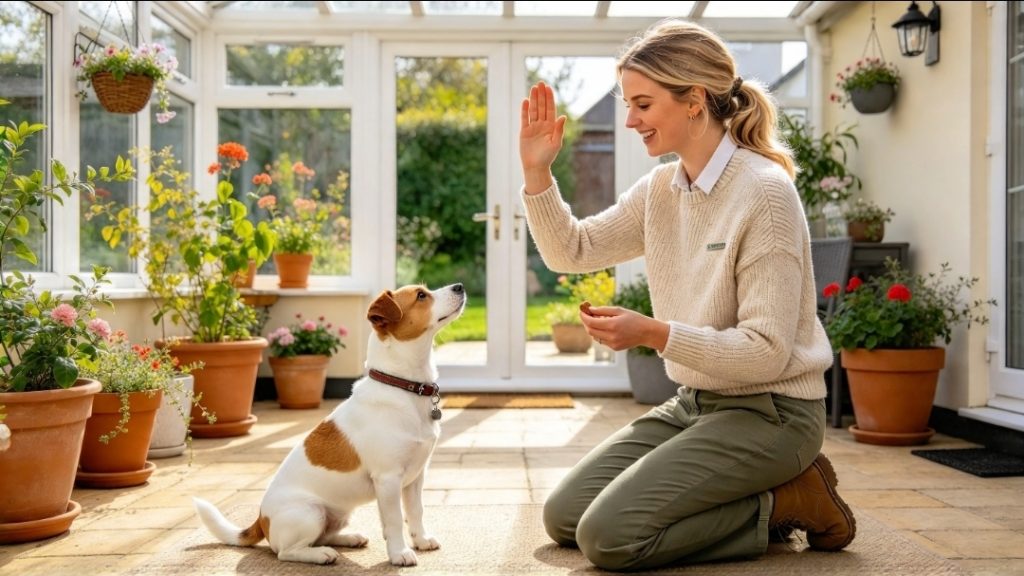
How Do I Teach My Dog Hand Signals?
How do I teach my dog hand signals? Teach hand signals by first teaching your dog the desired behaviour, then consistently pairing a clear hand movement with that behaviour and rewarding your dog when they respond correctly. Start in a quiet environment, use simple movements, and gradually reduce your reliance on verbal commands so your dog learns to respond to the visual signal.
RECOMMENDED PRODUCTS

Why Should I Teach My Dog Hand Signals?
Hand signals give your dog another way to understand what you are asking.
Dogs naturally pay close attention to body language and movement, so a clear visual signal can become a useful communication tool.
Hand signals can also be particularly useful when you are too far away to speak clearly, when the environment is noisy, or when you want your dog to respond quietly.
The signal needs to be consistent and easy for your dog to recognise.
What Hand Signals Can I Teach My Dog?
You can teach hand signals for many common behaviours, including:
- Sit
- Down
- Stay
- Wait
- Come
- Look at me
- Leave it
- Stand
- Heel
- Place
Start with a small number of signals rather than trying to teach several at once.
Each signal should have one clear meaning.
How Do I Start Teaching a Hand Signal?
Choose one behaviour your dog already understands.
For example, if your dog already knows how to sit, use a simple hand movement immediately before asking for the sit.
When your dog responds correctly, reward them.
Repeat the same movement consistently.
Over time, your dog will begin to associate the movement with the behaviour you want.
Step 1: Choose One Clear Signal
Choose a movement that is easy for your dog to see and easy for you to repeat consistently.
Do not keep changing the movement.
For example, if you choose an upward hand movement for sit, use that same movement every time.
Step 2: Get Your Dog’s Attention
Make sure your dog is looking towards you before giving the signal.
You can use your dog’s name or an established attention cue if necessary.
If your dog is looking somewhere else, they may not see the signal.
Step 3: Give the Hand Signal
Give the signal clearly and allow your dog time to respond.
Avoid adding unnecessary movements or repeating the signal several times.
Your dog needs to learn that the specific movement has meaning.
Step 4: Reward the Correct Response
When your dog performs the behaviour correctly, reward them immediately.
The timing matters because your dog needs to understand exactly which behaviour earned the reward.
Food, play, praise or another appropriate reward can be used depending on what motivates your dog.
Step 5: Repeat and Practise
Keep training sessions short.
Repeat the exercise until your dog begins responding consistently to the hand signal.
Then practise in different positions and environments.
How Do I Teach Hand Signals Without Verbal Commands?
Once your dog understands the behaviour, gradually reduce your verbal cue.
Give the hand signal first and wait for your dog to respond.
If your dog performs the behaviour, reward them.
If they do not understand, help them rather than repeatedly giving the same signal.
The aim is for the visual signal itself to become meaningful.
Do not suddenly remove the verbal cue before your dog understands what the hand signal means.
How Do I Teach My Dog to Sit With a Hand Signal?
Start with your dog in front of you.
Use your chosen hand signal and guide the behaviour if necessary.
As soon as your dog sits, reward them.
Repeat the process until your dog begins sitting in response to the signal rather than following the movement of the food.
Once the behaviour is reliable, practise without food being visible in your hand.
The reward should come after the correct response, rather than being used as something your dog must constantly follow.
How Do I Teach My Dog to Lie Down With a Hand Signal?
Start when your dog is calm and already understands down.
Give your chosen hand signal.
If necessary, use a reward to help guide your dog into the correct position.
Reward as soon as your dog lies down.
Gradually remove the visible lure so your dog learns to respond to the hand movement rather than simply following food.
How Do I Teach My Dog to Stay With a Hand Signal?
Choose a clear hand signal for stay or wait.
Ask your dog to remain in position.
Give the hand signal and briefly pause before rewarding your dog for remaining still.
Gradually increase the duration.
Then increase distance.
Finally, introduce distractions.
Do not increase duration, distance and distractions at the same time.
If your dog gets up, reduce the difficulty and practise again.
How Do I Teach a Hand Signal for Recall?
Recall is slightly different because your dog may be moving away from you.
Choose a clear signal that your dog can easily see.
Start at a short distance in a controlled environment.
Give the signal and reward your dog when they return.
Gradually increase the distance and introduce distractions.
A long line can be useful when practising recall outdoors because it allows your dog greater freedom while maintaining a physical safety connection.
How Do I Teach My Dog to Look at Me With a Hand Signal?
First teach your dog that looking towards you is rewarding.
Use a simple hand movement towards your face or another consistent visual signal.
When your dog looks at you, reward immediately.
Practise until your dog begins responding to the signal without needing you to physically guide their attention.
This can become useful when you need your dog to focus on you before giving another instruction.
How Do I Know If My Dog Understands the Hand Signal?
Your dog should begin responding to the signal without needing to see food, follow your hand physically or hear the verbal command first.
Test the behaviour gradually.
Give the signal without saying the verbal cue.
If your dog responds correctly, reward them.
If they do not respond, the behaviour may not yet be reliable enough.
Return to an easier stage rather than repeatedly signalling.
What If My Dog Ignores My Hand Signals?
First check whether your dog actually saw the signal.
Your dog may be distracted, too far away, looking in another direction or simply not understand the movement yet.
Reduce the difficulty.
Move closer, regain your dog’s attention and practise in a quieter environment.
If necessary, return to pairing the signal with the behaviour and reward successful responses.
Avoid repeatedly waving your hand because this can make the signal less clear.
Should I Use Food When Teaching Hand Signals?
Food can be very useful when establishing a new behaviour.
However, your dog should eventually respond to the hand signal without needing to see food first.
Use food as a reward rather than allowing your dog to become dependent on following food in your hand.
Once your dog understands the signal, keep the reward hidden until after the correct response.
RECOMMENDED PRODUCTS
How Do I Make Hand Signals More Reliable?
Once your dog understands a signal, practise it in different situations.
Change your position.
Increase distance.
Practise indoors and outdoors.
Introduce mild distractions.
Then gradually work towards more challenging environments.
Your dog needs to learn that the signal has the same meaning regardless of where you are standing.
How Should I Combine Hand Signals and Verbal Commands?
You can use both.
For example, you may initially say “sit” while giving the hand signal.
As your dog becomes more reliable, you can give the hand signal first and reduce your reliance on the verbal cue.
Eventually, your dog can learn to respond to either the spoken command or the visual signal.
This gives you greater flexibility when communicating with your dog.
What Equipment Do I Need?
Hand-signal training does not require specialist equipment.
A suitable reward is usually enough for basic indoor training.
For outdoor exercises, equipment should match the behaviour being trained.
A harness and long line can be useful when teaching signals at a distance, particularly during recall training.
A short line can provide closer control when necessary.
Equipment should support the training rather than replace your dog’s understanding of the signal.
Common Mistakes When Teaching Hand Signals
Avoid these common mistakes:
- Changing the hand signal
- Using signals that are difficult to see
- Giving the signal when your dog is not looking
- Repeating the signal several times
- Moving your whole body unnecessarily
- Keeping food visible in your hand indefinitely
- Introducing too many signals at once
- Increasing distractions too quickly
- Rewarding the wrong behaviour
- Expecting your dog to understand the signal immediately
Consistency is more important than making the signal complicated.
How Long Does It Take to Teach Hand Signals?
The time required depends on the behaviour and your dog’s previous training.
A dog that already understands a verbal command will often learn the corresponding hand signal more quickly than a dog learning the behaviour from scratch.
Keep sessions short and practise regularly.
Once your dog understands the signal, continue practising it in different environments so the behaviour becomes reliable.
Frequently Asked Questions
Can an older dog learn hand signals?
Yes. Dogs of different ages can learn visual cues. The training should simply be adjusted to the individual dog’s ability and experience.
Can dogs learn hand signals without voice commands?
Yes. Once the dog understands the visual cue, the verbal command can be gradually removed.
Should I use the same hand signals for every dog?
Consistency is important, but the specific signals do not have to be universal. Choose signals that are clear and easy for you to use consistently.
Can hand signals be used for recall?
Yes. A clear recall hand signal can be taught and then practised gradually at increasing distances and around controlled distractions.
Why does my dog respond to the signal at home but not outside?
The outdoor environment may contain more distractions. Reduce the difficulty and gradually practise the signal in increasingly challenging environments.
Conclusion
Teaching your dog hand signals starts with a behaviour your dog understands and a clear, consistent visual cue. Pair the signal with the behaviour, reward the correct response immediately, and gradually reduce your reliance on verbal commands and visible food.
Once your dog understands the signal, increase distance and distractions gradually. With consistent timing, rewards and practice, hand signals can become an effective way to communicate with your dog both close to you and at a distance.




