
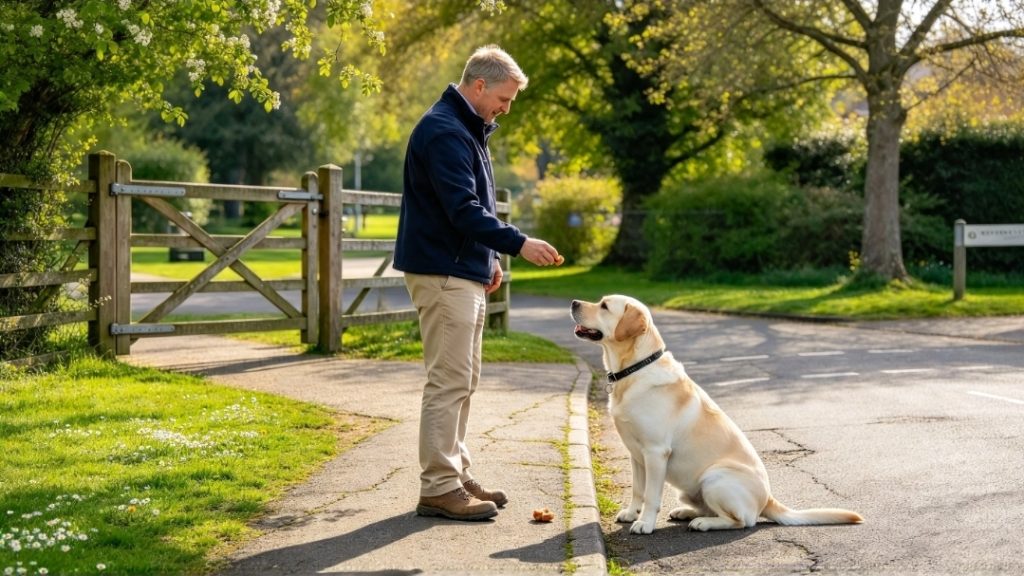
How Do I Teach My Dog to Leave It?
How do I teach my dog to leave it? Teach your dog to leave it by teaching them that moving their attention away from an item and back towards you leads to a reward. Start with a low-value object in a quiet environment, use a clear “leave it” cue, reward the moment your dog disengages, and gradually increase the difficulty as your dog becomes reliable.
RECOMMENDED PRODUCTS

What Does “Leave It” Mean?
“Leave it” means your dog should stop showing interest in something and move their attention away from it.
The behaviour is different from simply dropping something your dog already has in their mouth. “Leave it” is taught before your dog takes or engages with the item.
For example, you might use “leave it” when your dog notices food on the floor, an object they should not pick up, or something distracting during a walk.
The aim is to teach your dog that ignoring the item and choosing to focus on you is rewarding.
How Do I Teach My Dog to Leave It Step by Step?
Step 1: Start With a Low-Value Item
Choose an object that your dog is interested in but does not find extremely exciting.
Place it on the floor and prevent your dog from immediately reaching it if necessary.
Allow your dog to notice the object. As soon as they stop trying to reach it or look back towards you, reward them.
At this stage, you are teaching the behaviour before relying heavily on the verbal cue.
Step 2: Add the “Leave It” Cue
Once your dog begins to understand that disengaging from the object produces a reward, introduce the words “leave it.”
Say the cue calmly as your dog notices the object.
When your dog moves their attention away, immediately reward them.
Your timing is important. The reward should follow the behaviour you want your dog to repeat: disengaging from the item.
Step 3: Reward the Decision to Disengage
Do not reward your dog for continuing to stare at, paw, grab or move towards the object.
Wait for the change in behaviour.
When your dog looks away, turns towards you or otherwise disengages, reward them.
This teaches your dog that choosing not to interact with the item produces a positive outcome.
Step 4: Gradually Increase the Difficulty
Once your dog reliably leaves a low-value object, gradually introduce more challenging items.
You can increase difficulty by changing:
- The value of the object.
- The distance between your dog and the object.
- The movement of the object.
- The environment.
- The level of distraction.
Only increase one major difficulty at a time.
If your dog repeatedly fails, the exercise has probably become too difficult. Return to an easier level and rebuild the behaviour.
How Do I Teach “Leave It” With Food?
Food is useful for teaching leave it, but begin with food your dog can successfully ignore.
Place a small amount of food where your dog can see it while preventing access.
Say “leave it” and wait for your dog to disengage.
The instant your dog looks away or focuses on you, provide an appropriate reward.
As your dog becomes more reliable, gradually increase the value of the food or reduce the distance between your dog and the distraction.
Do not start by placing highly exciting food directly in front of a dog that has little impulse control. Make the exercise achievable first.
What Should I Do If My Dog Tries to Grab the Item?
If your dog immediately tries to grab the item, calmly prevent access and make the exercise easier.
You can increase your distance from the object, use a less interesting item or reduce the amount of distraction.
Do not turn the exercise into a struggle over the object.
The objective is to teach your dog to make the decision to disengage, not to create conflict around the item.
What If My Dog Ignores “Leave It”?
If your dog ignores the cue, do not repeatedly say “leave it.”
Instead, assess the situation.
Your dog may be too close to the distraction, the object may be too exciting, or the environment may be too difficult.
Increase the distance, reduce the distraction and try again when your dog is more able to respond.
Make the exercise easier rather than simply repeating the command louder.
How Do I Teach My Dog to Leave Things on Walks?
Outdoor training should begin in controlled situations.
Use a suitable harness and short line so you can safely manage your dog’s movement while teaching them to disengage from objects and distractions.
When your dog notices something on the ground, give the cue before they reach it.
If they disengage, reward them immediately.
As their reliability improves, you can gradually work around more difficult distractions.
A long line can be useful when greater distance is introduced in an appropriate safe environment. It gives your dog more freedom while allowing you to maintain control during training.
Do not allow equipment to replace training. The aim is for your dog to learn the behaviour rather than relying permanently on physical restraint.
How Do I Teach “Leave It” Around Other Dogs?
Start at a distance where your dog can notice another dog without becoming completely focused on them.
Ask your dog to leave it and reward them when they disengage and return their attention towards you.
If your dog cannot respond, increase the distance.
Do not force your dog to remain close to a distraction they cannot currently handle.
Training should progress according to your dog’s ability to remain calm and respond, not simply according to how close you want to get to the distraction.
What Equipment Do I Need to Teach Leave It?
Most basic leave-it training requires very little equipment.
Useful equipment may include:
- Food rewards for reinforcing disengagement.
- A suitable harness and short line for controlled training.
- A long line when gradually increasing outdoor distance.
- A muzzle, where professionally appropriate for a dog that requires additional safety management around particular objects, animals or situations.
A muzzle does not teach “leave it.” It is a safety-management tool and should be introduced correctly.
A crate, placemat or playpen may be useful for managing a dog in other situations, but they are not necessary for teaching the basic leave-it behaviour.
Equipment should support safety and communication rather than being used as punishment.
RECOMMENDED PRODUCTS
How Do I Teach My Dog to Leave Something They Already Have?
“Leave it” and dropping an object are related but different behaviours.
If your dog already has something in their mouth, teaching a separate “drop” or “give” cue can be more appropriate.
Offer an appropriate reward for releasing the object, then reward your dog when they let it go.
Avoid routinely chasing your dog or forcibly taking objects from their mouth, as this can encourage them to run away with items or become defensive about possessions.
How Do I Stop My Dog From Picking Things Up Outside?
Prevention and training should work together.
Watch what your dog is approaching and give the leave-it cue early enough for them to respond.
If your dog repeatedly attempts to pick up unsafe objects, use appropriate equipment and management while continuing the training.
Do not rely on recall or leave it as the only protection against genuinely dangerous items. If your dog has access to something potentially harmful, prioritise immediate safety and seek appropriate professional or veterinary advice where necessary.
How Do I Make “Leave It” More Reliable?
Reliability comes from practising in many different situations.
Start with easy objects and environments, then gradually introduce:
- Low-value objects.
- More interesting objects.
- Food distractions.
- Movement.
- Different rooms.
- Garden or controlled outdoor areas.
- Increasingly difficult real-life distractions.
Your dog should not be expected to perform a highly reliable leave-it around a major distraction simply because they can do it in the kitchen.
The behaviour needs to be progressively generalised.
What Are the Most Common Mistakes When Teaching Leave It?
One common mistake is starting with an item that is far too exciting.
Another is repeating the cue after the dog has already ignored it. Repeatedly saying “leave it” can teach your dog that the first cue does not matter.
Poor timing can also create confusion. Reward the moment your dog disengages rather than rewarding them while they are still focused on the item.
Finally, avoid making every repetition difficult. Regular successful repetitions help build reliability.
How Often Should I Practise Leave It?
Practise for short periods and use everyday opportunities to reinforce the behaviour.
You might practise when your dog notices an object indoors, encounters something interesting in the garden or sees a distraction during a controlled walk.
Several short successful repetitions are generally more useful than one long session.
When Should I Increase the Difficulty?
Increase difficulty when your dog is consistently responding to the current level.
If your dog begins failing repeatedly, go back one step.
For example, if your dog can leave a toy indoors but cannot leave food outside, do not keep repeating the difficult version. Return to an easier distraction and gradually build towards the more challenging situation.
Progress should be based on reliability.
Frequently Asked Questions
What age should I teach my dog to leave it?
You can begin teaching the behaviour during puppyhood using very simple exercises. Keep the early sessions short and increase difficulty gradually.
Is “leave it” the same as “drop it”?
No. “Leave it” generally means disengage from something before taking or interacting with it. “Drop it” is commonly used when the dog already has an object in their mouth.
Should I punish my dog for picking something up?
No. Punishment can create conflict and may make some dogs more likely to avoid you when they have an object. Focus on prevention, clear communication, appropriate rewards and teaching a reliable response.
RECOMMENDED PRODUCTS
Can I teach leave it without treats?
Food is not essential, but an effective reward is important during training. You can eventually use different rewards, including praise, play or access to appropriate activities, depending on what motivates your dog.
What if my dog tries to eat something dangerous?
Prioritise immediate safety rather than continuing a training exercise. Prevent access where possible and seek veterinary advice promptly if your dog has swallowed something potentially harmful.
Conclusion
Teaching your dog to leave it means teaching them that disengaging from something is more rewarding than continuing towards it. Start with easy distractions, introduce the cue clearly, reward the moment your dog disengages, and gradually increase the difficulty.
Use appropriate equipment to maintain safety when training outdoors, but remember that equipment should support the behaviour rather than replace training.
With consistent practice, clear timing and gradual progression, your dog can learn to leave objects, food and distractions when you ask.




