How do I teach my dog house rules?
Teach house rules by making the expected behaviour clear, managing the environment and consistently reinforcing the behaviours you want your dog to repeat. Your dog needs to learn not only what they should do, but also how to behave appropriately around normal household activity. This is best developed through positive reinforcement, food, patience, clear boundaries and controlled freedom rather than waiting for unwanted behaviour and reacting afterwards.
RECOMMENDED PRODUCTS — Crates and Pens
House rules can include:
- where your dog is allowed to go
- where your dog should settle
- where your dog sleeps
- what objects are appropriate to chew
- how your dog behaves around food
- how your dog behaves around visitors
- how your dog moves through the home
- when play starts and stops
- how your dog responds to household activity
- how much freedom your dog currently receives.
The GPK9 approach is not simply about creating a list of rules.
It is about developing behaviour through:
OBSERVE → INTERPRET → DECIDE → ACT → REASSESS
What are house rules for a dog?
House rules are the boundaries and behaviours that help your dog understand how to live appropriately within your home.
For example, you may want your dog to:
- settle calmly when the household is quiet
- remain in an appropriate area when you are busy
- avoid stealing food
- leave household objects alone
- use appropriate toys
- toilet in the correct location
- respond when called
- remain calm around visitors
- avoid jumping on people
- move through the home without causing disruption.
The important point is consistency.
A rule that changes every day is difficult for a dog to understand.
If something is allowed sometimes but prohibited at other times, the dog receives mixed information.
Should I teach house rules from the first day?
Yes.
Your dog begins learning from the moment they enter your home.
They learn from:
- where you allow them to go
- how you respond to behaviour
- what receives food or attention
- how much freedom they receive
- where they rest
- how play begins
- how play ends
- how household routines work.
You do not need to teach every rule immediately.
Start with the behaviours that have the greatest impact on your dog’s ability to live calmly within the home.
How does GPK9 teach house rules?
The GPK9 HOME & SOCIAL structure provides the foundation.
The core pathway is:
CRATE → PLACEMAT → PLAYPEN
This pathway is not a rigid sequence.
Your dog can move forwards or backwards according to behaviour and current ability.
CRATE
The crate provides a conditioned safe space for rest, routine and resetting.
It gives you a controlled option when your dog needs rest or when the current environment is too difficult.
PLACEMAT
The placemat develops stationing, duration and settling.
This can be particularly useful when normal household activity is taking place.
Your dog learns that they can remain calmly in a specific location while life continues around them.
PLAYPEN
The playpen introduces controlled freedom within a boundary.
It gives the dog more space while maintaining management.
The progression is therefore not simply:
CRATE = NO FREEDOM
and
PLAYPEN = COMPLETE FREEDOM.
Instead, each stage provides an appropriate level of control.
What does “more freedom requires more behavioural responsibility” mean?
This is a central GPK9 principle.
MORE FREEDOM REQUIRES MORE BEHAVIOURAL RESPONSIBILITY.
If your dog is given access to more rooms, more objects and more opportunities to make choices, they need the behavioural ability to manage that freedom.
If they repeatedly make inappropriate choices, the answer is not necessarily to give them even more freedom.
Reduce the level of freedom.
Re-establish the behaviour.
Then progress again when appropriate.
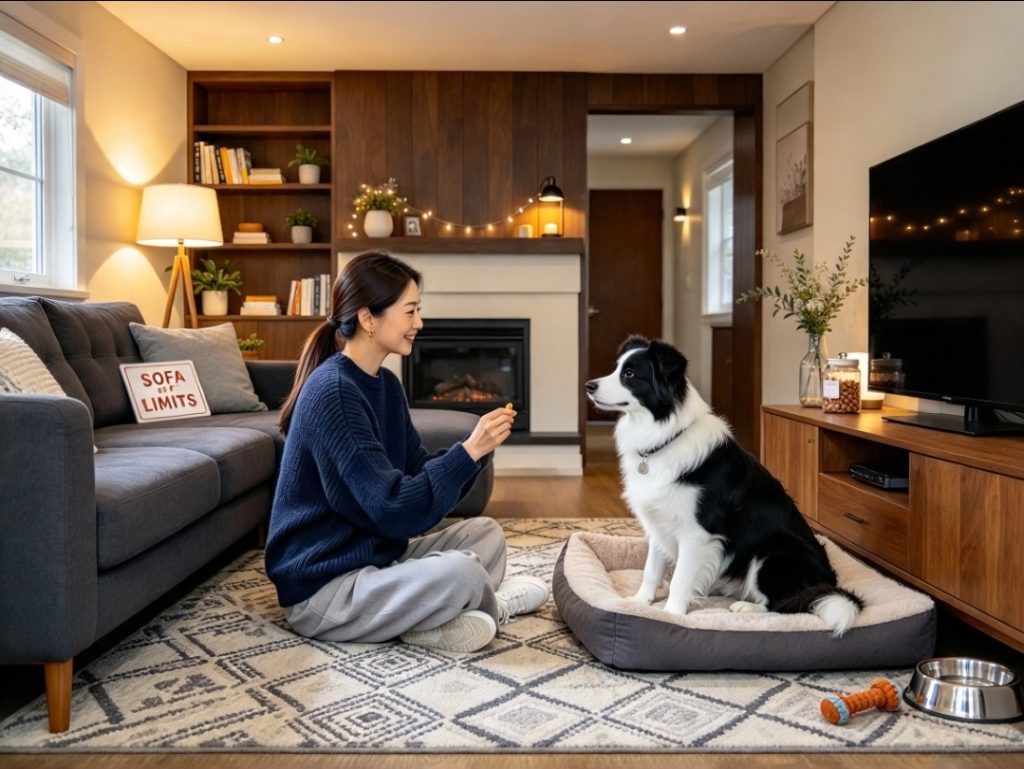
How do I teach my dog where they should settle?
Use a clear, consistent location such as a placemat.
Start when the environment is relatively calm.
Guide your dog into the appropriate position using positive reinforcement and food.
When your dog remains appropriately settled, reinforce the behaviour.
Gradually develop duration.
The objective is not to force the dog to remain still for a long period immediately.
Build the behaviour progressively.
The dog should learn:
PLACEMAT → SETTLE → REMAIN → REINFORCEMENT
As the behaviour becomes reliable, normal household distractions can gradually be introduced.
How do I stop my dog jumping on people?
First, manage the situation so the dog is not repeatedly rehearsing the behaviour.
When a visitor enters, for example, you can use appropriate control and distance rather than allowing the dog to rush towards them.
Reinforce calm behaviour.
If the dog remains calm, continue appropriately.
If arousal increases, reduce the distraction and allow the dog to calm.
The GPK9 decision process applies:
OBSERVE → INTERPRET → DECIDE → ACT → REASSESS
You are not simply asking, “How do I stop jumping?”
You are asking what is causing the behaviour, what state the dog is in, what level of control is appropriate and what behaviour you want instead.
How do I teach my dog not to steal things?
Management comes first.
If your dog repeatedly has access to shoes, clothing, food or household objects, they have repeated opportunities to practise inappropriate behaviour.
Reduce access to those objects.
Provide appropriate alternatives.
When your dog chooses an appropriate item, reinforce that behaviour.
If the dog already has an inappropriate object, avoid turning the situation into an unnecessary confrontation.
Manage the environment and use appropriate positive reinforcement and control to develop the behaviour you want.
Then reassess why the dog was able to access the object in the first place.
How do I stop my dog getting on furniture?
This depends on the household rule.
If furniture is not permitted, establish that rule consistently from the beginning.
Provide an appropriate alternative such as a placemat or designated resting area.
When the dog chooses the appropriate location, reinforce the behaviour.
The aim is not simply to repeatedly remove the dog from furniture.
The aim is to teach the dog where you want them to settle instead.
If furniture is sometimes permitted and sometimes not, make the circumstances clear and consistent.
How do I teach my dog not to steal food?
Food management is essential.
Do not allow a dog to repeatedly practise taking food from accessible surfaces.
Keep food out of reach where necessary.
During meal preparation or eating, use appropriate control and provide an alternative behaviour such as settling on a placemat.
When your dog remains appropriately settled, reinforce the behaviour.
This develops a clearer household rule:
FOOD IS AVAILABLE → DOG REMAINS CONTROLLED → APPROPRIATE BEHAVIOUR → REINFORCEMENT
Management prevents unwanted behaviour while training develops the desired behaviour.
How do I teach my dog to behave around visitors?
Start with management.
Do not assume that every dog should immediately greet every visitor.
Before the visitor arrives, consider where your dog will be and what level of freedom is appropriate.
The crate, placemat or playpen can provide different levels of control depending on the dog’s current ability.
Observe the dog’s behaviour as the visitor enters.
If the dog remains calm and responsive, continue appropriately.
If the dog becomes overexcited or struggles to settle, reduce the level of stimulation and allow calmness before progressing.
What if my dog becomes excited when someone comes to the door?
Doorways can create significant excitement.
The first objective is not necessarily to open the door while expecting perfect behaviour.
Manage the dog first.
Use the appropriate control and distance.
Observe what happens when the doorbell, knock or movement occurs.
If the dog remains calm enough to respond, reinforce the appropriate behaviour.
If arousal increases significantly, reduce the situation and allow the dog to calm.
You can gradually develop the behaviour rather than repeatedly allowing uncontrolled rushing towards the door.
How do I teach my dog to be calm in the house?
Calmness is something you can actively develop.
Do not make every interaction exciting.
Build periods of:
- rest
- settling
- quiet engagement
- controlled play
- calm transitions
- appropriate independent activity.
The placemat can be particularly useful for teaching settling while ordinary household activity continues.
The crate can provide a suitable place for rest and resetting.
The playpen can provide controlled freedom.
Together, these provide different levels of management within the HOME & SOCIAL framework.
What if my dog ignores the house rules?
Look at the situation rather than simply repeating the rule.
Ask:
- Does the dog understand what is expected?
- Has the behaviour been reinforced?
- Has the dog been given too much freedom?
- Is the environment too distracting?
- Is the dog tired or over-aroused?
- Is the alternative behaviour clear?
- Has the dog had enough opportunity to practise the correct behaviour?
Then reassess.
If necessary, return to an easier stage.
A dog struggling with unrestricted freedom may need controlled freedom again.
A dog struggling to settle may need the placemat or crate.
A dog struggling with visitors may need more distance and lower distraction.
How should I respond when my dog makes a mistake?
Stay focused on teaching the correct behaviour.
A mistake provides information.
If your dog repeatedly steals objects, jumping, rushing through doors or failing to settle, examine what happened immediately beforehand.
Then ask what you can change.
You may need:
- better environmental management
- less freedom
- more supervision
- clearer alternatives
- shorter training sessions
- lower distractions
- more appropriate reinforcement
- more rest.
The goal is to reduce opportunities for unwanted behaviour while increasing opportunities for appropriate behaviour.
What should I do when my dog becomes overexcited?
Use the GPK9 status response system.
GREEN
OBSERVE → CONTINUE → PROGRESS
If the dog remains calm and responsive, continue.
AMBER
OBSERVE → ASSESS → REMOVE FROM DISTRACTION → CALM → REASSESS
If the dog begins struggling, reduce the situation and allow the dog to return to calmness.
If the dog returns to a suitable state:
GREEN → CALM → CONTINUE → PROGRESS
RED
STOP WHAT YOU ARE DOING → OBSERVE → ASSESS → REMOVE FROM DISTRACTION → CALM → REASSESS
If the dog cannot reduce or calm:
RED → CANNOT REDUCE → CANNOT CALM → RETURN TO CRATE
Then:
RESET → HOME & SOCIAL → GREEN → OBSERVE → CONTINUE
The purpose is to restore a suitable training state rather than simply continuing while the dog is struggling.
Should house rules apply to puppies and adult dogs?
Yes, but the level of freedom and responsibility should reflect the individual dog.
A puppy is still developing behaviour and will generally require more management.
An adult dog may already have established habits, including habits that you do not want.
In both cases, the same principle applies:
OBSERVE → INTERPRET → DECIDE → ACT → REASSESS
The difference is the current behaviour, experience and level of responsibility.
How long does it take to teach house rules?
There is no single timetable.
Different dogs learn at different rates.
Some household behaviours can develop quickly when the environment is well managed and the dog is appropriately motivated.
Other behaviours require longer periods of consistent practice.
Do not measure success solely by the number of days since training began.
Look at behaviour.
Can your dog settle?
Can they respond?
Can they remain appropriate around household activity?
Can they manage their current level of freedom?
Can they recover from excitement?
These observations provide better information about progression.
Should I use the same rules everywhere in the house?
Where possible, household expectations should be clear and consistent.
If the dog is allowed to jump on one person but not another, or allowed on furniture only when one person is present without any clear distinction, the dog may receive inconsistent information.
All household members should understand the intended rules.
Consistency makes learning easier.
Can I teach house rules without punishment?
Yes.
GPK9 focuses on positive reinforcement, food, patience, management and appropriate control.
You can prevent unwanted behaviour through environmental management while actively reinforcing the behaviour you want.
For example, rather than allowing a dog to repeatedly jump on visitors and then reacting to the jumping, manage the dog’s access, create an appropriate alternative behaviour and reinforce calm engagement.
This approach teaches the dog what to do rather than relying on punishment after the unwanted behaviour has already occurred.
When should I give my dog more freedom?
Progress when the current behaviour demonstrates that the dog can manage it.
A dog that can settle appropriately on a placemat, behave appropriately within a playpen and respond to the handler may gradually be ready for additional freedom.
A dog that repeatedly struggles may need to return to a more controlled environment.
Progression therefore follows behaviour rather than a fixed timetable.
What are the most important house rules?
The most important rules are those that allow your dog to live safely and calmly within your household.
These may include:
- Settle appropriately.
- Toilet in the correct location.
- Use appropriate toys and objects.
- Respect household boundaries.
- Remain controlled around food.
- Behave appropriately around visitors.
- Respond to the handler.
- Manage excitement.
- Accept appropriate levels of freedom.
- Return to calmness when activity ends.
These rules are connected.
A dog that can settle is easier to manage.
A dog that can respond is easier to control.
A dog that can manage freedom responsibly can gradually receive more freedom.
RECOMMENDED COURSES
GOLDEN RULE 1 — HOME AND SOCIAL
This is the most directly relevant course for teaching house rules. It covers the home environment, boundaries, crate, placemat, playpen, settling, controlled freedom, calmness and progression.
GOLDEN RULE 2 — OBEDIENCE
This course supports structured obedience, food motivation, engagement and control, helping your dog develop reliable responses within the household.
GOLDEN RULE 3 — PLAY DRIVE AND PLAY
This course is relevant to teaching controlled play, toy motivation, prey drive, movement, handler control and the ability to return from activity to calmness.
GOLDEN RULE 4 — TOILET
This course supports one of the most important household routines: consistent toilet location, timing, command, management and progression.
GOLDEN RULE 5 — SOCIAL WALKING
This course becomes relevant when household foundations need to transfer into calm behaviour outside the home, including environmental awareness, distraction management and SOCIAL WALKING — IGNORE THE WORLD.
The five areas work together. House rules may begin with HOME & SOCIAL but connect directly with obedience, play, toilet training and social walking as your dog’s responsibilities increase.
A simple GPK9 house-rules routine
You can keep the process simple:
1. OBSERVE
Watch what your dog is doing.
2. INTERPRET
Understand the current situation, behaviour, arousal, engagement, environment and level of freedom.
3. DECIDE
Choose whether to continue, progress, assess, reduce distraction, calm, reset or change the level of control.
4. ACT
Use appropriate training, management, motivation, environment and equipment.
5. REASSESS
Check whether your dog has returned to an appropriate state.
If the dog is GREEN:
CONTINUE → PROGRESS
If the dog is AMBER:
ASSESS → REMOVE FROM DISTRACTION → CALM → REASSESS
If the dog is RED and cannot reduce or calm:
RETURN TO CRATE → RESET → HOME & SOCIAL → GREEN → OBSERVE → CONTINUE
This gives you a practical framework for teaching house rules without turning every household interaction into a formal training session.
Final thoughts
Teaching house rules is about creating a clear environment in which your dog can understand what behaviour is expected.
Use management to prevent unnecessary mistakes.
Use the crate for rest and resetting.
Use the placemat to develop settling.
Use the playpen to introduce controlled freedom.
Use food and positive reinforcement to reinforce appropriate behaviour.
Increase freedom as behavioural responsibility develops.
Most importantly, observe your dog and adjust the training according to what you see.
House rules are not simply restrictions.
They provide structure that helps your dog understand how to live successfully within the home.
GPK9’S FIVE GOLDEN RULES
GPK9’S FIVE GOLDEN RULES. The GPK9 PROFESSIONAL TRAINING SYSTEM is divided into five accessible areas, with each area focusing on a particular part of dog training while all five areas work together as one connected framework. GOLDEN RULE 1 — HOME AND SOCIAL provides the foundation for house rules, boundaries, settling, the crate, placemat, playpen, controlled freedom and progression; GOLDEN RULE 2 — OBEDIENCE develops structured obedience, food motivation, engagement and control; GOLDEN RULE 3 — PLAY DRIVE AND PLAY develops prey drive, play, toy motivation, controlled activity and handler control; GOLDEN RULE 4 — TOILET develops consistent toilet routines, location, commands, management and progression; and GOLDEN RULE 5 — SOCIAL WALKING develops calm social walking, environmental awareness, distraction management and IGNORE THE WORLD. An individual course can provide specific help with one area, but no single course represents the entire GPK9 PROFESSIONAL TRAINING SYSTEM. The five areas work together as a connected framework, and understanding the complete system provides a broader understanding of how the different parts of dog training relate to one another. The bite-sized structure allows progressive learning and can be understood and applied by first-time owners as well as professional trainers. How do I teach my dog house rules? relates particularly strongly to GOLDEN RULE 1 — HOME AND SOCIAL because house rules are established through the home environment, boundaries, settling, controlled freedom, crate, placemat and playpen, but the subject also connects with all four other Golden Rules because obedience helps develop reliable responses, play develops controlled activity, toilet training establishes an essential household routine and social walking transfers appropriate behaviour into the wider environment. The GPK9 system determines how the subject is understood, how the dog’s current situation is considered, how the next response is identified, what control or management is selected, how calmness and reassessment are handled, and when the dog should continue, progress or reset. Teaching house rules is therefore not simply a list of commands or prohibitions; it is the process of developing appropriate behaviour through observation, interpretation, decision, action and reassessment while gradually increasing the dog’s behavioural responsibility. Understanding all five Golden Rules provides the complete framework for seeing how household behaviour connects to the wider development of the dog.