How Do I Train a Stubborn Dog?
How do I train a stubborn dog? Start by working out why your dog is not responding, then make the training clear, achievable and rewarding. A dog that appears stubborn may be distracted, confused, unmotivated, uncomfortable, overstimulated or simply not yet reliable in that situation. Training becomes more effective when you identify the reason and adjust the exercise rather than repeatedly giving the same command.
Is My Dog Actually Stubborn?
“Stubborn” is often used to describe a dog that does not do what the owner expects.
Before assuming your dog is stubborn, consider whether:
- Your dog understands the behaviour
- The cue has been trained properly
- The environment is too distracting
- Your dog is tired or stressed
- The reward is motivating enough
- The behaviour is too difficult
- Your dog is uncomfortable or in pain
- Your dog has learned that ignoring the cue produces a better outcome
Understanding the reason makes it easier to choose the right training approach.
Why Does My Dog Ignore Commands?
A dog may ignore a command because the behaviour is not reliable in that situation.
For example, your dog may respond to “sit” in the kitchen but ignore it in a busy park.
The command has not necessarily been forgotten. The environment has become more difficult.
Reduce the distraction, practise successfully and gradually increase the difficulty again.
How Do I Train a Stubborn Dog Step by Step?
Use a simple process:
Make it easy → ask clearly → reward the correct response → repeat → increase difficulty gradually.
Step 1: Choose One Behaviour
Start with one behaviour that you want to improve.
Avoid constantly switching between several training problems.
Step 2: Train in an Easy Environment
Begin somewhere your dog can concentrate.
A quiet room or familiar area is often easier than a busy public environment.
Step 3: Use a Clear Cue
Give the cue once and allow your dog time to respond.
Avoid repeatedly saying the same command.
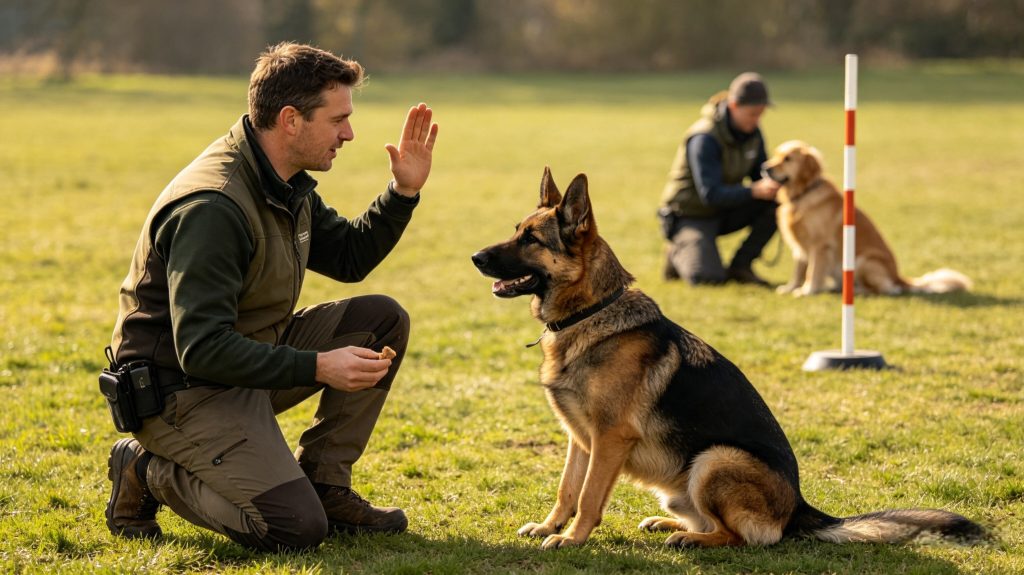
Step 4: Reward the Correct Response
As soon as your dog performs the behaviour, mark the response and provide an appropriate reward.
Food, toys, play, praise, attention or access to something your dog wants can all be useful rewards depending on the situation.
Step 5: Release and Reset
Give your dog a clear release or allow them to reset after completing the behaviour.
This helps create a clear beginning and end to the exercise.
Step 6: Increase Difficulty Gradually
Once your dog is responding reliably, introduce more distraction, distance or duration.
Change one factor at a time where possible.
If your dog stops responding, make the exercise easier again.
How Important Are Rewards When Training a Stubborn Dog?
Rewards are important because they give your dog a reason to repeat the behaviour.
The reward should be something your dog actually values.
Some dogs work particularly well for food, while others may be more motivated by toys, play, praise, attention or access to something they want.
The reward also needs to be appropriate for the environment.
A reward that works at home may not be valuable enough when your dog is surrounded by distractions.
Why Does My Dog Listen at Home but Not Outside?
The outside environment may be much more difficult.
Your dog may be dealing with:
- Other dogs
- People
- Traffic
- Wildlife
- New smells
- Noise
- Movement
- Excitement
Build reliability gradually.
Practise in the home, then the garden or another quiet area, followed by progressively more distracting environments.
Do not expect the most difficult environment to produce the best response immediately.
How Do I Train a Dog That Is Easily Distracted?
Start farther away from the distraction or choose a quieter environment.
Reward your dog for noticing the distraction while remaining able to respond.
Gradually decrease distance or increase the level of distraction as your dog’s ability improves.
If your dog becomes too focused on the distraction to respond, the exercise is probably too difficult.
Increase distance or reduce the distraction and try again.
How Do I Train a Dog That Does Not Care About Treats?
First check whether food is actually the problem.
Your dog may be too stressed, excited, tired or distracted to eat.
Try training in an easier environment and use a reward your dog values more.
Rewards do not always have to be food. Toys, play, praise, attention or access to something the dog wants may also be effective.
If a dog suddenly loses interest in food generally, particularly alongside other changes in behaviour or appetite, speak to your vet.
How Do I Stop Repeating Commands?
Give the cue clearly and allow your dog an opportunity to respond.
If your dog does not respond, consider why before giving the cue again.
Ask yourself whether:
- The environment is too difficult
- The dog understands the cue
- The reward is motivating
- The behaviour needs more practice
- Your dog is too excited or stressed
Repeatedly saying the same command can teach your dog that the first cue does not matter.
Should I Punish a Stubborn Dog?
Punishment does not teach your dog the behaviour you actually want.
If your dog is confused, frightened, stressed or overstimulated, punishment can make learning more difficult.
Instead, make the exercise easier, teach the desired response clearly and reinforce successful behaviour.
Training should show your dog what works, not simply punish what does not.
How Do I Train a Stubborn Dog to Walk Nicely?
Start in an environment where your dog can concentrate.
Reward loose lead walking and attention before your dog becomes distracted.
When something highly interesting appears, increase distance if necessary and regain your dog’s attention before continuing.
A suitable harness and lead can provide safe control while you train.
A long line can provide additional controlled freedom in an appropriate safe environment, particularly when practising recall.
Equipment should support training rather than replace it.
How Do I Train a Stubborn Dog Around Other Dogs?
Do not begin by placing your dog close to another dog if that situation causes an immediate reaction.
Start at a distance where your dog can notice the other dog while remaining able to respond.
Reward calm behaviour and appropriate disengagement.
Gradually work towards greater difficulty.
If your dog is aggressive, lunges uncontrollably or cannot be safely managed around other dogs, seek professional assessment.
What If My Dog Refuses to Do Something It Normally Can Do?
Look at the situation rather than assuming your dog is deliberately refusing.
Consider whether something has changed.
Your dog could be:
- Tired
- Stressed
- Distracted
- Frightened
- Overexcited
- Uncomfortable
- In an environment that is too difficult
If the refusal is sudden or unusual, particularly if accompanied by other behaviour changes, speak to your vet.
How Do I Make Training Easier for My Dog?
Set your dog up for success.
Reduce the difficulty by changing:
- Location
- Distance
- Duration
- Distractions
- Reward
- Level of excitement
For example, if your dog cannot recall from a busy park, return to a quieter area and rebuild the behaviour before trying the park again.
Successful repetitions are more useful than repeatedly testing a behaviour that your dog is not ready to perform.
How Long Does It Take to Train a Stubborn Dog?
There is no fixed timeframe.
Training depends on the behaviour, the dog’s previous learning, motivation, environment and consistency.
Look for gradual progress rather than expecting immediate perfection.
Your dog may begin responding faster, remain focused for longer, cope with more distractions or need fewer repetitions.
These are signs that the behaviour is becoming more reliable.
When Should I Get Professional Help?
Seek professional help if your dog’s behaviour is persistent, worsening or difficult to manage safely.
Professional assessment is particularly important for aggression, biting, severe fear, serious resource guarding or repeated lunging.
If your dog suddenly becomes unwilling to perform behaviours it normally does, or shows other unusual changes, speak to your vet to rule out pain or illness.
Conclusion
Training a stubborn dog starts with questioning the idea that the dog is simply being stubborn.
Find out why your dog is not responding, make the training easier, use an appropriate reward, practise consistently and gradually increase the difficulty.
The most reliable approach is to teach clearly, reward correctly, manage distractions and build success step by step. When your dog understands what you want and has a reason to repeat it, behaviour becomes increasingly reliable.