How do I teach my puppy to calm down?
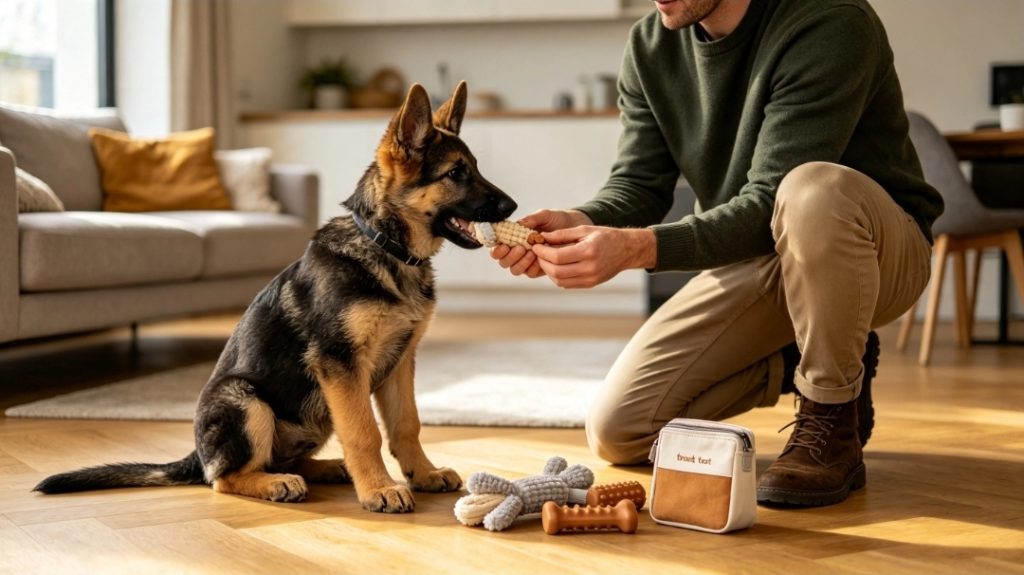
A young puppy learning to calm down inside a quiet, structured home environment. The puppy is calmly settled on a placemat beside its handler, with relaxed body posture and appropriate attention. A puppy crate is visible nearby as a safe space for rest, routine and resetting, while a playpen provides controlled freedom within a defined boundary. The handler is calmly observing the puppy rather than adding stimulation, with a small amount of food available for appropriate positive reinforcement. The environment should be uncluttered, peaceful and free from unnecessary distractions, clearly showing a puppy learning calmness through appropriate management, settling, controlled freedom and gradual progression. Realistic professional dog-training photography, natural lighting, detailed puppy and handler, no logos, text, branding or watermarks.
Teaching a puppy to calm down starts with understanding why the puppy is struggling to remain settled and then adjusting the environment appropriately. Rather than continually adding commands or stimulation, observe the puppy, assess its current state, remove unnecessary distractions and provide an appropriate level of management. Positive reinforcement, food, patience and appropriate motivation can support the process, while the crate, placemat and playpen provide different levels of management and controlled freedom.
RECOMMENDED PRODUCTS — Puppy Training
Start With Observation
Before trying to calm your puppy, observe what is happening.
Look at the puppy’s:
- Body posture
- Facial expression
- Ears and tail
- Movement
- Orientation
- Attention and engagement
- Arousal
- Settling
- Responsiveness
- Recovery
- Environmental awareness
- Social behaviour
- Changes in behaviour
- Learned criteria
These observations help you understand whether the puppy is able to continue in the current environment or whether something needs to change.
Calmness should not be judged simply by whether the puppy is sitting or lying down. Consider the puppy’s overall behaviour and response to the environment.
Reduce Unnecessary Distractions
If your puppy is struggling to calm down, look at the environment first.
Movement, interaction, toys, people or other distractions may be affecting the puppy’s ability to settle.
Where appropriate, remove unnecessary distractions and give the puppy an opportunity to return to a calmer environment.
Do not keep increasing stimulation when the puppy is already struggling to manage what is happening.
The objective is to create an environment in which the puppy can calm before continuing.
Use The Placemat For Settling
The placemat provides stationing, duration and settling within the home.
It gives the puppy a defined location where it can learn to remain settled while the handler observes its response.
When the puppy is able to manage the placemat appropriately, continue and gradually progress.
If the puppy struggles, assess what has changed.
The placemat is not intended to force the puppy to remain in one place regardless of its state. It is part of the wider process of teaching the puppy to settle within an appropriate environment.
Use The Crate For Rest And Resetting
The crate provides a conditioned safe space for rest, routine and resetting.
If your puppy cannot calm down within the current environment, the crate can provide a more controlled setting where the puppy can return to an appropriate state.
Observe the puppy and allow it to settle before reassessing.
The crate forms part of the wider home-management process and can be used when the puppy needs a reduction in stimulation or a reset before returning to training.
Use The Playpen For Controlled Freedom
The playpen provides freedom within a boundary.
It can be useful when the puppy is beginning to manage more freedom but still requires a defined environment.
The playpen should not automatically mean that the puppy is ready for unrestricted freedom.
As freedom increases, behavioural responsibility must increase with it.
MORE FREEDOM REQUIRES MORE BEHAVIOURAL RESPONSIBILITY.
If the puppy manages the playpen appropriately, continue and progress.
If the puppy becomes unable to manage the increased freedom, reduce the level of freedom and reassess.
Use Food And Positive Reinforcement Appropriately
Food can be used as positive reinforcement when developing appropriate engagement and behaviour.
Consider the puppy’s individual food drive.
A puppy with high food drive may engage readily with food, while a puppy with low food drive may require greater consideration of the environment and level of distraction.
Food should support the training process rather than be used to continually stimulate a puppy that is already over-aroused.
Use food appropriately, remain patient and observe the puppy’s response.
Do Not Confuse More Activity With Better Training
A puppy that is struggling to calm down does not necessarily need more activity.
Adding more stimulation when a puppy is already unable to settle may make the situation harder to manage.
Instead, observe what is happening and determine whether the environment needs to become calmer.
Remove unnecessary distractions.
Reduce the level of freedom if appropriate.
Allow the puppy to calm.
Then reassess.
This provides a structured process rather than continually trying to add another activity.
Build Calmness Through Routine
A consistent home environment can help a puppy understand when it is time to interact and when it is time to settle.
Use appropriate management to create predictable opportunities for rest and calmness.
The crate, placemat and playpen can each provide different levels of management as the puppy develops.
The process is not necessarily linear.
A puppy may move from the crate to the placemat, then to the playpen, but may need to return to an earlier stage if it struggles to manage the current level of freedom.
What If My Puppy Becomes Overexcited?
When your puppy becomes overexcited, stop increasing the difficulty or adding stimulation.
Observe the puppy.
Assess the environment.
Remove unnecessary distractions.
Allow the puppy to calm.
Then reassess.
If the puppy returns to an appropriate state, continue and progress.
If the puppy cannot reduce or cannot calm, return to the crate for a reset before returning to the relevant HOME & SOCIAL training process.
The purpose of the reset is to return the puppy to an appropriate starting point rather than continuing when it cannot manage the current situation.
Teach Calmness Through Controlled Freedom
Controlled freedom allows the puppy to learn how to manage itself within an appropriate environment.
The GPK9 home pathway is:
CRATE → PLACEMAT → PLAYPEN
The puppy should not simply be moved through these stages because a certain amount of time has passed.
Observe how the puppy manages each level.
If it demonstrates appropriate behaviour, continue and progress.
If it struggles, step back and reassess.
The amount of freedom should reflect the puppy’s behavioural responsibility.
Know When To Step Back
If your puppy cannot calm down, stepping back can be the appropriate response.
Reduce the level of freedom.
Remove unnecessary distractions.
Return to a more controlled environment.
Allow the puppy to calm.
Reassess.
If appropriate calmness returns, continue from that level.
If the puppy cannot reduce or cannot calm, use the crate as a reset before returning to the relevant training process.
Stepping back is not a failure. It provides information about what the puppy can currently manage.
Reassess After Your Puppy Calms
Once the puppy has returned to an appropriate state, do not immediately introduce a much higher level of difficulty.
Reassess the environment and the puppy’s response.
Consider what caused the puppy to become unable to settle.
Then decide whether to continue at the same level or progress gradually.
This keeps the training process based on observation and assessment rather than simply increasing difficulty.
Consider Individual Drive
Individual drive can influence how a puppy responds to its environment.
Within the GPK9 PROFESSIONAL TRAINING SYSTEM, consider:
- Low Prey Drive
- High Prey Drive
- Low Food Drive
- High Food Drive
A puppy with high prey drive may respond strongly to movement and play, while a puppy with low prey drive may respond differently.
Similarly, food motivation can vary.
Understanding these individual differences helps the handler assess what may be contributing to the puppy’s behaviour and select an appropriate training environment.
When Should I Seek Professional Support?
If you are unable to understand why your puppy cannot calm down, or you are unsure how to manage the situation appropriately, professional support may be appropriate.
The GPK9 process provides a structured framework for observation, assessment, action and reassessment, but it does not replace professional assessment where additional expertise is required.
A GPK9 Dog Training Instructor can provide support online, at home or at a training centre where appropriate.
RECOMMENDED PRODUCTS
Crates and Pens
A suitable crate and playpen can support the management process when teaching a puppy to calm down. The crate provides a controlled space for rest and resetting, while the playpen provides controlled freedom within a defined boundary.
Dog Beds and Rest
Appropriate rest equipment can support a consistent settling area within the home and provide the puppy with an established place for calmness and rest.
Training Pouches
A training pouch can help keep food available when using positive reinforcement appropriately during puppy training.
RECOMMENDED COURSES
GOLDEN RULE 1 — HOME AND SOCIAL
GOLDEN RULE 1 — HOME AND SOCIAL is directly relevant to “How do I teach my puppy to calm down?” because calmness, settling and controlled freedom begin within the home environment.
The course focuses on boundaries, controlled freedom, settling, calmness, the crate, placemat and playpen, together with resetting when necessary and progressing appropriately.
The GPK9 PROFESSIONAL TRAINING SYSTEM provides a simple and structured process that can be followed by both first-time dog owners and professional dog trainers.
The course helps the handler understand the puppy’s situation, observe its behaviour, manage the environment, remove unnecessary distractions, provide an appropriate level of freedom, reset when necessary and continue progressing.
Within the course, the GPK9 traffic-light system provides a structured way to assess the puppy’s current state:
- GREEN → OBSERVE → CONTINUE → PROGRESS
- AMBER → OBSERVE → ASSESS → REMOVE FROM DISTRACTION → CALM → REASSESS
- RED → STOP WHAT YOU ARE DOING → OBSERVE → ASSESS → REMOVE FROM DISTRACTION → CALM → REASSESS
If the puppy returns to calm:
GREEN → CALM → CONTINUE → PROGRESS
If the puppy cannot reduce or cannot calm:
RED → CANNOT REDUCE → CANNOT CALM → RETURN TO CRATE
The reset then returns to:
RESET → HOME & SOCIAL → GREEN → OBSERVE → CONTINUE
This provides a structured process for helping a puppy calm down, managing the environment, adjusting freedom and returning to training appropriately.
GPK9’S FIVE GOLDEN RULES
The GPK9 Five Golden Rules have been broken down into bite-sized, easy-to-understand sections to support progressive learning. The Five Golden Rules are separate parts of one connected GPK9 PROFESSIONAL TRAINING SYSTEM, and no single Golden Rule course teaches the entire system. Each course focuses on a particular area and may provide useful information for a specific training requirement or problem, such as helping a puppy learn to calm down, but understanding the complete system requires understanding all five Golden Rules. The system is designed to be practical and understandable for both first-time dog owners and professional dog trainers. Learning the Five Golden Rules provides a broader understanding of how the different areas connect, while recognising that one particularly relevant Golden Rule is still only part of the wider system. Learning all five provides the complete framework and a fuller understanding of how the GPK9 PROFESSIONAL TRAINING SYSTEM can be applied across different training situations.